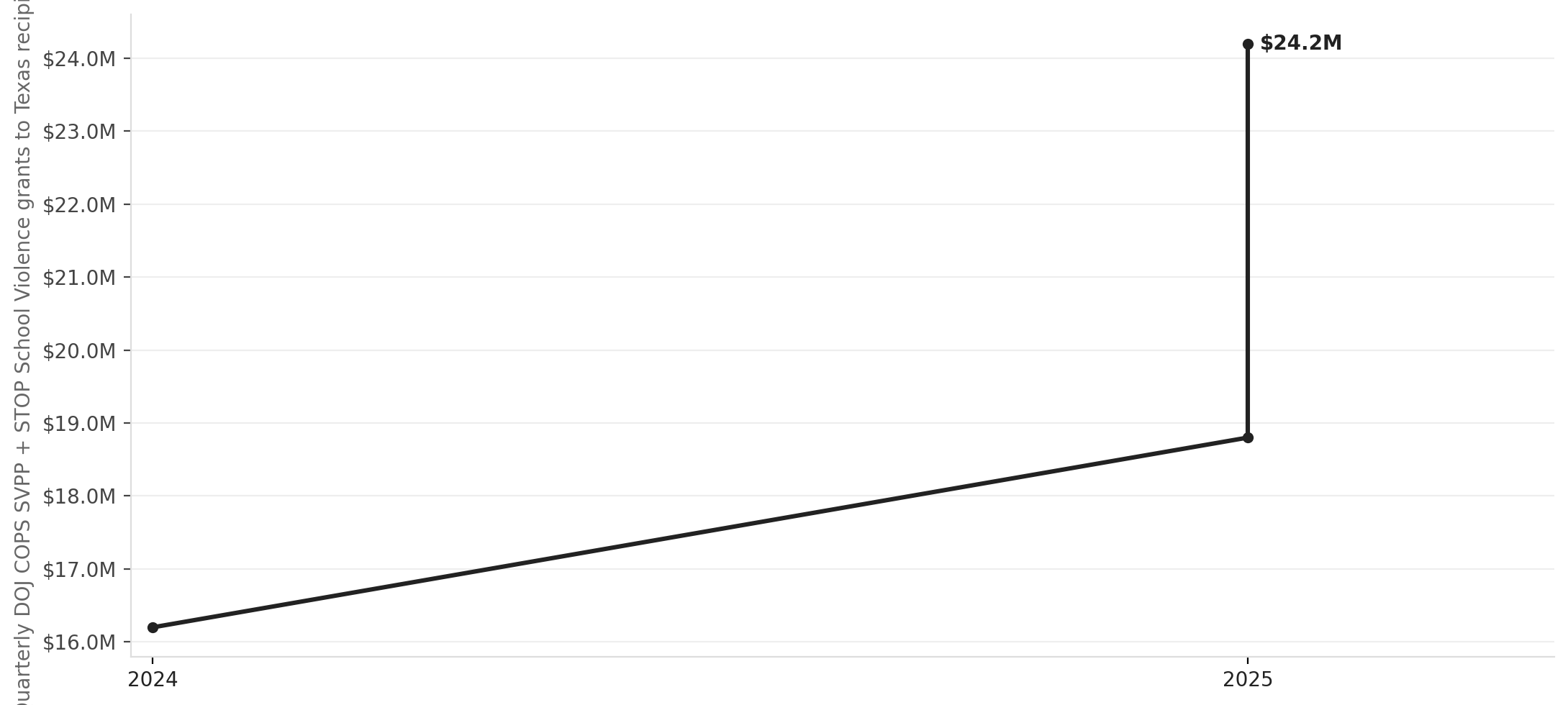
Federal school safety grants flowing to Texas school districts reached $24.2 million across 17 awards in the fourth quarter of 2025 alone, up from near-zero before mid-2024. That is not a one-time outlier: the quarterly totals have roughly doubled in each successive period, rising from $16.2 million in Q4 2024 to $18.8 million in Q3 2025 before hitting $24.2 million last quarter. Texas is not just receiving more school safety money. It is receiving it on a fundamentally different scale than it ever has.
The timing is not accidental. Three forces converged in 2025 to produce the surge. The DOJ COPS Office released its FY25 School Violence Prevention Program with $73 million available nationally, up to $500,000 per award, and roughly 200 anticipated grants beginning October 2025. Simultaneously, the 89th Texas Legislature passed SB 260, which doubled the per-student school safety allotment from $10 to $20 and raised the per-campus funding floor from $15,000 to $33,540, effective September 1, 2025. And HB 33, the Uvalde Strong Act, took effect the same day, requiring standardized crisis response protocols and law enforcement accreditation for active-shooter events statewide. Each of these would have mattered in isolation. Together, they created a single fiscal pressure point that hundreds of districts could not ignore.
The recipient list tells the story of who is most exposed. Uvalde CISD, the site of the 2022 Robb Elementary massacre that killed 19 children and two teachers, received a $1 million STOP School Violence grant running through September 2027. El Paso ISD and Harlingen CISD each received $1 million. Texas State University's Texas School Safety Center, which serves as the state's federally designated hub for evidence-based safety program development, secured $1.39 million through 2027. Harris County Department of Education received $931,000. A cluster of small rural East Texas districts, including Center, Palestine, Big Sandy, Commerce, Bartlett, and River Road, appear among the awardees as well. Senator John Cornyn announced more than $3 million in SVPP awards to Texas districts in October 2025, citing support for technology upgrades, access control, and law enforcement coordination.
Source: NationGraph.
The rural concentration matters because it maps directly onto where compliance has been hardest. Texas has approximately 1,200 school districts, more than any other state, and hundreds of them have no local law enforcement agency to draw from. HB 3, passed in 2023, required one armed officer per campus but provided no dedicated funding mechanism for districts that had to contract with outside agencies or hire and train their own staff. Pflugerville ISD, a mid-size suburban district, calculated $3 million in combined annual and one-time costs just to meet the requirement. For a district of a few hundred students with a property tax base measured in farmland, the number is proportionally larger and the options are narrower.
As of January 2025, a Texas Senate Education Committee report found that more than half of Texas school districts still did not meet HB 3's armed-officer standard, two years after the law passed. Governor Greg Abbott called for $500 million in additional school safety investment in his February 2025 State of the State address. The legislature responded with SB 260's funding increases and the Uvalde Strong Act's mandate expansions, but the compliance gap remained the subtext of every floor debate.
The Texas Education Agency had separately allocated more than $1.1 billion in SAFE grants for physical security upgrades, but reporting indicated only 12 percent had been spent as of early 2025. The original completion deadline of October 2025 has since been extended to April 2027, reflecting how difficult it has been for districts to absorb large capital expenditures quickly, especially when staff capacity for grant management is thin. The TEA's 89th Legislature updates outline the new compliance requirements districts now face, and the federal dollars arriving through DOJ are in part filling gaps the state's own infrastructure programs have been slow to close.
Nationally, the FY25 STOP School Violence program expanded to $83 million, a $20 million increase over the prior year, per program documentation from the DOJ. Texas, given its size, its political salience on school safety, and the presence of an established state safety center at Texas State, is positioned to capture a disproportionate share of future rounds.
For families and administrators in the hundreds of districts still working toward compliance, the practical signal is this: the money is now real, the mandates have deadlines, and the federal application windows are annual. Districts that missed the FY25 cycle have FY26 to prepare for. The next benchmark to watch is September 2026, when TEA will assess how many campuses have met both the armed-officer requirement and the new Uvalde Strong Act protocols under the expanded SB 260 funding. That report will show whether the billion-dollar machine has actually closed the gap, or only widened the distance between districts that can navigate grant bureaucracy and those that cannot.