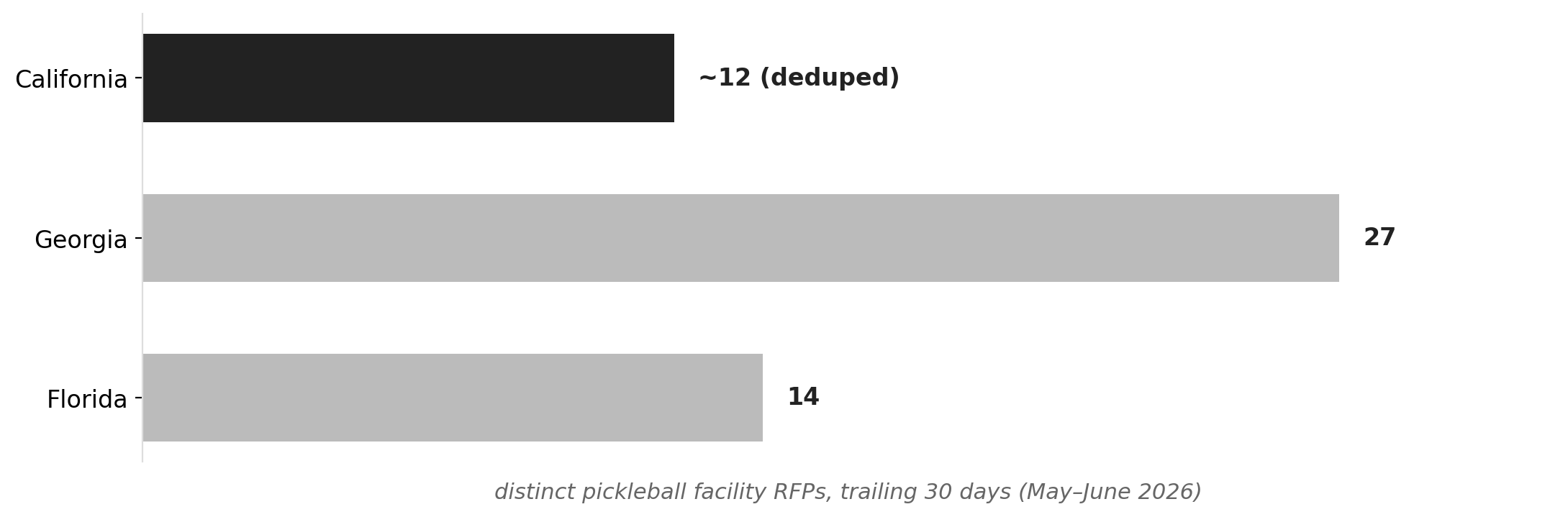
Roughly 11 to 12 distinct pickleball facility RFPs have landed in California's public procurement channels over the past 30 days, triple the two-to-four per month pace recorded from January through April 2026. The cities behind them span seven counties from San Diego to Alameda, and most share a common calculation: two funding deadlines are converging in the next 90 days, and a pickleball court has become the fastest way to spend park dollars that municipal governments can no longer afford to sit on.
The first clock is federal. American Rescue Plan Act State and Local Fiscal Recovery Funds that local governments obligated before December 31, 2024 must be fully expended by December 31, 2026. That distinction matters: obligation is a promise, but expenditure means construction contracts signed and money out the door. Cities that earmarked ARPA recreation dollars two years ago are now in active procurement or risk losing them. The pickleball court, quick to design and relatively inexpensive to build compared to an aquatic center or a synthetic turf field, fits that window.
The second clock is the state's. California's Statewide Park Development and Community Revitalization Program Round 5 draws $188.5 million from Proposition 4, the $10 billion climate and parks bond that California voters passed in November 2024. The public comment period for SPP Round 5 closes June 26, 2026. Competitive applications open that same summer. Critically, SPP scoring criteria favor "critically underserved communities" and explicitly list recreational amenities, including pickleball courts, as eligible projects. To score well, applicants need construction-ready designs and procurement documents already in hand. An RFP filed now is not a coincidence; it is a grant strategy.
Source: NationGraph.
The geographic spread of active projects illustrates how broadly that strategy has been adopted. Loma Linda in San Bernardino County is bidding Phase 2 of its Leonard Bailey Park, focused on new dedicated courts. Poway in San Diego County is procuring its South Poway Pickleball Courts. San Mateo County issued a restriping RFQ to convert existing tennis courts, reflecting the lower-cost end of the same demand pressure. Gilroy, Chowchilla, Oxnard, and Dublin round out a list that cuts across coastal cities, inland valley towns, and Bay Area suburbs alike.
The ambition scales up further in Los Angeles: the Bureau of Engineering's 25-year Sepulveda Basin master plan, discussed at a June 2026 HACLA meeting, folds pickleball courts into a $4.8 billion investment envelope for one of the largest urban recreation corridors in the country.
A secondary force is reshaping what these facilities have to look like, not just whether they get built. Noise complaints have reached the point of litigation and local ordinance in multiple California cities. Carmel-by-the-Sea became the first city in the state to ban pickleball at public facilities outright after residents sued over court noise. Laguna Beach adopted an ordinance in 2026 requiring quieter paddles or citation. Saratoga set aside $100,000 specifically for acoustic mitigation at its courts. Those developments are pushing procurement language: cities issuing RFPs now are specifying sound-absorbing surfaces, setbacks, and screening rather than simply repainting tennis baselines. A dedicated court designed to pass a noise review is more expensive to build, which is one more reason agencies need grant money rather than general fund reserves.
California leads all states in pickleball facility RFP volume over this period, ahead of Georgia and Florida in the same 30-day window. That reflects the state's particular structural exposure: more than 14,000 parks statewide, a historical reliance on tennis court conversions rather than purpose-built infrastructure, and a population density that puts courts within earshot of dense residential neighborhoods. Governor Newsom's framing of Prop 4's park equity mandate, centered on underserved communities who lack nearby recreation access, gives municipal agencies political cover to prioritize sport-specific construction over multi-purpose upgrades. The Legislative Analyst's Office's analysis of Prop 4 notes that the SPP program has historically been oversubscribed, with demand far exceeding available funds, which means early and well-documented applications carry a measurable advantage.
For residents watching this play out in their own cities, the immediate signal to watch is the June 26 public comment deadline on SPP Round 5 guidelines. Comments filed by local advocates or council members can influence scoring criteria before the competitive window opens. After that, the relevant date is whatever a city's procurement timeline sets as a bid opening: projects that cannot award a contract before late summer 2026 risk missing the ARPA expenditure window entirely.
The pickleball court started as a pandemic-era workaround, a pair of temporary lines on a tennis surface. What California's bidding surge shows is that it has matured into a line item with its own procurement infrastructure, its own grant eligibility categories, and its own litigation risk if built wrong. Cities have until the end of the year to prove the upgrade was worth it.