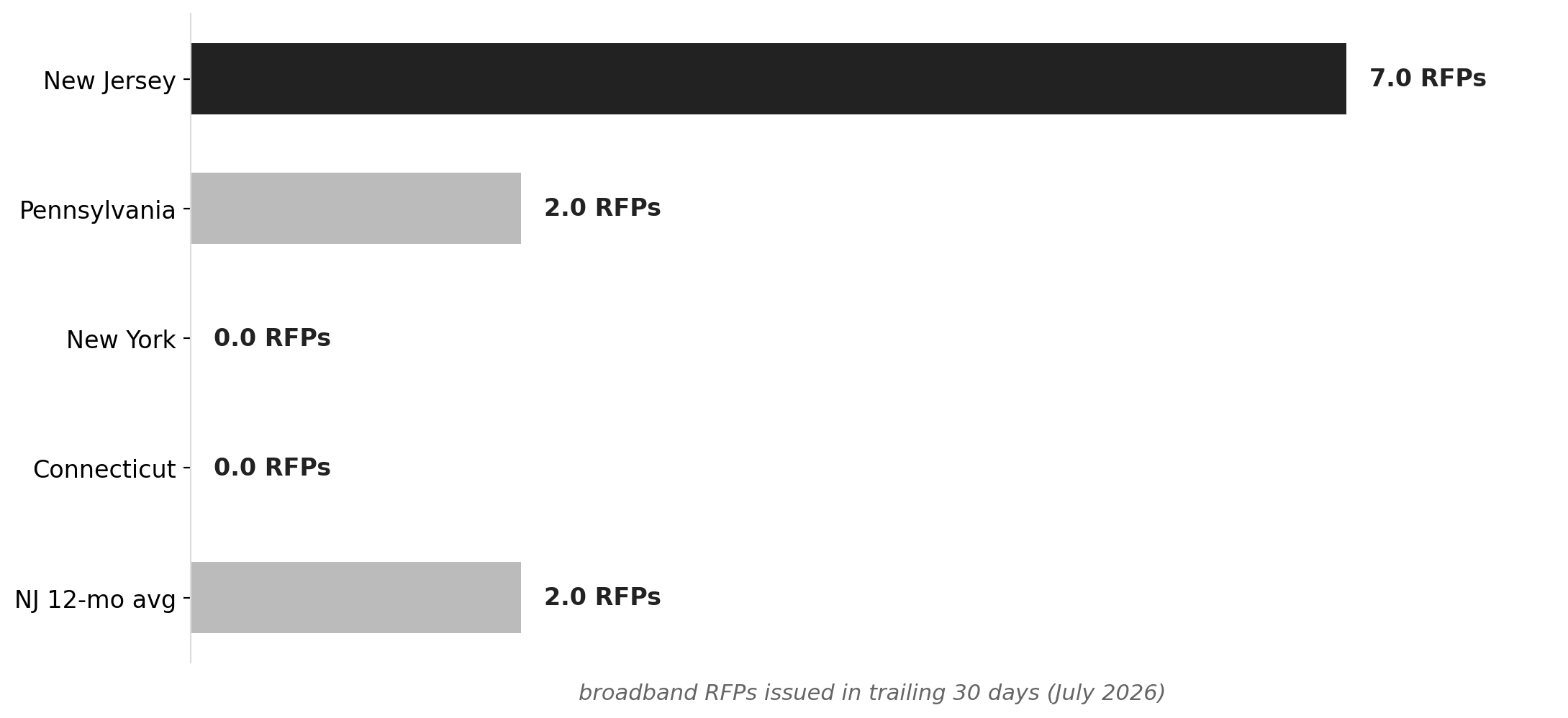
New Jersey issued seven broadband procurement solicitations in the last 30 days, 3.5 times its 12-month monthly average of roughly two, and most of them are coming from a single county that has already tried and failed once to find a contractor. That fact, more than the volume, explains what is actually happening in South Jersey right now.
Salem County's Purchasing Department is the dominant issuer in this surge, running active rebids on two NJBIDE-funded projects: a Fiber-to-the-Home build covering Salem and Cumberland counties, and a Middle Mile project spanning Salem, Cumberland, and Gloucester. Both are marked "REBID" in public procurement records, meaning the original solicitations drew no acceptable response. The county is now compressing a second contractor selection into the summer of 2026, with a hard deadline that leaves almost no margin for a third attempt.
The deadline is real and carries financial consequences. The NJBIDE pilot program, a $40 million state Capital Projects Fund initiative, distributed grants to awardees including Salem County, Vineland, Brightspeed, and Verizon with a single binding condition: projects must be substantively complete by December 31, 2026, or face clawback. Salem County holds a $22.76 million Department of Commerce Middle Mile Broadband grant, active through June 2028, with zero dollars yet outlayed. The money is committed. No contractor has broken ground.
Source: NationGraph.
The federal accelerant arrived on December 26, 2025, when the NTIA approved New Jersey's BEAD Final Proposal, unlocking approximately $62 million in federal deployment funds and authorizing the state to begin construction in early 2026. New Jersey is one of only about eight states nationally already in the active BEAD deployment phase; the remaining 39 are still working through challenge processes. That positioning matters because it means New Jersey's procurement activity is not theoretical, it is contractually obligated spending with a countdown clock attached.
The geography of that obligation is concentrated and specific. Salem County is among the most connectivity-deprived jurisdictions in a state that is otherwise densely wired. New Jersey's total BEAD allocation exceeds $263 million, but the first $62 million tranche is disproportionately aimed at rural southern counties, Salem, Cumberland, Sussex, Warren, that commercial ISPs bypassed during the broadband build-out of the past two decades. The NJBIDE pilot alone targets more than 7,700 households and 2,000 businesses across seven counties. For the communities involved, this is not an incremental upgrade. It is first-time service.
The procurement compression is visible in the regional comparison. New Jersey logged seven broadband RFPs in the trailing 30 days. Pennsylvania logged two. New York and Connecticut combined for zero. That gap does not reflect a difference in need, it reflects a difference in deadline exposure. According to a state announcement on the BEAD approval, NJBPU President Christine Guhl-Sadovy described the program as "a historic investment to connect the unconnected." The procurement calendar is now the mechanism that delivers or forfeits that investment.
For residents in Salem and Cumberland counties, the next signal to watch is whether the current rebid cycle produces signed contracts before September. A summer 2026 award would leave roughly four months for mobilization and construction before the December 31 deadline, a tight but executable window for a fiber build of this scale. A second failed solicitation would almost certainly trigger a renegotiation of grant terms or a clawback proceeding, and there is no obvious replacement funding source at the federal level given the current BEAD pipeline is already allocated.
The NJBPU's Office of Broadband Connectivity has indicated construction was authorized to begin in early 2026. Six months into that window, the dominant activity in the state is still procurement, not shovels. The rebid notices are the clearest public signal of where the bottleneck sits, and how much time remains to clear it.