Federal AI grants committed to Tennessee institutions in the last 90 days total $5.55 million across nine awards, a 153% jump over the $2.20 million awarded in the same window a year ago. That puts Tennessee second among all Southeastern states, behind only Virginia's $6.22 million and well ahead of Georgia ($3.57M) and North Carolina ($3.19M), two states with considerably larger research university systems.
The numbers are striking on their own, but they land on top of something larger: 75 currently active AI grants in Tennessee carrying $110.3 million in total federal obligations, of which $40.2 million has already been spent. The new surge is not a first wave. It is an acceleration of a base that has been building for years.
Three federal catalysts converged in the last six months to produce this spike. The first is the Department of Defense's HBCU and Minority-Serving Institution equipment program, which in May 2026 seeded Tennessee State University with roughly $1 million to establish the RAIVS Laboratory, focused on Robotics, AI, Visualization, and Simulation for human-machine teaming research. TSU is Nashville's only public HBCU land-grant institution, and as the university's newsroom reported, the RAIVS lab positions TSU at the intersection of Pentagon priorities: autonomous systems, AI-assisted decision-making, and the military's broader push toward human-machine teaming. That investment did not happen in isolation. Congress is currently considering the HBCU Artificial Intelligence Research Leadership Act, which would require 10% of NSF's National AI Research Institutes to be operated by or in partnership with HBCUs, a provision that would structurally favor institutions like TSU that have already built the infrastructure to compete.
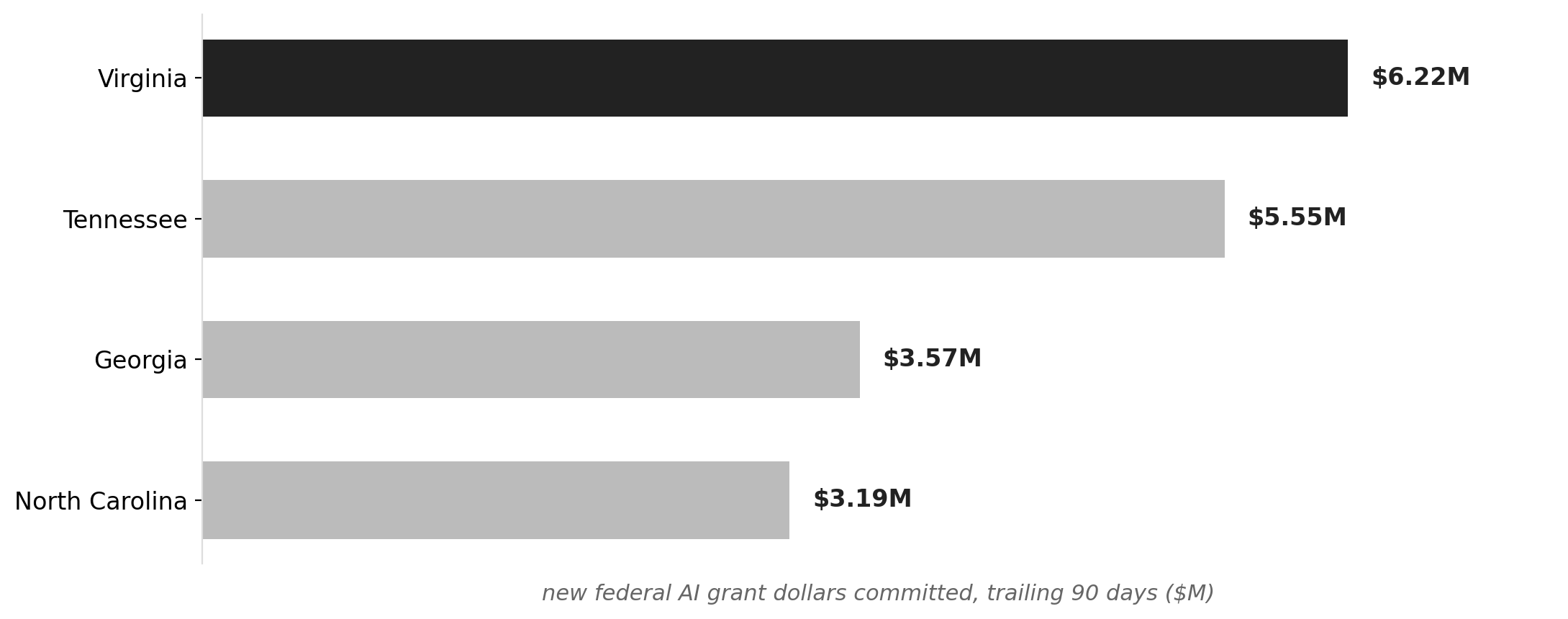
Source: NationGraph.
The second catalyst is Oak Ridge National Laboratory. In early 2026, the Department of Energy deployed the Lux AI cluster at ORNL as part of a public-private partnership with AMD and HPE under the DOE's Genesis Mission, a national initiative to expand AI supercomputing capacity at federal laboratories. Oak Ridge is now a named node in that network. Tennessee is the only Southeastern state with a DOE national laboratory, and that structural fact matters: Georgia and North Carolina can build research programs, but they cannot easily replicate what a facility with Oak Ridge's existing computing infrastructure and federal relationships provides.
The third catalyst is state-level signaling. In November 2025, Tennessee's AI Advisory Council released its first statutory Action Plan to Governor Bill Lee, explicitly naming ORNL as one of the nation's foremost AI research institutions and framing the state's energy resources and broadband as the physical backbone for AI enterprise. Tennessee CIO Stephanie Darby described 2025 as the year for building guardrails and 2026 as the year to put those frameworks into practice. Federal program officers read state readiness documents. The action plan gave agencies a clear signal that Tennessee's institutions were organized, policy-aligned, and ready to absorb and account for federal dollars.
The three largest grants in the current 90-day window illustrate how broadly this is landing. Nashville Metro Government captured $2.44 million in EPA recycling-infrastructure funding with an AI component, the single largest award in the cohort. TSU's RAIVS grant accounts for roughly $998,000. A $550,000 NSF Engineering award to the University of Tennessee rounds out the top three. NSF also made AI-adjacent awards in the window to Tennessee Tech, Austin Peay, and Vanderbilt, a distribution that signals the agency is treating Tennessee as a multi-institution research ecosystem rather than routing everything through a single flagship.
For residents and civic institutions in Tennessee, what changes is primarily institutional capacity. Universities building AI laboratories now have the personnel, equipment, and federal relationships to attract follow-on funding, industry partnerships, and graduate students in fields the state's labor market increasingly needs. For Nashville specifically, the EPA grant's AI component is a leading indicator that city agencies are beginning to embed machine learning into operational infrastructure decisions, not just research settings.
The near-term signals to watch are two. First, whether the HBCU Artificial Intelligence Research Leadership Act advances: if it does, TSU's existing DoD investment becomes a competitive advantage in the next NSF National AI Research Institutes solicitation cycle. Second, the DOE has issued requests for proposals on AI data center development at the Oak Ridge Reservation specifically, a signal that the federal government is considering ORNL as a site for commercial-scale AI infrastructure beyond the Lux cluster. Awards from that solicitation would move Tennessee's AI footprint from research-scale to industrial-scale in a single budget cycle.