On a single Tuesday, May 11, 2026, cities including Fountain Valley, San Gabriel, Moraga, and Ventura Water all posted nearly identical NPDES consulting solicitations. None of them had issued a stormwater RFP in the prior twelve months. They were not coordinating. They were reacting to the same regulatory clock.
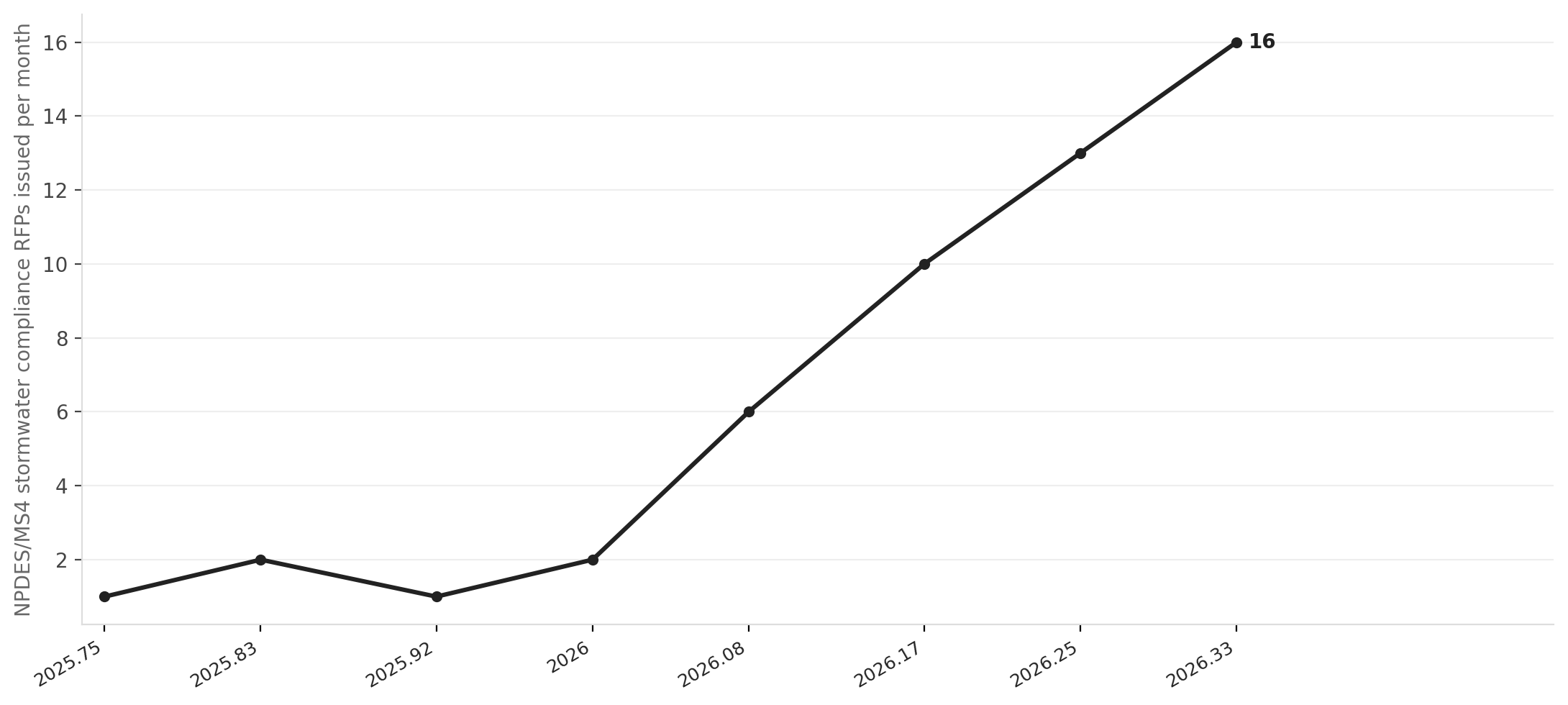
May 2026 closed with 33 California institutions issuing a stormwater-related RFP for the first time in over a year, a 100 percent novelty rate for the window. NPDES and MS4-specific solicitations, which ran at roughly one or two per month from October 2025 through January 2026, jumped to twelve to sixteen per month by spring. The list of first-timers spans the full breadth of California's public sector: cities (Richmond, Santa Monica, Dublin, Moorpark, Thousand Oaks), transit agencies (San Joaquin RTD), school districts (Fairfield-Suisun USD, West Contra Costa USD), special districts (Sanitation Districts of LA County), and the California Natural Resources Agency itself. This is not a geographic cluster or a single grant program producing similar projects. It is something rarer: a compliance emergency hitting every tier of government at once.
Three regulatory shocks arrived in close enough succession to feel simultaneous. The first was the Supreme Court's 5-4 ruling in City and County of San Francisco v. EPA on March 4, 2025, which held that the Clean Water Act does not authorize EPA to impose "end-result" requirements in NPDES permits, provisions that held permittees responsible for the quality of the receiving water body, not just their own discharge. Legal analysts have noted the ruling effectively renders end-result permit criteria unenforceable, upending compliance frameworks California agencies had built around those provisions for decades. The irony is pointed: the case bore San Francisco's name, but its shockwaves landed hardest on the hundreds of smaller MS4 permittees across the state who now need to audit whether their existing permits can withstand challenge, revision, or both.
Source: NationGraph.
The second catalyst is procedural but time-pressured. The California State Water Resources Control Board has declared renewal of the Construction General Permit its top permitting priority for 2026, with a working draft expected in late 2026. The reissuance is expected to modify the Qualified Rain Event definition and the site risk-level determination process, two pillars of how construction-site operators calculate their Stormwater Pollution Prevention Plan obligations. Agencies responsible for large public construction programs cannot wait for the final text to begin updating their SWPPP and NPDES program capacity; the procurement window is now, before the draft circulates and consultant bandwidth tightens.
The third shock is the most geographically concentrated but arguably the most consequential in raw compliance cost. The Los Angeles Regional Water Quality Control Board is advancing a new Commercial, Industrial, and Institutional stormwater permit that would apply to properties over five acres in major southwest LA County watersheds. The proposed permit would expand regulated pollutants from two to more than thirty, impose numeric effluent limits, and require individual property-level SWPPPs, a scope that legal analysts describe as sweeping and potentially exposing individual property owners to six-figure per-violation penalties. The LA basin's dense network of cities, districts, and agencies means a single regional board action fractures into dozens of simultaneous procurement decisions, each jurisdiction needing its own consultant to parse what the new obligations mean for its specific footprint.
Together, the three catalysts produced something California's stormwater compliance market has not seen: a synchronized procurement spike driven entirely by regulatory uncertainty rather than capital projects or disaster recovery. The $202 million in active federal stormwater grants across EPA, DOT, Interior, Agriculture, and the Infrastructure Bank provides the fiscal backdrop that makes compliance investment rational, but the spending itself is not grant-funded. Cities are hiring consultants to understand what their permits now require, a more fundamental question than most compliance cycles ask.
For residents, the immediate consequence is less visible than a construction project: the work product is legal analysis and program restructuring, not new infrastructure. The downstream effect, though, is real. Agencies that get the post-ruling compliance picture wrong face permit violations; agencies that overbuild their programs in response to uncertainty will pass those costs to ratepayers. The quality of the consulting work procured in this window will shape how California's stormwater programs operate for the next permit cycle.
The next signal to watch is the State Water Board's construction permit working draft, expected in late 2026. When it circulates, the agencies that spent this spring shoring up internal expertise will be positioned to comment and adapt; those that did not will face another procurement scramble on a shorter timeline. The May 11 cluster was not the peak of this cycle. It was the opening.