Twenty-one California institutions issued a homelessness-related RFP for the first time in more than a year during the 30-day window ending June 12, 2026, not because they suddenly have money to burn, but because a $500M deadline is bearing down on them and they have almost nothing to show.
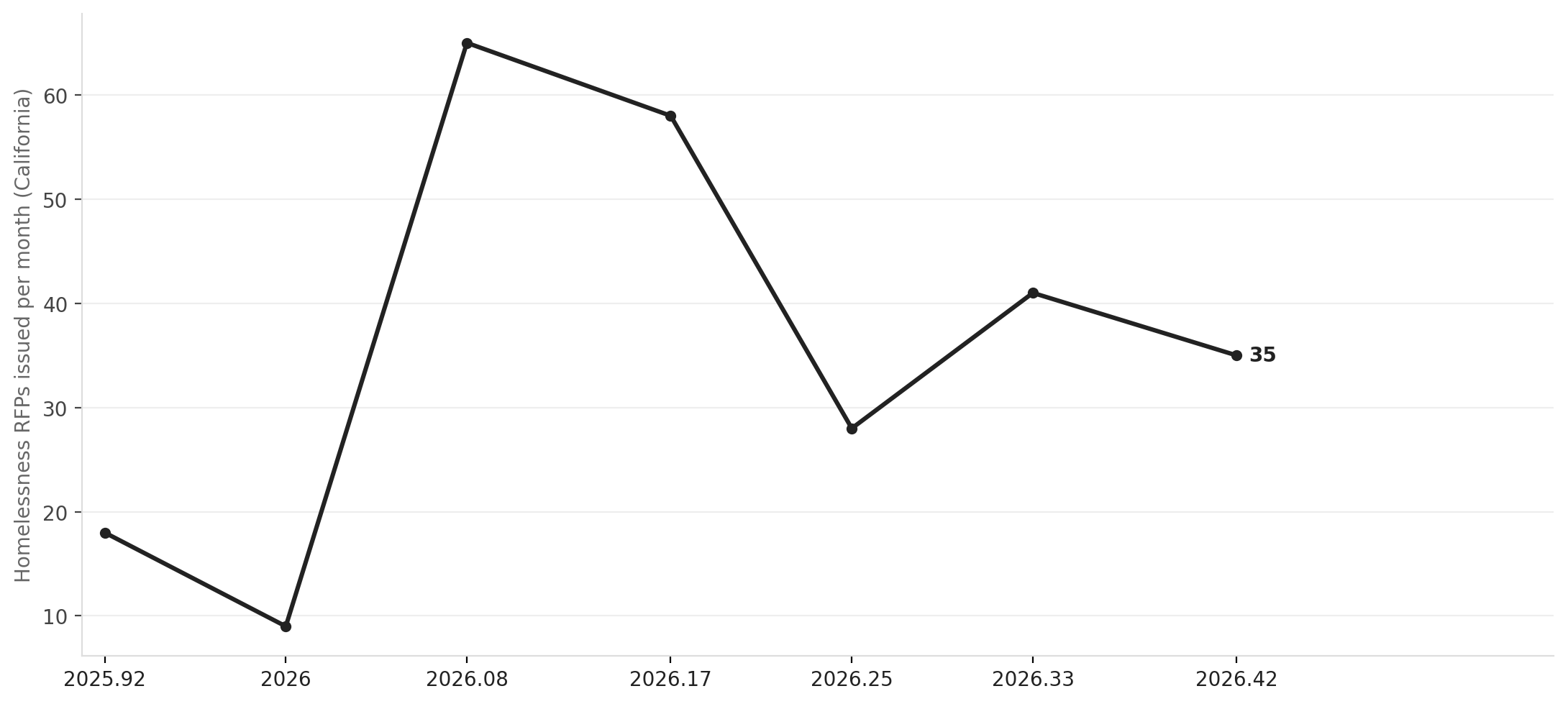
The burst of procurement activity is visible in the aggregate numbers: 35 total homelessness RFPs from 19 distinct agencies in the past 30 days, spread across Los Angeles County, Mariposa County, Sacramento County, Ventura County, and a dozen smaller jurisdictions each posting one or two solicitations. That geographic distribution matters. This isn't a story about Los Angeles finally moving dollars. It's a story about Mariposa County (population roughly 18,000), Torrance, Lake County, and Gilroy suddenly rejoining a procurement market they had exited entirely.
The time series explains why. California homelessness RFP volume collapsed to just 9 total filings from 7 agencies in January 2026, a low that reflects the 2025-26 budget's elimination of HHAP funding for that fiscal year, cutting a program that had run at roughly $1 billion annually for four consecutive cycles down to zero. Jurisdictions that depend on HHAP to fund service contracts had no confirmed dollars to spend, so they stopped issuing RFPs. The freeze was a rational response to a funding gap, not negligence.
Source: NationGraph.
The thaw began in February and March, when volume surged to 65 and 58 RFPs respectively. The timing aligns directly with HHAP Round 6 disbursements rolling out to more than 20 California regions, with Governor Newsom completing the full $760M distribution to all 42 eligible regions by May 13, 2026. Confirmed dollars unlocked procurement. That link between state award timing and local RFP volume is now the clearest signal in the dataset.
But the re-acceleration in May and June is being driven by something different: forward pressure from Round 7. The $500M enacted via SB 131 carries eligibility conditions that prior HHAP rounds did not. Under the new framework, localities must demonstrate an active local encampment policy consistent with state guidelines and meet housing performance benchmarks before HCD will disburse funds, with the agency targeting September 2026 for initial awards. That means jurisdictions need to show operational services, not just plans, when their applications land.
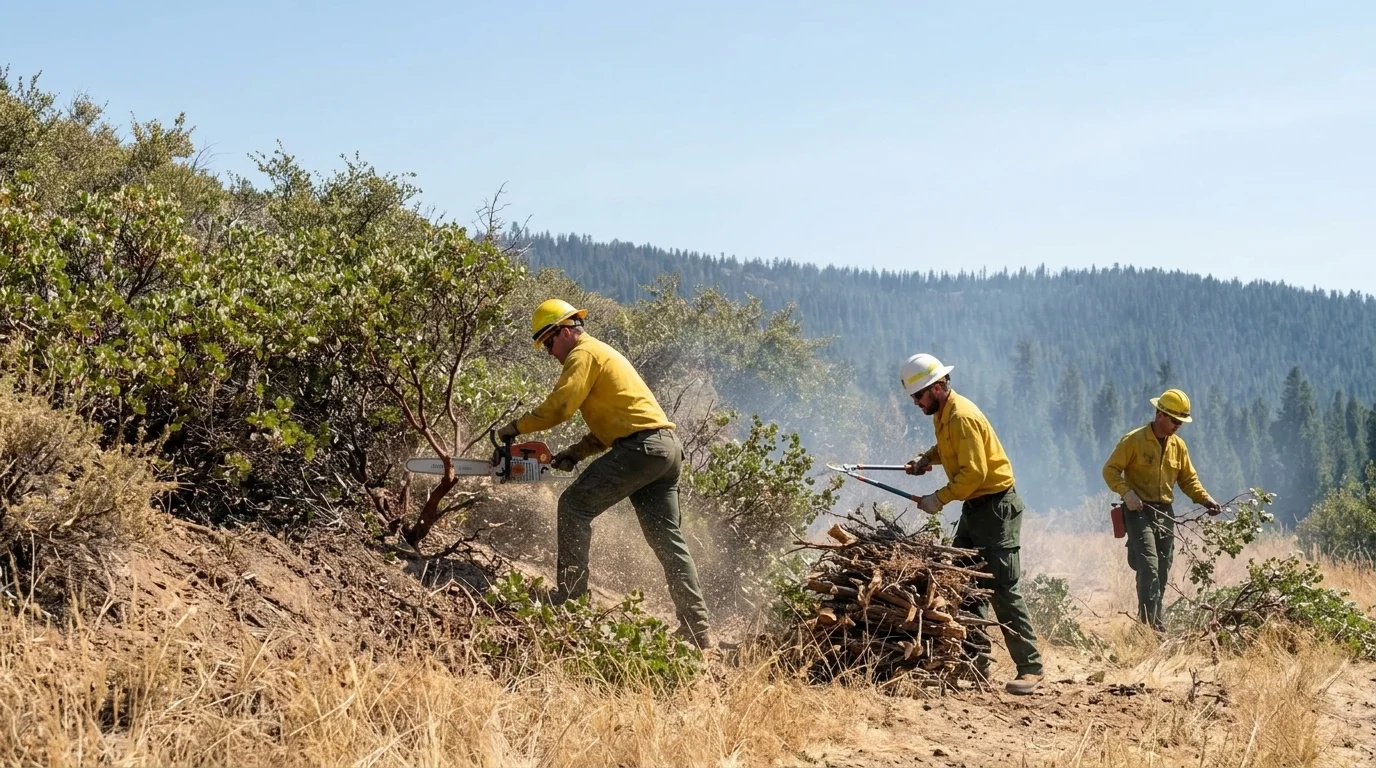
The RFP titles make the strategy legible. Mariposa and Sacramento counties are soliciting emergency shelter operators. Lynwood, Torrance, and Ventura are procuring encampment cleanup contracts, the category most directly tied to the encampment policy compliance requirement. San Diego City and the San Diego Port District are advertising street outreach services. Stockton and Fontana are moving on interim and transitional housing. Shasta County has posted a Homekey+ affordable housing development solicitation. Taken together, the mix maps almost exactly onto the performance categories HCD will be evaluating.
The accountability architecture here is worth naming plainly. California is the only state that conditions homelessness grant eligibility on demonstrable local policy compliance at this scale, and the LAO's October 2025 analysis of the HHAP framework noted that the performance-benchmark requirement was specifically designed to prevent jurisdictions from receiving funds without active service infrastructure. What the procurement data shows is that the design is working as intended: smaller cities and counties that went dormant during the funding gap are now scrambling to build the service pipeline they need to qualify, not just to spend money they already have.
Governor Newsom's March 26 final warning to 15 communities violating state housing laws added a legal dimension to what was already a financial incentive. For smaller jurisdictions with limited staff capacity, the combination of funding access and legal exposure is proving more motivating than either pressure alone.
The California Budget Center warned in February 2026 that without sustained HHAP, service providers would be forced to scale back or eliminate programs as early as next year. The RFP surge suggests local governments heard that warning and are trying to get contracts in place before the window closes, but at half the prior annual funding level, some of the providers responding to these solicitations will be competing for significantly smaller awards than they received in prior rounds.
The next signal to watch is which of these 21 newly reactivated jurisdictions can actually execute: award a contract, stand up services, and document compliance in time to meet HCD's September application window. Issuing an RFP is the first step in a procurement process that, for smaller counties without dedicated homeless services staff, routinely takes three to five months to complete. For Mariposa County and its peers, the clock is already tight.