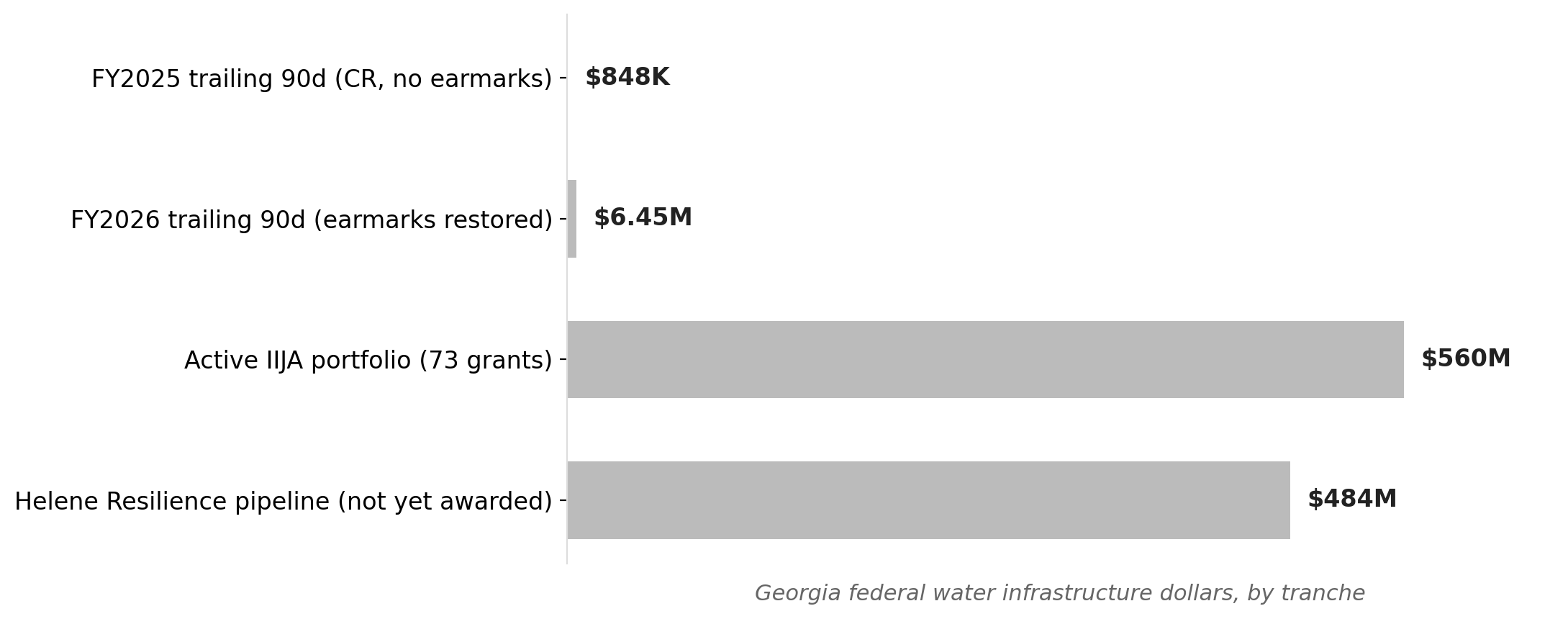
Federal water infrastructure grants to Georgia have hit $6.45 million in the trailing 90 days, a 661% increase over the $848,000 the state received in the same window last year. The number sounds like a crisis response. It is, in part, a bookkeeping rebound, and the genuinely large money has not shown up yet.
The two grants driving the spike are both labeled "Congressionally Mandated Projects": $3.45 million to the City of Roswell, active through December 2027, and $3 million to the City of Savannah, running through March 2027. Neither of these could have existed a year ago. The FY2025 continuing resolution (P.L. 119-4) contained zero Community Project Funding earmarks for EPA water programs, which is why the prior-year comparison window shows only $848,000. When Congress passed the FY2026 appropriations package (P.L. 119-74) earlier this year, it restored that earmark mechanism, and city-specific grants began flowing again almost immediately. The 661% increase is real, but it measures the distance between a year with earmarks and a year without them as much as it measures any new urgency about Georgia's water systems.
Under those two headline grants sits a substantially larger active portfolio. Georgia currently holds 73 water infrastructure grants under the Infrastructure Investment and Jobs Act totaling roughly $560 million, anchored by annual State Revolving Fund capitalization tranches that GEFA, the Georgia Environmental Finance Authority, distributes to utilities across the state. The largest of those tranches runs $67.5 million. In March 2026, GEFA awarded $32.2 million to 10 communities specifically for PFAS and emerging contaminant remediation, a separate IIJA priority that has been moving in parallel.
Source: NationGraph.
The more consequential number, though, is one that has not yet appeared in any grant database: $484 million in Hurricane Helene Resilience Funding that GEFA is eligible to pursue. Congress passed the American Relief Act in December 2024, allocating $3 billion nationally in supplemental State Revolving Fund money for Helene-impacted states. Georgia's share breaks down to $359.5 million in drinking water funds and $124.9 million in clean water funds. GEFA opened a project call for that money with a December 31, 2025 deadline, and EPA has separately announced $48 million for southeastern states to repair water systems damaged by the storm. None of those awards have cleared yet.
The underlying need is not abstract. Hurricane Helene made Category 4 landfall on September 26, 2024, and the Presidential Disaster Declaration covers 31 Georgia counties, including rural north Georgia communities in Habersham, Hart, White, and Lumpkin counties that took direct flooding. FEMA has obligated more than $1.5 billion in Public Assistance funds to Georgia for Helene recovery as of June 2026, with additional tranches continuing to move. The water infrastructure piece of that recovery is the portion GEFA controls, and the agency is now positioned to manage its largest-ever single-event capital deployment.
One detail in the federal data is easy to miss but worth noting: Georgia was the only state in the country to receive an increase in its Lead Service Line Replacement allotment for federal fiscal year 2026, gaining $2 million (a 6% bump) while every other state saw cuts. That is a small number relative to the SRF tranches, but it signals that federal allocators are treating Georgia's water infrastructure position differently than most states right now.
For residents in the counties that bore the worst of Helene's flooding, the practical question is when construction starts, not when grants are awarded. SRF funding typically moves through GEFA to local utilities as low-interest loans rather than direct grants, which means communities still have to demonstrate repayment capacity. Rural systems with smaller rate bases, exactly the systems most exposed in north Georgia, can qualify for principal forgiveness on a portion of their loans, but the administrative work to get there is significant. GEFA is managing that pipeline with a staff and process built for a normal capital cycle, not a post-disaster surge.
The next signal to watch is when the Helene Resilience Funding awards appear on EPA's grants database. The project call closed at the end of 2025, and awards of this scale typically take several months to finalize. When they do post, the current 90-day figure of $6.45 million will look like a rounding error next to what comes next.