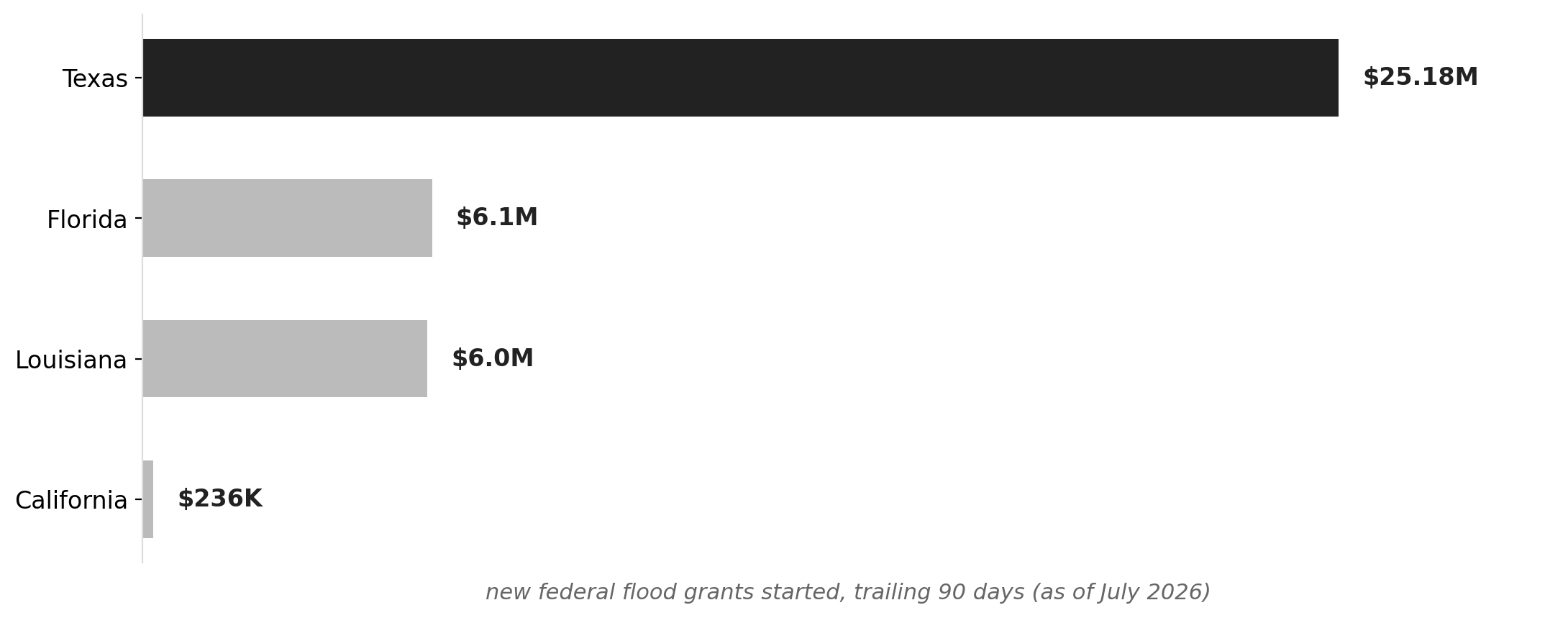
Federal flood grants newly obligated in Texas have reached $25.18 million over the past 90 days, nearly triple the $8.49 million awarded in the same window last year, and the dominant source is a single $24.3 million FEMA Flood Mitigation Assistance grant to the Texas Water Development Board, obligated April 24, 2026, with a three-year spending clock that runs through April 2029.
The surge makes Texas the largest recipient of new federal flood grants in the country by a wide margin. Florida received $6.1 million in the same period, Louisiana $6.0 million. The $25 million arriving now lands on top of an already active Texas flood-grant portfolio exceeding $165 million across DHS, DOT, the EPA, and the Commerce Department, $47.8 million of that held by DHS and FEMA alone.
The driver is not mysterious. On July 4, 2025, a catastrophic flash flood along the Guadalupe River in Central Texas killed at least 139 people and caused an estimated $1.1 billion in damages, only about $135 million of which was covered by the National Flood Insurance Program. The disaster exposed the near-total absence of outdoor warning infrastructure across the Hill Country's steep, fast-draining terrain, an arc of limestone canyons, shallow soils, and summer camps that hydrologists call Flash Flood Alley. Cellular dead zones meant that even the standard emergency alert push never reached many victims.
Source: NationGraph.
The legislative response was unusually fast. Governor Abbott called a special session, and Texas SB3, authored by Sen. Paul Bettencourt and designated a priority by Lt. Gov. Dan Patrick, passed the Senate 30-0 and was signed September 5, 2025. The bill directs TWDB to map flash-flood-prone areas across 30 disaster-declared counties and mandates installation of outdoor warning sirens. A companion bill, SB5, appropriated $50 million from the state's economic stabilization fund for siren grants. TWDB delivered grant agreements to all 30 counties by December 17, 2025, faster than most observers expected.
The $24.3 million FEMA award fits directly into that architecture. It is part of a broader FMA round announced April 22, 2026, in which FEMA distributed more than $235 million nationally from $600 million available for FY2024 under the Infrastructure Investment and Jobs Act. Texas's single award represents more than 10 percent of the total national round, a concentration that reflects both the scale of the July 2025 disaster and TWDB's ability to submit a competitive application with 22 sub-transactions already structured.
Procurement activity tells a similar story. Flood-related RFPs in Texas spiked to 165 in July 2025, the disaster month, then collapsed as the system absorbed the shock. They re-surged to 81 in February 2026 and 68 in April, tracking the SB3 implementation timeline closely. The machinery is moving.
But the central friction in this story is not whether Texas can win grants. It is whether Texas can spend them. Investigative reporting by Scientific American documented that the state relinquished $225 million in FEMA mitigation grant money over the past decade, largely because local governments failed to draw down funds before deadlines. The pattern was severe enough that the Trump administration briefly halted new Hazard Mitigation Grant Program approvals in spring 2025 while reviewing Texas's track record, a pause that coincided with the very season the Guadalupe River flooded.
The new $24.3 million award expires in April 2029. Three years sounds comfortable. The history suggests it is not. Rural Hill Country counties, the same ones now receiving SB3 siren grants, typically lack the grant administrators, engineering staff, and procurement capacity to move federal dollars quickly. TWDB has structured the current award with 22 sub-transactions, which may help distribute execution risk, but each sub-transaction carries its own compliance requirements.
For residents of Kerr, Kendall, Comal, and the other counties in the disaster footprint, the question is practical: will warning sirens be in the ground before the 2027 summer storm season, when flash-flood risk along the Guadalupe and its tributaries is statistically near its peak? The SB5 state grants are already flowing, and TWDB's December delivery of county agreements was a genuine milestone. The federal money now compounds that effort, if the spending apparatus holds.
The next signal to watch is TWDB's quarterly drawdown reports to FEMA, which will become public by late summer 2026. If expenditure rates on the April grant lag the pace set in the SB3 county agreements, the state will face the same deadline math it has failed before. The money is here. The clock started April 24.