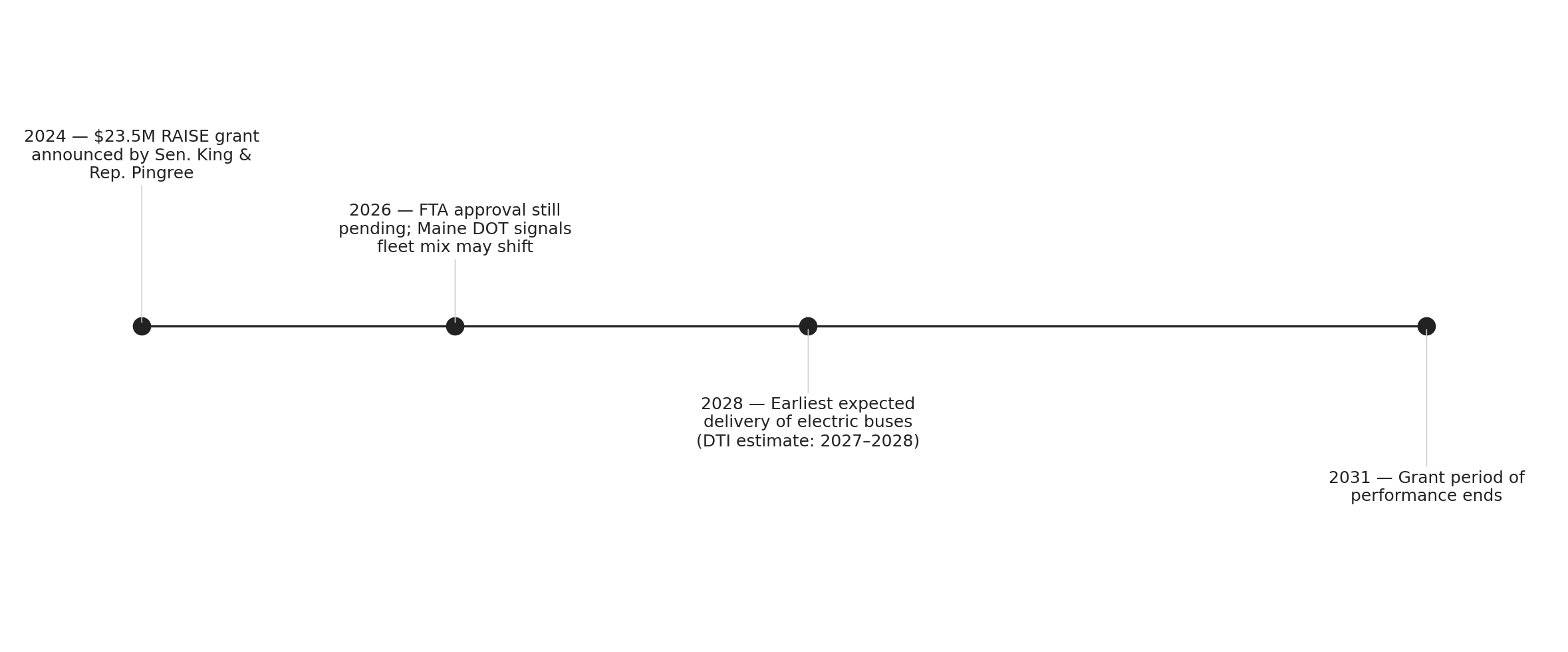
Maine's federal transit grant activity has surged 356% year over year, from $5.2 million in the same 90-day window last year to $23.5 million today, and almost every dollar of that increase traces to a single award: the "Electrify Downeast Acadia" RAISE grant, formally obligated May 18, 2026 to Maine DOT on behalf of Downeast Transportation Inc. The money is now in the bank. The electric buses it will buy are not expected to carry a single passenger until spring or summer 2028 at the earliest.
That gap is the story. Sens. Angus King (I-ME) and Rep. Chellie Pingree (D-ME) announced the $23.5 million award in June 2024, citing the Bipartisan Infrastructure Law's RAISE program, which distributes $1.5 billion annually through FY2026. The original project timeline envisioned funds available by July 2025 and electric buses in service by May 2027. Instead, Federal Transit Administration approval was still pending as of February 2026, formal obligation cleared ten months behind schedule, and DTI executive director Paul Murphy now puts fleet delivery somewhere between 2027 and 2028, with 2028 the more realistic target once manufacturing and delivery lead times are factored in.
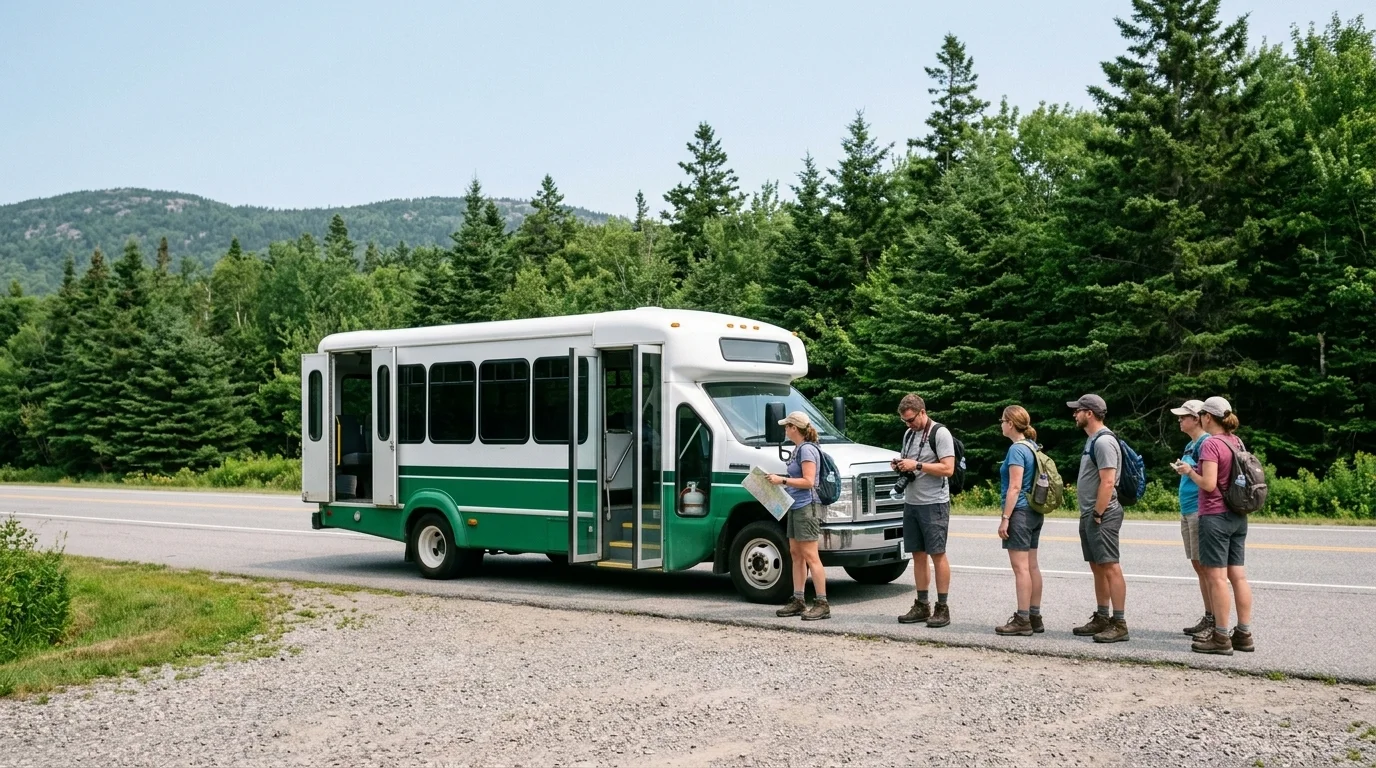
The Island Explorer is not an ordinary transit system. Operating seasonally from mid-June through early October across eight routes on Mount Desert Island, the propane-fueled shuttle has carried more than 9 million riders since its launch in 1999 and functions as essential traffic-relief infrastructure for Acadia National Park, one of the most-visited national parks in the United States. Without it, the narrow roads of Mount Desert Island would face gridlock during peak summer weekends. Replacing the fleet's 21 propane buses with roughly 23 electric vehicles and the charging infrastructure to support them would eliminate the system's largest operating cost and its most visible emissions footprint.
Source: NationGraph.
As of this summer, visitors boarding the Island Explorer are stepping onto the same propane buses that were supposed to begin retirement planning two years ago. Maine DOT transit coordinator Damian Veilleux acknowledged in February 2026 that the final fleet composition might still shift, noting that "as federal priorities, funding requirements, and vehicle costs evolve, the project may also include other non-diesel options such as hybrid or propane buses", a signal that even the electric-only commitment is not fully locked down.
The grant's financial structure adds some stability. The $23.5 million federal award is matched by $5.58 million from the National Park Service's Federal Lands Transportation Program and $300,000 from Friends of Acadia, bringing total project value to roughly $29.4 million. The grant runs through April 2031, giving Maine DOT a five-year runway to execute. But the clock is already running: procurement, manufacturing queues for electric buses, and charging infrastructure installation all take time that was originally supposed to be consumed before now.
Maine's 90-day surge in transit grant volume also puts the state well ahead of comparable New England peers. Connecticut received $11 million across nine grants in the same window; New Hampshire drew $4.9 million across five. Rhode Island recorded just $439,000. Maine's outperformance is essentially an artifact of a single large award finally clearing the pipeline, but the underlying portfolio is broader than that one grant suggests. The Greater Portland Transit District holds roughly $22.5 million across three active federal grants, and Casco Bay Island Transit District carries about $7 million more, bringing Maine DOT's active transit grant portfolio to over $55 million in currently-running federal commitments.
There is a parallel pressure building outside the park. Bangor bus ridership climbed 21% in the first quarter of 2026, a jump transit officials have tied directly to gasoline prices exceeding $4 per gallon statewide. Maine is the most rural state east of the Mississippi, and transit infrastructure outside Portland and Bangor is sparse. Downeast Transportation operates year-round commuter routes across Hancock County that most residents don't associate with the Island Explorer brand, and those routes are under the same pressure to modernize.
A separate $2 million state discretionary transit fund distributed this year across ten Maine agencies reflects how widespread that pressure has become. But the federal grant pipeline moves on its own schedule, as the Island Explorer project has demonstrated. The RAISE program has now distributed $7.2 billion nationally since its inception, and delays between announcement and obligation are not unique to Maine. What is unusual here is the size of the gap relative to the stakes: a park system that logged millions of riders on aging propane buses while the paperwork to replace them took two years to clear.
The next concrete milestone to watch is procurement. Maine DOT must now finalize vehicle specifications and issue a competitive bid for the electric bus contract. How long that process takes will determine whether Paul Murphy's 2027-to-2028 delivery window holds or slips further. Acadia's 2027 tourist season begins in June.