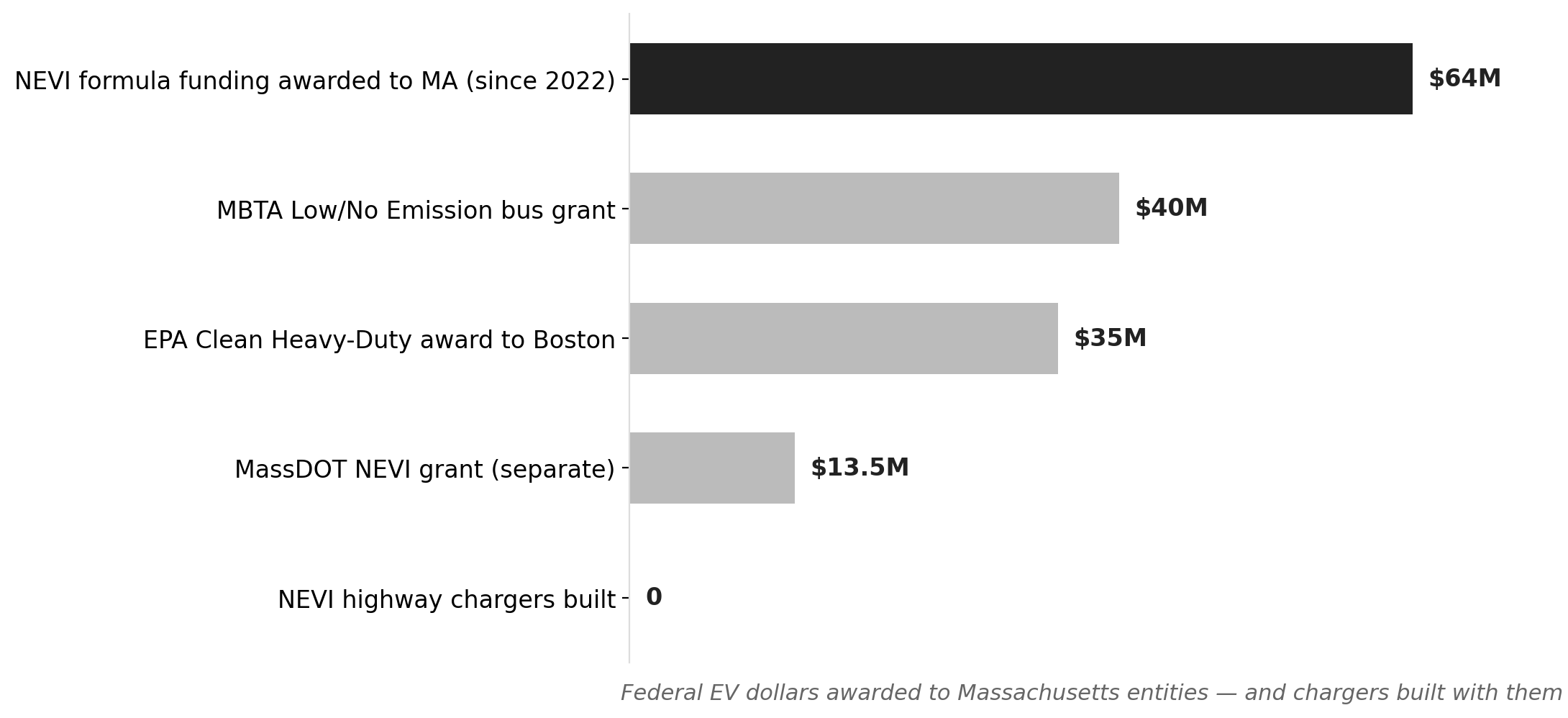
Massachusetts has issued 20 electric vehicle infrastructure RFPs in the last 30 days, twice its trailing 12-month average of roughly 9.8 per month, and almost none of that activity is happening where four years of federal policy said it would. The state holds approximately $64 million in NEVI formula funding awarded since 2022. As of June 2026, it has not installed a single NEVI-funded highway charger.
The acceleration is real, but its geography tells the story. The top issuers in the past 30 days are Watertown, the MBTA, Amherst, and Shrewsbury, not MassDOT. The state's own procurement apparatus issued exactly one explicit NEVI charging installation RFP during that window, dated May 27, 2026, with responses due October 31. That timeline means construction cannot realistically begin before early 2027 on any MassDOT-led corridor project.
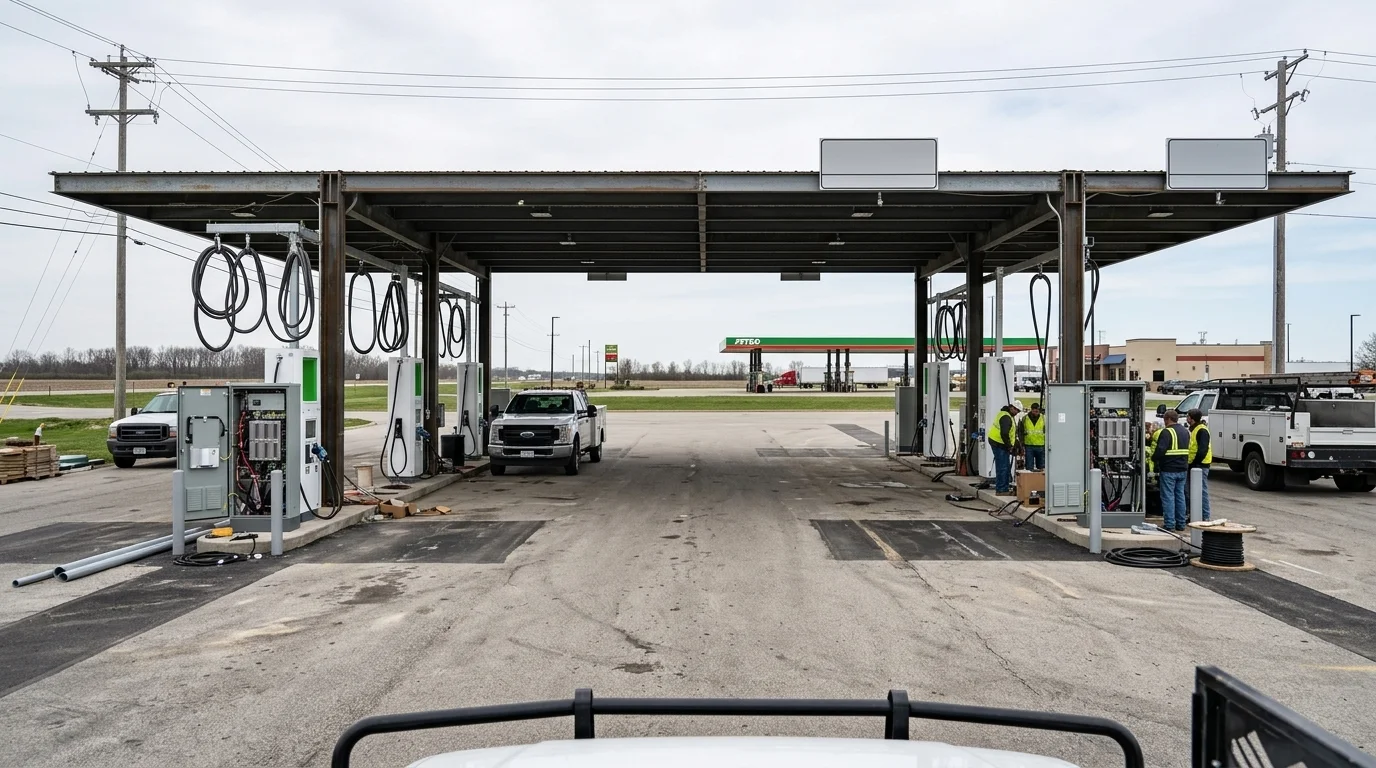
The reason for the detour is a combination of procedural failure and legal dispute. MassDOT selected two vendors, Applegreen and Global Partners, to build out NEVI sites along Massachusetts highways. A legal challenge from one vendor against the other, combined with a state inspector general finding that the underlying service-plaza contract contained too many procedural flaws to stand, forced MassDOT to rebid the entire highway service plaza contract. The highway charging program has effectively been frozen at the selection stage while that process restarts. Applegreen is now targeting a late July 2026 construction start at sites in Greenfield and Newburyport; Global Partners is finalizing plans for Lancaster, Wrentham, and Raynham. Those are the first physical NEVI chargers Massachusetts may ever see, and they are arriving nearly four years after the federal money was approved.
Source: NationGraph.
As a June 2026 investigation by Cambridge Day and CommonWealth Beacon documented, MassDOT declined to answer questions about the delay. Jim Aloisi, a former state transportation secretary and current MIT lecturer, called the slowness "mystifying." Eric Bourassa of the Metropolitan Area Planning Council said "everyone would agree that the pace of NEVI deployment in Massachusetts has been disappointing." Nationally, only 19 states have any operating NEVI charger at all, per the National Association of State Energy Officials, but Massachusetts's combination of aggressive EV mandates, substantial federal funding, and short highway corridors makes its absence from that list particularly hard to explain.
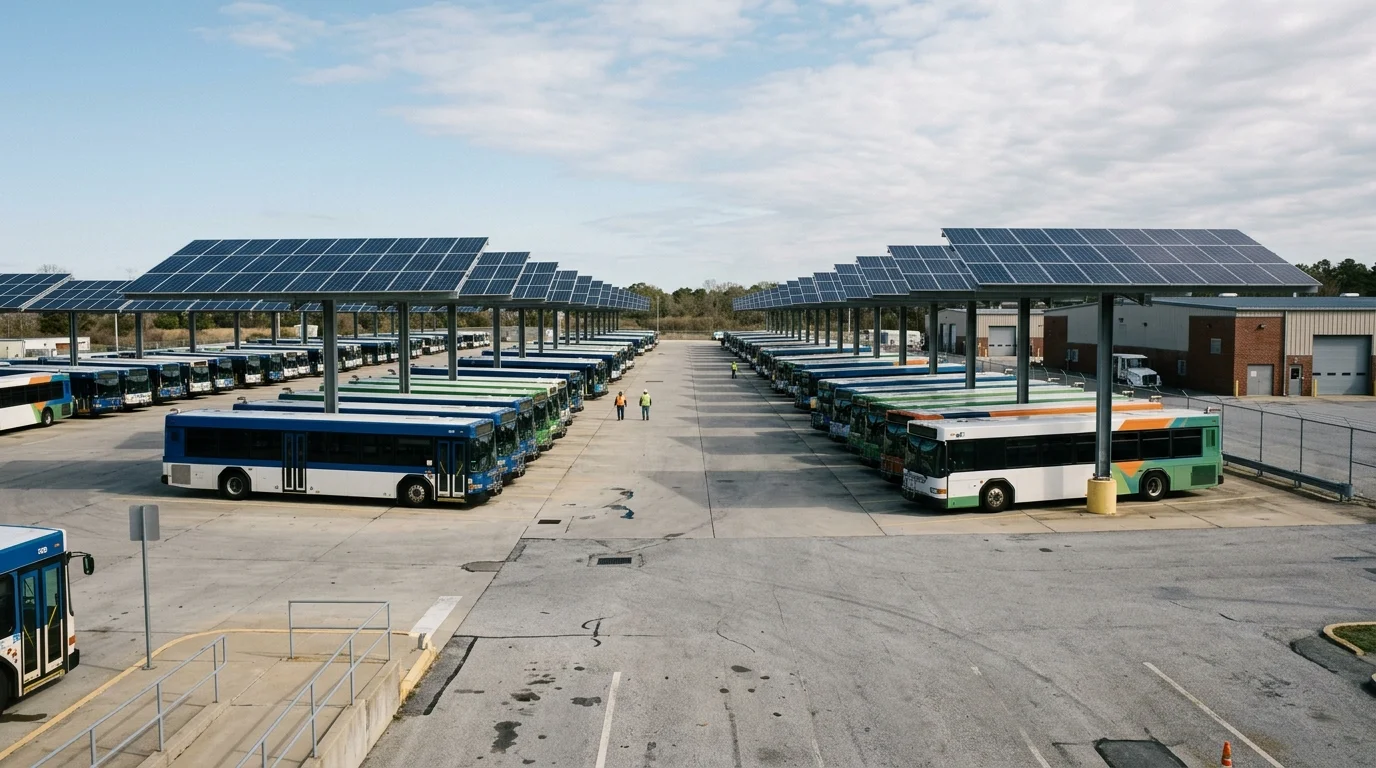
While the highway program has stalled, money has been flowing through parallel channels, and municipalities are spending it. MassEVIP covers up to 100 percent of Level 2 charger costs for public entities. The MBTA is procuring charging infrastructure for its Arborway Bus Maintenance Facility as part of a $40 million federal Low/No Emission bus grant running through 2029. Boston holds a $35 million EPA Clean Heavy-Duty Vehicles award, most of it still unoutlayed, with a 2026 deadline creating real urgency. MassDOT's $13.5 million NEVI deployment grant, awarded in December 2024, entered its active phase this spring, triggering site-specific equipment solicitations from both the state and municipalities downstream of state grant programs.
The result is a procurement surge that is structurally inverted from the original federal design. NEVI was built to fund direct-current fast chargers on highway corridors, the kind of 150-kilowatt infrastructure that makes long-distance EV travel viable. What Massachusetts is actually building, at speed, is a dense network of Level 2 and Level 3 chargers at bus depots, municipal parking facilities, and public works yards. That infrastructure matters for fleet electrification and local EV adoption. It does not solve the highway coverage gap that leaves Massachusetts drivers without a federally funded fast-charging option between the Rhode Island and New Hampshire borders.
Neighboring states have moved faster on exactly that gap. Rhode Island, Vermont, and New York all have operating NEVI chargers. Massachusetts's small geographic footprint, which should make corridor deployment simpler and cheaper than in larger states, has not translated into speed.
For residents and fleet managers, the near-term signal to watch is whether Applegreen's late-July construction target at Greenfield and Newburyport holds. Those would be the state's first highway DCFC sites under NEVI and would mark a concrete break from four years of inaction. The MassDOT NEVI EVSE solicitation due October 31 represents the next formal decision point for the broader highway program. If that deadline slips, or if the rebid service-plaza contract draws another legal challenge, the municipal procurement surge now underway may remain the primary story of Massachusetts EV infrastructure for another year.