Federal flood grants flowing into Louisiana have jumped 2,226% in the past 90 days, from $258,000 in the same window a year ago to $6.0 million today. The number sounds like a breakthrough. The fuller picture is more complicated.
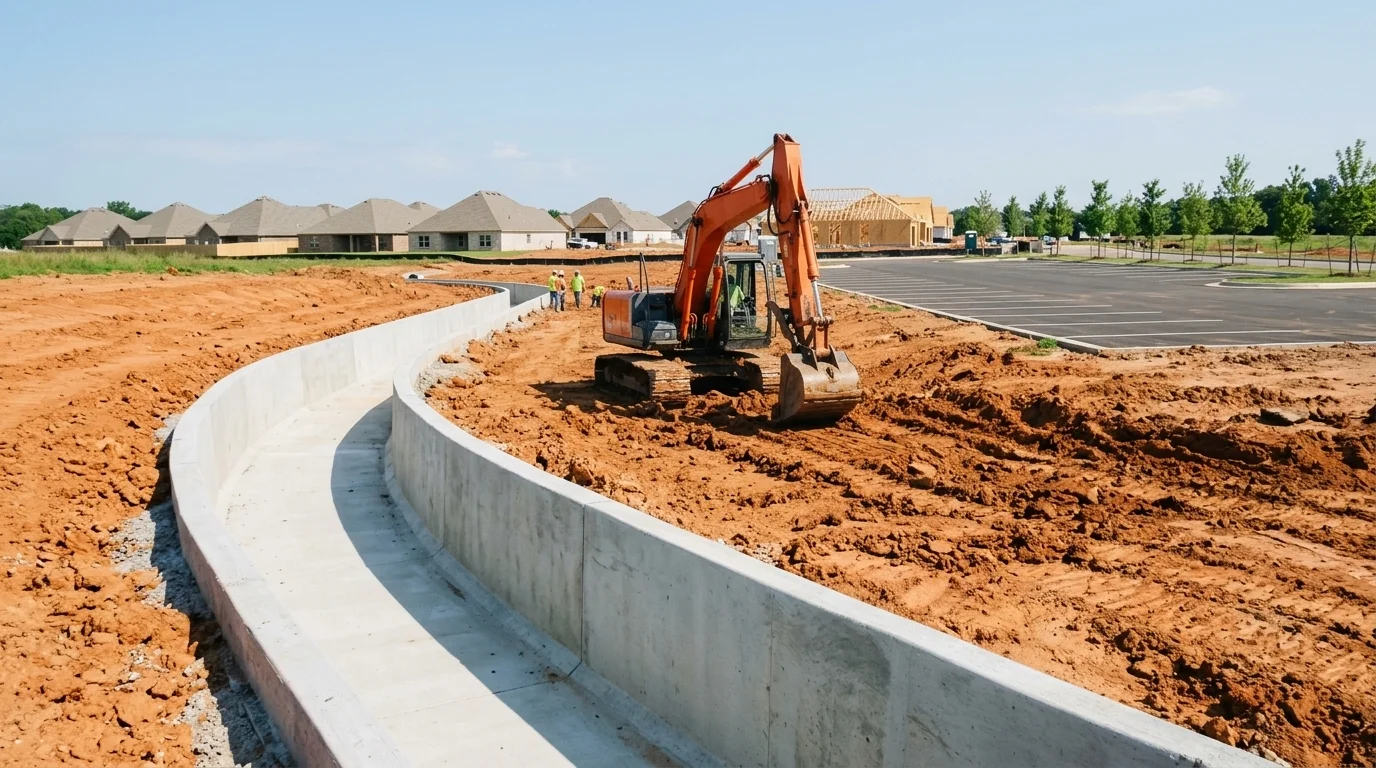
The surge is real, and it has a specific cause. On April 22, 2026, FEMA announced more than $250 million in national Flood Mitigation Assistance and Swift Current awards, the program's first major disbursement cycle after it was partially pulled from Grants.gov in March 2025 and relaunched under Secretary of Homeland Security Markwayne Mullin's directive to clear a backlog of pending mitigation grants. Louisiana's share of that announcement was direct: a $5.72 million FMA award to the Governor's Office of Homeland Security and Emergency Preparedness (GOHSEP), starting April 24, 2026 and running through April 2029. A $282,000 DOT PROTECT Act resilience grant to the Louisiana Department of Transportation and Development landed in the same window. FEMA's press release specifically named Louisiana as receiving more than $20.2 million to rebuild drainage infrastructure in a neighborhood with chronic flooding, including new diversion systems built into a local canal.
The awards reflect applications submitted well before the current administration took office. GOHSEP's FMA pipeline typically runs eight months from application to award, meaning the April 2026 disbursements are the downstream result of planning cycles that began in 2025 or earlier. This is not a new program; it is a stalled one finally moving again.
Source: NationGraph.
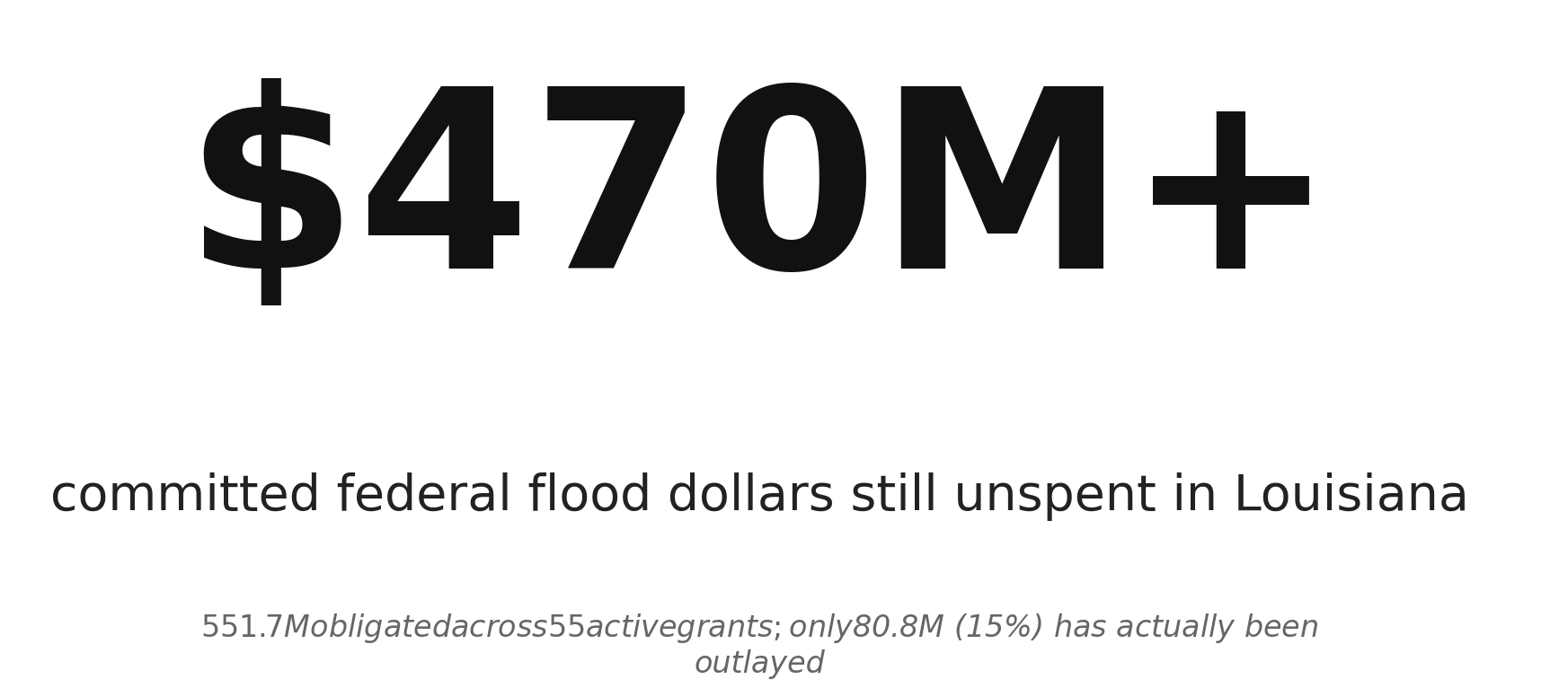
But the 90-day surge is almost beside the point when set against what already exists on the books. Louisiana currently holds 55 active federal flood grants with $551.7 million obligated. Of that, only $80.8 million, roughly 15 cents of every committed dollar, has been outlayed. More than $470 million in federal flood money is sitting in accounts, committed to Louisiana, waiting to become pumps and levees and elevated homes. That gap is the defining operational fact of the state's flood defense posture right now.
The scale of what Louisiana is attempting to manage is not accidental. The state drains roughly two-thirds of the continental U.S. watershed, has hundreds of miles of subsiding coastline, and holds more than 3,000 of the nation's top 10,000 repetitive-loss structures, more than any other state. Jefferson and Orleans parishes rank first and second nationally for repetitive-loss property counts, a distinction that reflects decades of flooding, repair, and flooding again. FEMA's own case studies on New Orleans document the scale of elevation and buyout work already completed there, and how much more remains.
The funding trajectory over the past two quarters signals genuine federal commitment. Louisiana took in $169 million in new flood grants in the fourth quarter of 2025 alone, anchored by a $122 million RESTORE Act tranche to the Coastal Protection and Restoration Authority. In January 2026, Senator John Kennedy announced $479.8 million in FEMA hurricane recovery grants covering five named storms: Isaac, Laura, Zeta, Ida, and Francine. The April 2026 FMA awards add another layer. What Louisiana is building, on paper, is the largest federal flood mitigation commitment in its history.
Among Gulf Coast peers in this same 90-day window, Texas leads new flood grant activity at $25.2 million and Florida is nearly even with Louisiana at $6.1 million. Louisiana's per-capita flood risk exposure, measured by repetitive-loss properties and coastal subsidence rates, still exceeds both.
The practical question the outlay gap raises is whether Louisiana has the administrative and contractor capacity to move $470 million through project design, permitting, procurement, and construction before the next major storm resets the clock. GOHSEP, the Coastal Protection and Restoration Authority, and LADOTD are the three agencies carrying most of that load. Each has a track record, and each is simultaneously managing new award cycles on top of existing ones.
The next signal to watch is not a grant announcement. It is the outlay rate: how fast that $470 million unspent balance shrinks over the next 12 months. If it doesn't move, the story of Louisiana's flood funding stops being about Washington's commitment and starts being about Baton Rouge's throughput. The April 2026 awards set a three-year clock for the GOHSEP FMA project. That deadline, April 2029, arrives before the next full hurricane cycle is likely to leave the state alone long enough to catch up.