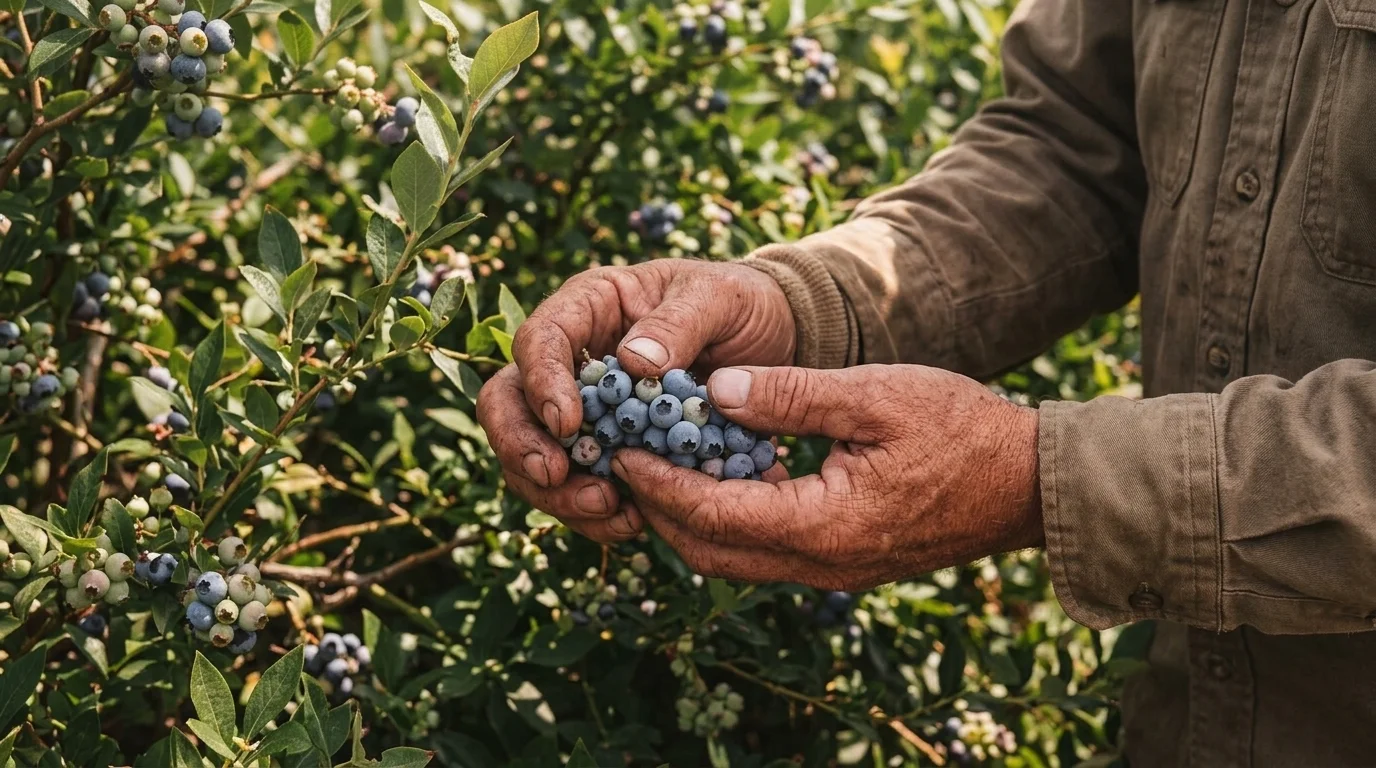
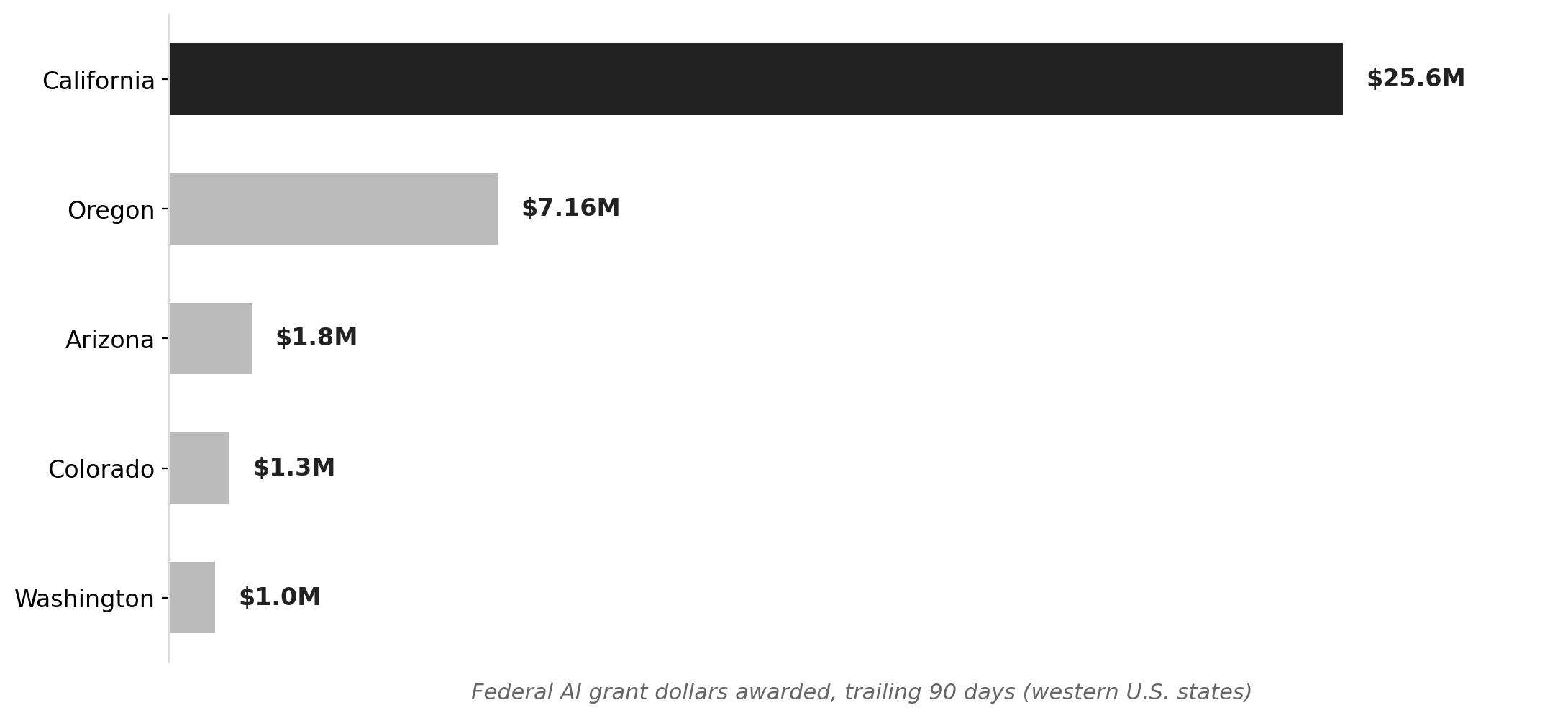
Federal AI grants flowing into Oregon have hit $7,158,496 in the trailing 90 days, a 923% jump from $700,000 in the same window last year. Nearly every dollar of that increase traces to a single award: a $6,958,497 USDA Specialty Crop Research Initiative grant to Oregon State University, which began July 1, 2026, and runs through June 2030. The mission is not to build a large language model or optimize a logistics network. It is to build an autonomous harvester that can pick a fresh-market blueberry without bruising it.
While federal AI policy debates have centered on semiconductor supply chains and foundation models, the largest federal AI check cashed in the western United States this quarter outside California went to a national team led by Dr. Wei Q. Yang of OSU’s North Willamette Research and Extension Center working on computer vision, horticulture, and the structural fragility of a piece of fruit. Oregon now ranks second in the West for AI grant volume over the past 90 days, behind only California's $25.6 million across 21 awards, and ahead of Arizona, Colorado, and Washington state combined.
The driver is structural, not coincidental. USDA's Specialty Crop Research Initiative, administered through NIFA, is authorized at up to $175 million per year nationally and explicitly targets the kind of high-labor, high-value crops that have been squeezed hardest by farm-labor scarcity. Oregon is the second-largest blueberry-producing state in the country. Fresh-market blueberry harvest, unlike processed-berry harvest, cannot tolerate the bruising and berry loss that mechanical harvesters inflict. Every pound for the fresh market still moves through human hands. With H-2A visa dependency rising and per-unit labor costs climbing, growers have been waiting on a autonomous solution that the market alone could not fund.
Source: NationGraph.
OSU did not arrive at this grant cold. The university was a core participant in the 20-million-dollar NSF and USDA AgAID Institute launched in 2021, which produced early fruit-picking and pruning robots for apples and blueberries across the Pacific Northwest. Its Collaborative Robotics and Intelligent Systems Institute in Corvallis has been developing AI-guided orchard equipment since at least 2020. That institutional track record is precisely what USDA's coordinated agricultural project mechanism rewards: not a new idea, but a proven team ready to scale one.
The July 2026 award is the federal government's largest single commitment yet on that research arc. A smaller, complementary piece also landed this spring: a $199,999 NSF Computer and Information Science and Engineering grant to OSU in April 2026, bringing the university's new AI commitments to just over $7.1 million in the quarter.
OSU's agricultural AI work sits alongside a parallel Oregon research corridor anchored by OHSU, which holds more than $22 million in active HHS grants touching AI and computer vision for biomedical applications. The two streams do not overlap much programmatically, but together they mean Oregon's AI research footprint is considerably larger than a simple ranking of recent awards would suggest.
The broader federal funding context makes the USDA channel more significant, not less. FY2026 appropriations cut NSF's budget by roughly 3 percent while defense R&D grew by nearly $5 billion. For land-grant universities without major defense research portfolios, USDA's specialty-crop programs represent one of the few expanding federal AI funding routes available. OSU's ability to capture the flagship award in that category reflects years of positioning, but it also reflects the relative absence of competition from coastal research universities less oriented toward agricultural systems.
For Oregon growers, the practical question is how quickly lab-scale robotics translate to harvest-season deployment. The grant runs four years, through mid-2030, which means the first commercially viable systems would realistically enter the market near the end of that window, assuming the engineering hurdles around gentle manipulation and real-time berry detection in variable light conditions are resolved on schedule. Blueberry growers in the Willamette Valley and the Coast Range foothills will be watching OSU's field trials closely; a successful system here would have direct applicability across Washington state, British Columbia, and Michigan, the other top fresh-market producers.
The next signal to watch is whether USDA's SCRI competition for fiscal 2027 produces a comparable coordinated project award, and whether OSU builds a multi-institution consortium around the blueberry platform to compete for it. The agency has signaled continued priority for labor-displacement technology in specialty crops. If OSU led research team delivers credible field results in years one and two, the odds of a follow-on award increase substantially, and Oregon's anomalous position near the top of the western AI grant rankings may turn out to be less of a one-quarter spike than the beginning of a sustained funding relationship.