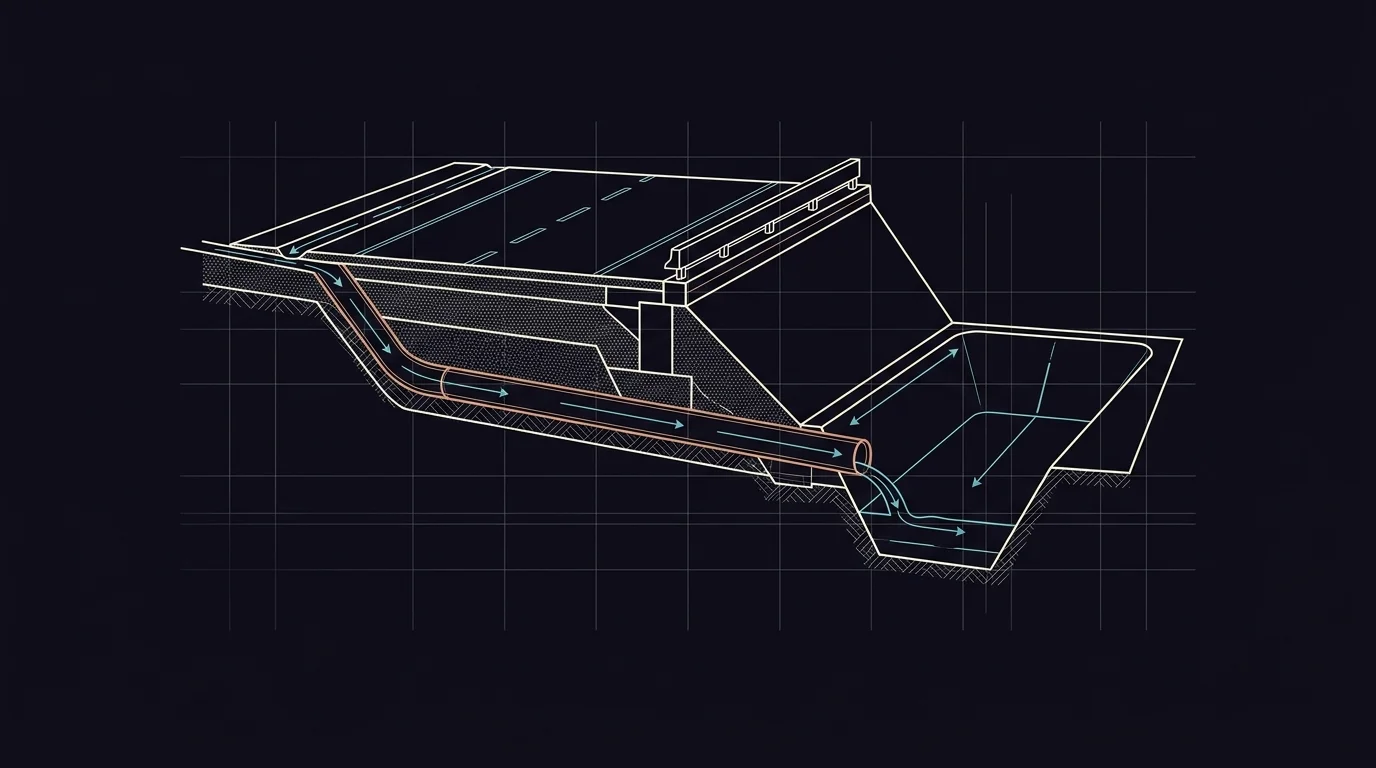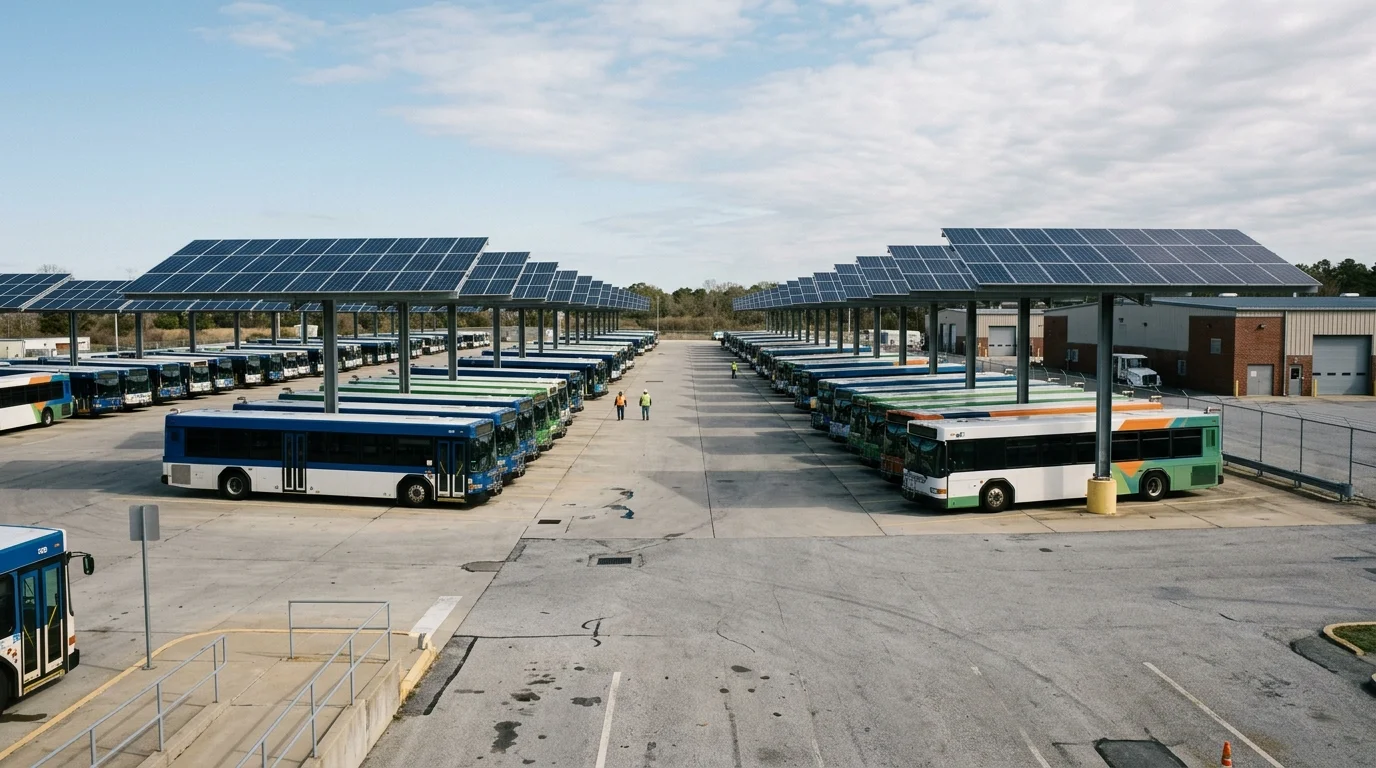
Federal solar grants flowing into Delaware have hit $9.8 million over the past 90 days, a 755% increase over the same window last year. The entire sum traces to a single Federal Transit Formula Grant awarded to the Delaware Department of Transportation on May 11, 2026. The project it funds: solar panels installed over bus canopies in Dover, plus a new battery-electric bus maintenance bay at DART First State's central operations facility.
That is not a small footnote. It is the story.
Delaware's SB 33, signed by Governor Carney on February 10, 2021, raised the state's Renewable Portfolio Standard to 40% renewables by 2035, with a 10% solar carve-out embedded in that target. For a state with no large uninhabited desert, no offshore wind portfolio yet online, and a land area smaller than many single counties in the American West, that mandate requires creativity. The 25% milestone under the prior standard falls due in 2026. The clock is running.
Source: NationGraph.
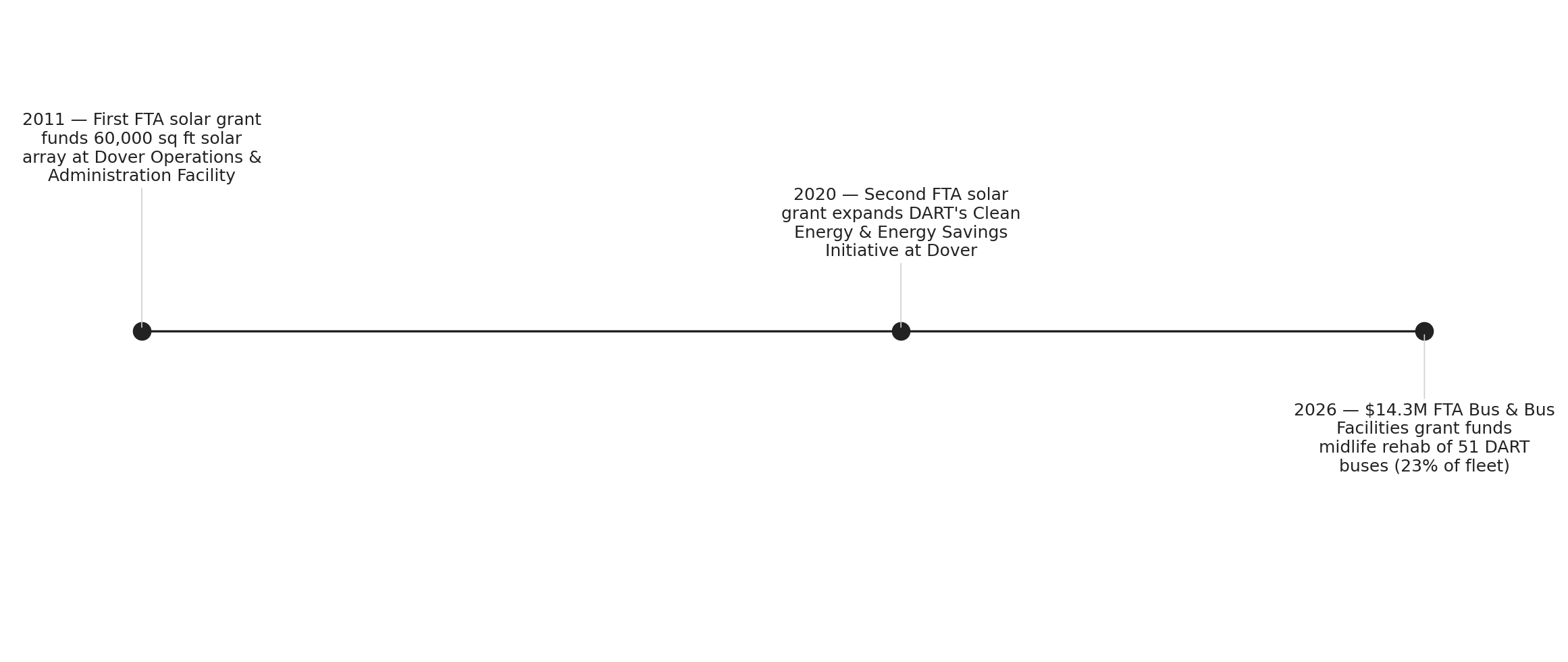
What DART First State offers is something most solar developers cannot: a state-owned, already-paved, already-staffed facility in the center of the state, sitting under open sky every night, where more than 100 buses park in predictable rows. DART's Dover Operations and Administration Facility already hosts a 60,000-square-foot solar array installed through earlier FTA grants in 2011 and 2020. The May 2026 award is the third layer of a 15-year solar buildout on the same footprint, this time extending coverage to the bus canopies themselves and pairing generation capacity with battery-electric vehicle infrastructure.
The FTA's Buses and Bus Facilities Program was not designed as a renewable energy tool. It funds transit capital: vehicles, maintenance facilities, passenger shelters. But its project eligibility is broad enough that a transit agency can bundle solar generation into a facility construction package, and DART has done exactly that across three separate grant cycles. The result is that Delaware's most reliable federal financing mechanism for solar capacity is not the Department of Energy or FEMA's resilience programs. It is the Federal Transit Administration.
The scale of Delaware's federal transit investment makes this clearer. A separate $14.3 million FTA Bus and Bus Facilities grant, awarded in March 2026, funds midlife rehabilitation of 51 DART buses, roughly 23% of the fixed-route fleet. Taken together, the two grants represent a coordinated federal-state strategy: harden the fleet, green the infrastructure, and generate solar capacity as a byproduct of the same capital projects.
No other Mid-Atlantic state received a comparable solar-tagged federal grant in the same 90-day window. Pennsylvania drew $533,000; Maryland, New Jersey, and Virginia drew nothing comparable. That gap is partly a function of Delaware's aggressive grant-seeking posture through DelDOT, and partly a function of DART's unique position as the state's only public transit system, making it a single point of coordination that larger, more fragmented transit networks cannot replicate.
The solar push is not confined to the DART campus. Delaware State University and the City of Newark both issued solar PV installation and feasibility RFPs in spring 2026. DNREC is running a $2 million DOE Renewable Energy R&D grant through 2027, focused on extending solar access to lower-income households, areas where rooftop ownership barriers have historically left residents outside the benefits of the state's renewable energy programs. The transit canopy model matters here: publicly owned generation capacity can, in principle, feed into programs that serve renters and lower-income ratepayers in ways that private rooftop solar cannot.
Delaware is also the lowest-lying state in the country. In a jurisdiction where climate-driven sea level rise is not a distant scenario but an active coastal management challenge, energy resilience and renewable transition carry the same urgency. A solar array on a bus canopy is not a symbolic gesture; it is generation capacity that keeps operating when the grid is stressed, paired with battery storage at the maintenance bay that can buffer demand spikes.
The next signals to watch are concrete. DNREC will publish its annual RPS compliance report later this year, which will show whether Delaware's utilities are on track for the 25% milestone. DART's construction timeline for the Dover canopy project will determine whether the new solar capacity comes online before or after that reporting window. And the FTA's next Buses and Bus Facilities funding cycle, expected in late 2026, will reveal whether DelDOT submits another bundled solar-transit package, continuing a grant strategy it has now run successfully three times in 15 years.