Six Minnesota municipalities issued their first solar procurement request in more than a year during July and August 2026, St. Paul, Stillwater, Brooklyn Center, the University of Minnesota, Bloomington, and North Mankato, and the timing is not a coincidence. For a narrow window this summer, a state grant covering up to 70% of installation costs and a federal tax credit covering another 30% to 70% were both available simultaneously, making solar installations on public buildings effectively free or near-free to local taxpayers. Both windows are closing.
The convergence has two gears. Minnesota's Solar on Public Buildings Grant Program, authorized under Minn. Stat. § 216C.377 and administered by the state Commerce Department, opened its third funding round on April 27, 2026, with $4.3 million available to local governments in Xcel Energy's service territory. Since the program launched in 2024, it has awarded more than $18 million in grants across 86 local governments, reaching 204 executed grant agreements. According to a Minnesota Commerce Department announcement, solar coordinator John-Michael Cross noted about 30 more projects are currently in the works. Simultaneously, the One Big Beautiful Bill Act imposed a July 4, 2026 construction-start deadline for commercial and public solar projects to lock in federal Investment Tax Credits worth 30% to 70% of project costs. Logan O'Grady, executive director of the Minnesota Solar Energy Industries Association, told the Star Tribune that "every member of the association that works in the commercial sector is rushing" to meet it, with at least $1 billion in Minnesota solar projects in the pipeline racing toward that date.
The municipalities issuing RFPs right now are not newcomers to the idea of solar. Most have spent years conducting feasibility studies or waiting for funding alignment. What changed this summer is that the state program's readiness-assessment process, which vets buildings for structural and electrical suitability before awarding grants, had already cleared these institutions. An RFP issued today by a program participant is a reliable signal that ground will break within months, not years.
Source: NationGraph.
The scale of individual projects varies widely, which is part of what makes the procurement wave legible as a policy response rather than organic market activity. Brooklyn Center's West Fire Station rooftop array and North Mankato's submission sit at the smaller end; the University of Minnesota's 60-kilowatt grid-tied arrays for its West Central Research and Outreach Center and St. Paul's Oxford Community Center microgrid project represent the larger, more complex end of the program's 40-kilowatt ceiling for grant eligibility. Olmsted County, an earlier grant recipient, received state funding for eight solar projects with a combined value of roughly $544,000, with 70% covered by state grants and an additional IRA direct-pay reimbursement anticipated in 2027, a template other counties are now following. Details on the Round 3 program structure are available in the Clean Energy Resource Teams program overview.
Neighboring states are not moving at the same pace. Wisconsin had three institutions and Iowa had two issue solar RFPs in the same 30-day window, compared to Minnesota's six. That gap reflects a structural difference: Minnesota's program is specifically designed to target local governments rather than utilities or developers, and its multi-round administration gives municipalities a predictable procurement calendar to plan around. Wisconsin and Iowa have no direct equivalent.
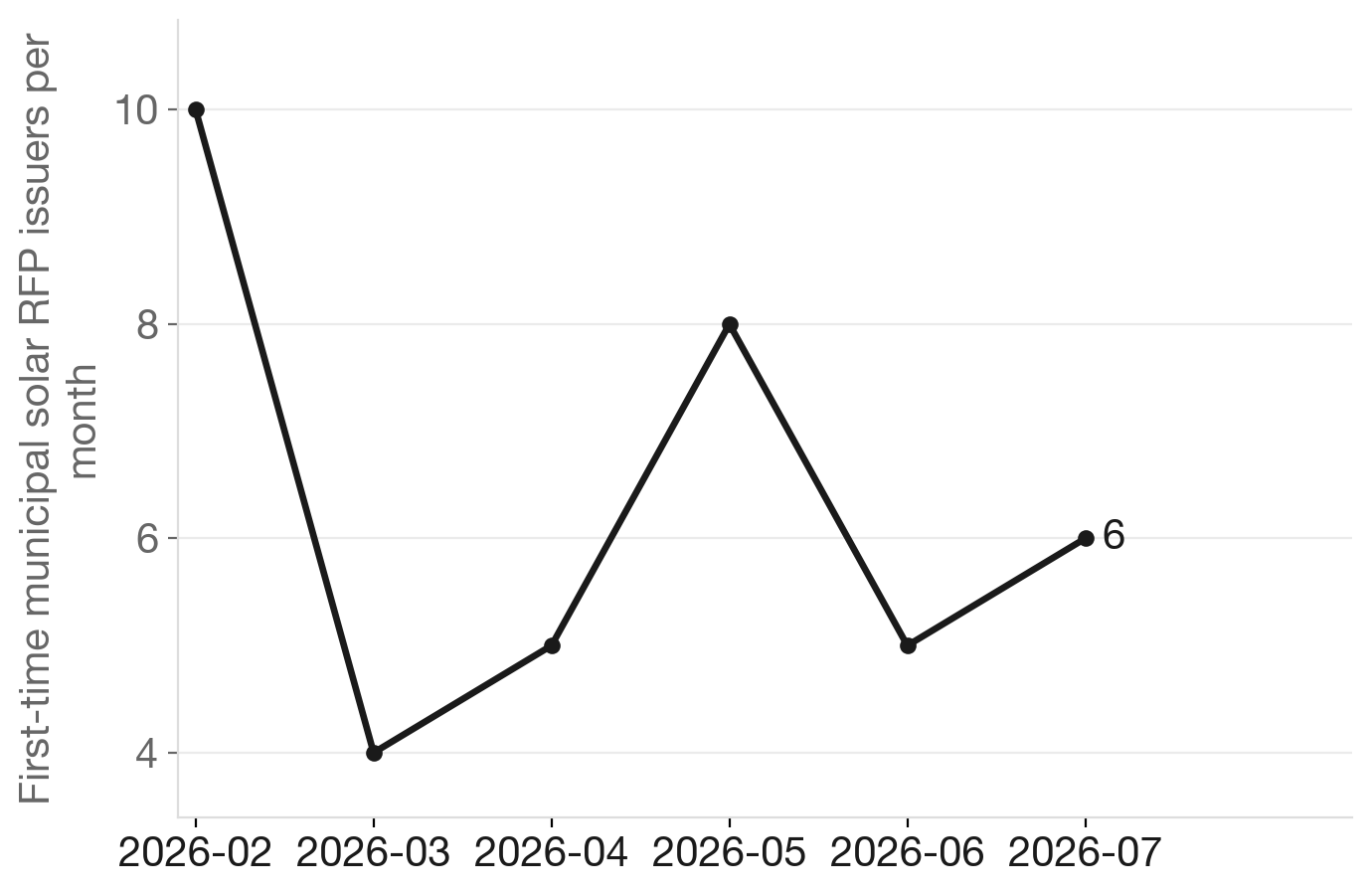
The sustained volume over six months reinforces that this is a wave, not a spike. February 2026 saw 10 Minnesota institutions issue solar RFPs; May saw 8; July added 6 first-timers. The MN Commerce Department's own statewide Solar on Public Buildings RFP, issued in May 2026, appears to be catalyzing downstream municipal activity as Round 2 grant-award winners move from planning to contractor selection.
For residents in affected municipalities, the practical consequence is construction activity on public buildings over the next 12 to 18 months and lower long-run utility costs for those facilities. The harder question is what happens to Round 4. Minnesota's 100% carbon-free electricity by 2040 mandate sustains political pressure for continued program funding, but the federal ITC window that made the math so favorable this summer has narrowed. Institutions that cleared the readiness-assessment process but missed the July construction-start deadline will face a different cost calculus when Round 4 opens.
The next signal to watch is the Commerce Department's Round 3 award announcement, expected later this year. How many of the 30-plus projects John-Michael Cross flagged as "in the works" convert to executed agreements will indicate whether the procurement sprint produced durable capacity or a one-cycle surge.