School-zone speed camera RFPs in Georgia roughly doubled in the last 30 days compared to the monthly average, and the agencies issuing them are not reacting to a spike in school violence. They are reacting to a law that just rewrote the rules of a multi-million-dollar enforcement market.
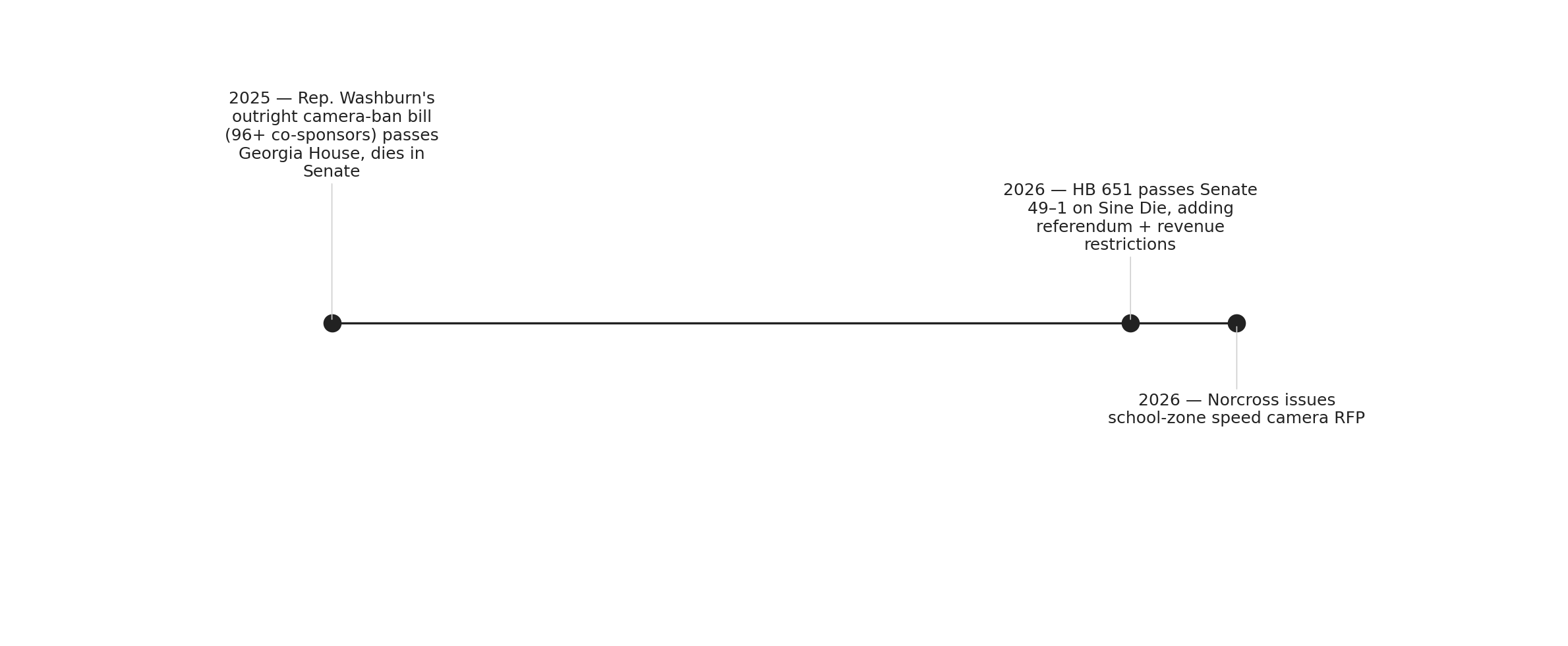
Governor Brian Kemp signed House Bill 651 in May 2026, effective immediately, after the Georgia General Assembly passed it 49-1 in the Senate on the final day of the 2026 session. The law mandates that any jurisdiction wishing to deploy or renew a school-zone speed camera contract must first win a local referendum, hold that vote every six years, and direct all citation revenue exclusively to school safety purposes: physical security, surveillance, crossing guards, visitor management, and mental health support. It also caps enforcement at one-hour windows around school start and end times and limits citations to drivers exceeding the posted limit by more than 10 mph. As CBS News Atlanta reported, the bill was a two-year legislative fight that ended with a compromise neither camera critics nor safety advocates fully embraced.
The procurement response was immediate. Gwinnett County issued multiple competitive iterations of its "Automated Speed Detection School Zone Safety Program on Annual Contract" (RP018-26) across April and May 2026, signaling active re-procurement in the state's most populous county. Brunswick (Glynn County) and Tifton issued their own school-zone camera RFPs in May. Norcross followed. The thread connecting all of them is timing: localities with existing camera programs, or those planning new ones, are now racing to establish contractual footholds before the referendum requirement forces a public vote they may or may not win.
Source: NationGraph.
This is a market scramble dressed in safety language. Georgia was already one of the most restrictive states in the country for automated speed enforcement, permitting cameras only in school zones while neighboring Alabama, Florida, Tennessee, and North Carolina allow broader deployment. HB 651 layers a referendum requirement on top of that already-constrained framework, making Georgia a national outlier and a potential template for camera-skeptic legislators elsewhere.
The backstory explains why the bill landed where it did rather than going further. Rep. Dale Washburn's 2025 outright-ban bill passed the House with 96-plus co-sponsors but died in the Senate. Camera vendors spent more than $728,000 on Georgia political committee donations in recent years, including more than $175,000 to Lt. Gov. Burt Jones, who presides over the Senate. The Georgia Virtue described HB 651 as "a far cry from prohibition", a reform that reformed the market without dismantling it. Advocates for Highway and Auto Safety urged Kemp to veto the bill, noting that Insurance Institute for Highway Safety data shows school-zone speed cameras reduce fatal and incapacitating crash likelihood by 19 percent. The referendum requirement, in their view, is a de facto barrier to a proven safety tool.
For residents in Gwinnett, Glynn, and Tifton, the procurement rush carries a practical implication: the camera programs operating near their children's schools may be locked into new multi-year contracts before anyone votes on whether they should exist at all. HB 651 requires referendums for new or renewed contracts, but the law's effective date creates an incentive to sign before the vote requirement fully materializes in local political calendars.
The next signal to watch is whether any locality schedules the first referendum under HB 651 before a camera contract is signed. If Gwinnett or another large county moves to a public vote, that outcome will set a precedent for every jurisdiction still weighing its options. A failed referendum in a high-traffic suburban county would effectively close the school-zone camera market in Georgia's most economically significant corridors. A successful one would validate the compromise and likely quiet the legislative push for an outright ban, at least for another session.
The vote hasn't happened yet. The contracts are already moving.