Seventeen California public agencies issued solar procurement solicitations in a single 30-day window, a burst that dwarfs anything happening in comparable states: Florida, New York, and Texas each had three institutions do the same. The institutions span 13 counties from Humboldt to San Diego and include school districts, wastewater authorities, a library district in Susanville, and a one-room school on the Big Sur coast. They don't share much, except one thing: a federal tax deadline most of their constituents have never heard of.
The forcing mechanism is a construction-start safe-harbor tied to the Inflation Reduction Act's elective pay provision. Under that 2022 law, tax-exempt public bodies, municipalities, school districts, special districts, can for the first time claim solar investment tax credits as a direct IRS cash payment rather than a tax offset they have no use for. The credit runs 30 percent or more of project cost. But to lock in eligibility, agencies must have at least 5 percent of project costs "incurred" and construction meaningfully underway by July 4, 2026. Miss that window and the full credit is at risk. As the California School Boards Association warned in March 2026, "local educational agencies hoping to benefit from current federal funding programs… need to act quickly."
That warning landed. San Diego Unified, one of the largest school districts in the state, issued a district-wide solar maintenance solicitation. Santa Monica-Malibu USD followed. Big Sur Unified went out for an off-grid electrical upgrade at Pacific Valley School, a facility so remote that grid reliability has long been an obstacle. West County Wastewater District and Redwood Coast Energy Authority, a regional clean energy body in Humboldt County, both entered the market in the same stretch. These are not agencies that typically move in unison.
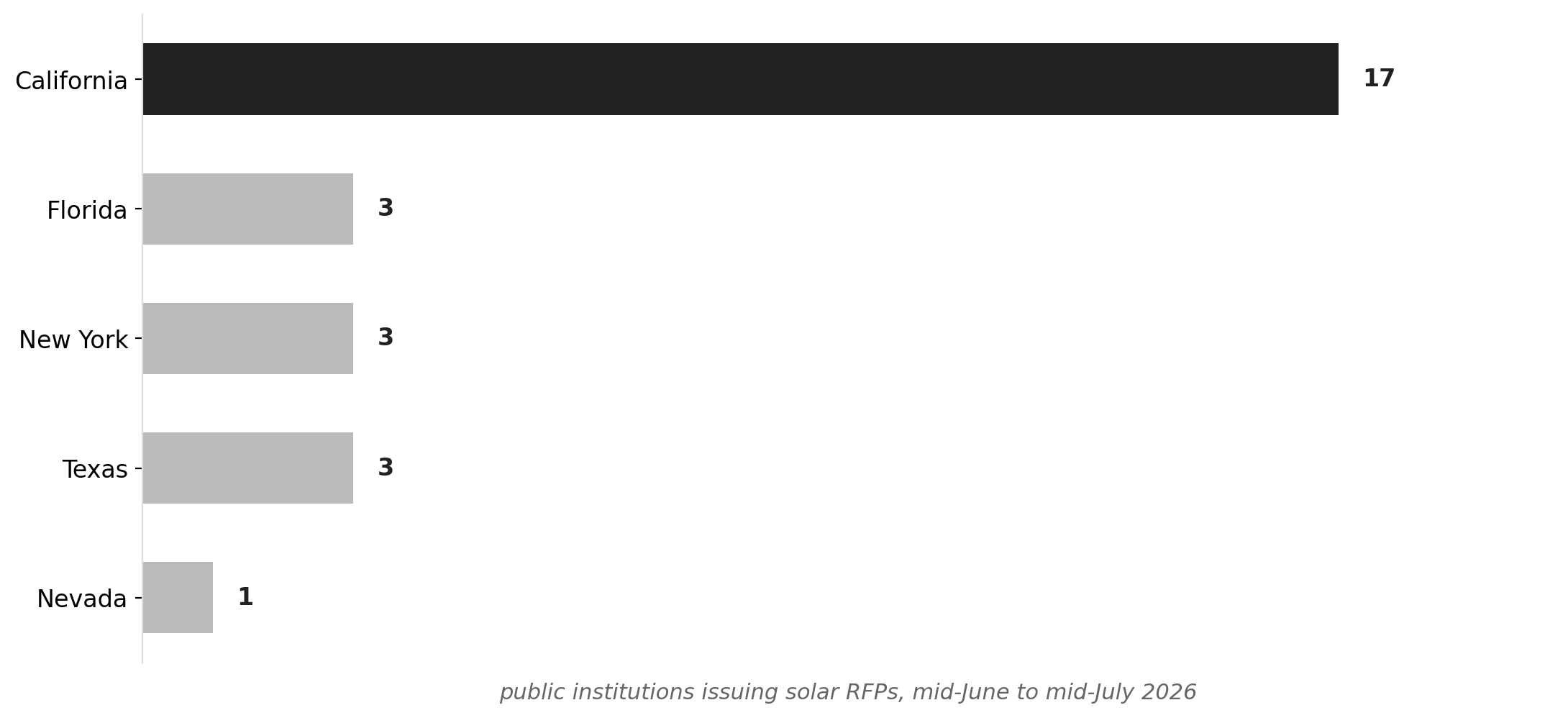
Source: NationGraph.
The scale of California's response compared to other states reflects something structural, not just enthusiasm. California has roughly 3,000 independent special districts, a figure that exceeds most other states by an order of magnitude. Library districts, cemetery districts, recreation districts, resource conservation districts: each is a separate legal entity, each is now eligible for direct IRA payments, and each faced the same July 4 deadline. The addressable market for this procurement wave is simply larger here than anywhere else, which is why 17 agencies mobilized while Texas managed three.
The IRA direct-pay mechanism, formalized under EPA guidance on elective pay for green power, is the first federal solar incentive engineered specifically for entities that pay no income tax. Before 2022, a school district that wanted solar had to either find a tax-equity partner willing to structure a third-party ownership deal, or forgo federal incentives entirely. Direct pay eliminates that friction. The IRS sends a check. What changed this spring is that the construction-start clock made the incentive time-sensitive in a way it hadn't been before.
California's regulatory environment added pressure from a second direction. The CPUC's February 26, 2026 Integrated Resource Planning decision required that all new clean energy procurement under its jurisdiction be fossil-fuel-free, closing off gas-hybrid options that some agencies had been considering as fallbacks. And Title 24, the state's building energy code updated effective January 1, 2026, now requires solar paired with battery storage for new nonresidential construction, pushing even agencies building new facilities toward solar as a code floor rather than an elective choice.
None of this means California agencies were sitting idle before this sprint. Monthly RFP issuance held elevated through February through May 2026, suggesting that procurement officers were already working the pipeline. The July 4 deadline is pulling forward activity that would otherwise have drifted into a slower summer and fall, compressing what might have been a 12-month procurement cycle into a few weeks of parallel solicitations.
California already leads the nation with more than 49,000 MW of installed solar capacity, but that base is overwhelmingly utility-scale and privately financed. The public-agency tier, the school with leaking portables, the wastewater plant on a fixed operating budget, the library branch in a high-desert county seat, has lagged precisely because the incentive structure wasn't built for entities without tax liability. The current sprint is the first large-scale test of whether direct pay can unlock that tier at scale.
The next signal to watch is not another wave of RFPs but what happens to the ones already issued. Agencies that get bids back in time, negotiate contracts, and make the 5 percent incurred-cost threshold by July 4 will lock in credits that could cover nearly a third of their project costs. Those that slip past the deadline face a harder calculation: proceed at full cost, restructure as a third-party ownership deal, or wait for the next legislative vehicle. The IRA's direct-pay window does not have a guaranteed renewal, and Congress has not signaled one.