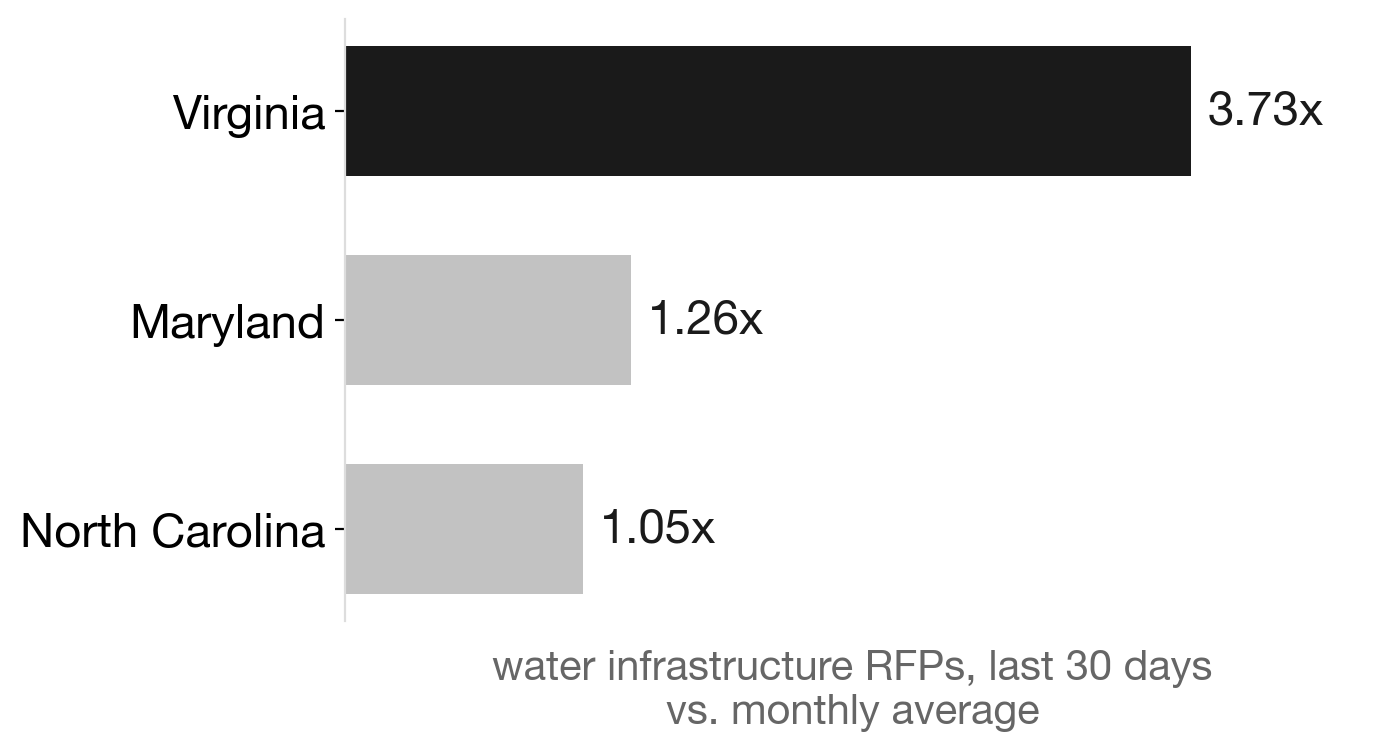
Virginia localities issued 14 water infrastructure RFPs in the past 30 days, a pace 3.7 times the state's genuine monthly average and nearly three times the activity level of neighboring Maryland (1.3x) and North Carolina (1.1x). The surge is not a coincidence. September 30, 2026, is the final day of IIJA supplemental appropriations for the Clean Water and Drinking Water State Revolving Funds, and the clock is running hard against a $637 million active EPA grant portfolio to the state in which only $99.9 million has actually been outlayed.
The math is stark: more than $537 million in federally obligated water dollars is still moving through Virginia's pipeline, and it needs to reach local procurement before the largest single water-funding era in a generation closes with no replacement legislation on the horizon.
The IIJA, enacted in 2021, quadrupled annual federal SRF capitalization from roughly $2.7 billion to $11.4 billion nationally. FY2026 is the final year of that supplemental run, and in May 2026 EPA announced $2.9 billion nationally for lead service line replacement under the Drinking Water SRF, the last annual tranche under the act. Virginia's share matters especially because the state holds an estimated 200,000 lead service lines, and Richmond alone is actively pursuing an additional $20 million from the Virginia Department of Health specifically for lead pipe replacement in 2026.
Source: NationGraph.
A 53 percent national drop in water project awards during the first half of 2025, driven by federal staffing reductions and regulatory uncertainty, created a backlog that is now clearing in a very compressed window. Virginia's DEQ closed the VCWRLF FY2026 application window on July 25, 2025, and the awards from that cycle are now flowing into local procurement pipelines, which explains much of the activity visible in the RFP data.
The entities moving fastest illustrate where the pressure is greatest. Henrico County leads all Virginia jurisdictions with four active RFPs, including a bond-funded park water project. Amherst County and its Service Authority account for three RFPs centered on advanced metering infrastructure, a category that layers federal water efficiency dollars on top of SRF loan eligibility. Hanover County has entered procurement on Phase 1 of its Hickory Hill water improvements. These are county-level governments and water authorities, not large urban utilities, which signals that smaller systems, historically slower to navigate federal grant requirements, are now moving because the deadline leaves them no room to wait.
Behind the RFP activity sits Virginia's grant disbursement structure. The Virginia Department of Health holds $260 million in obligated EPA grant funds; the Virginia State Board of Health holds $186 million; Virginia DEQ holds $177 million. Those three intermediaries together account for the bulk of the unspent pipeline, and the pace at which local governments can get projects into contract will determine how much of that money actually reaches the ground before authorization lapses.
Virginia's largest SRF borrower, Hampton Roads Sanitation District, offers a data point on what structured use of this funding window can accomplish. HRSD recently secured $60 million in SRF financing at below-market rates, and a January 2026 Old Dominion University study found that HRSD's combined SRF and WIFIA financing strategy saved ratepayers $390 million compared with conventional bond financing. That kind of outcome requires years of preparation, which is precisely the capacity smaller county systems lack, making the current sprint more difficult for the jurisdictions that need the dollars most.
No reauthorization bill has been introduced in Congress as of spring 2026. Analysis from multiple budget and infrastructure research groups suggests that base SRF capitalization after September 30 reverts to pre-IIJA levels, roughly a 75 percent reduction in annual federal water investment. Virginia has no state-level funding mechanism large enough to fill that gap: there is no Virginia equivalent of the IIJA supplemental appropriation waiting in reserve.
For residents in the localities now issuing RFPs, the immediate signal is that work is coming, waterline replacements, metering upgrades, treatment improvements, some of it long deferred. The question that will determine how much gets done is whether local procurement offices can move from RFP to awarded contract fast enough to satisfy federal obligation deadlines before the window shuts. For anyone watching Virginia's water systems, the RFP count over the next 60 days is the number to track.