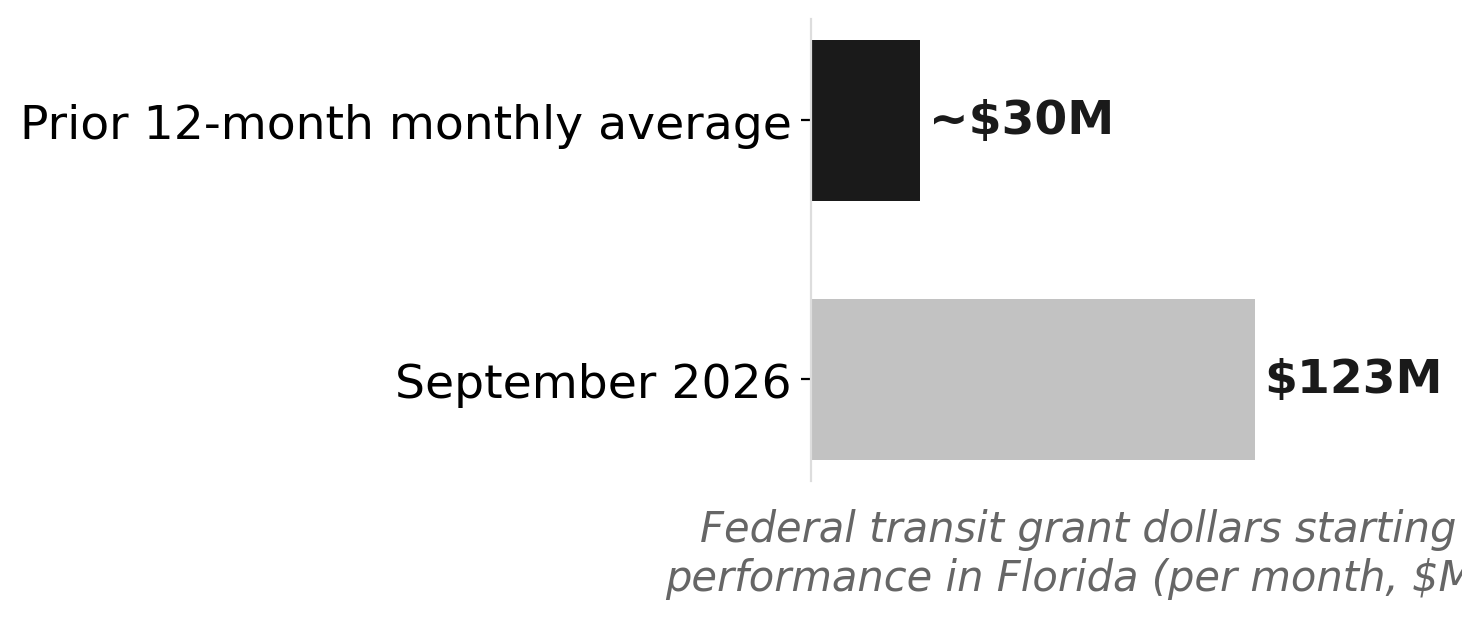
Thirty-three federal transit grants totaling $123 million started performance in Florida in September 2026 alone, roughly three times the monthly pace of the preceding year, because today, September 30, 2026, is the last day of the Infrastructure Investment and Jobs Act, and dozens of agencies needed their paperwork signed before the clock ran out.
The surge is not coincidental. The IIJA, signed in November 2021, authorized five years of expanded federal transit formula funding across three distinct programs: Section 5307, which sends urbanized-area formula dollars to large transit systems; Section 5311, which funds rural transit for communities under 50,000 residents; and Section 5339, a competitive bus-fleet program that financed new vehicle purchases at agencies that had never previously qualified for that level of capital support. All three programs share the same authorizing statute and the same expiration date. Congress has not introduced a replacement surface transportation reauthorization bill, and as Transportation for America reported in July 2026, a full reauthorization before this deadline was definitively off the table.
The result is a genuine cliff, not a routine funding rollover. When the IIJA lapses, formula apportionments revert to pre-2021 authorization levels, and competitive discretionary programs stop issuing new awards until Congress acts. The FTA's grant management system, TrAMS, was simultaneously closed for fiscal year-end financial reconciliation, compressing the effective signing window into the final weeks of September.
Source: NationGraph.
Florida's September grant stack reflects both the scale of the law and the scramble to capture it. The Florida Department of Transportation anchored the month with a $58.1 million Section 5307 urbanized-area formula grant starting September 9, running through June 2035. Palm Beach County secured $25.4 million under the same program on the same date. Those two awards alone account for more than two-thirds of the month's total, and they fit the familiar profile of large agencies with established grant relationships.
What makes this cycle notable is the tier below them. Indian River County received a $7.7 million Buses and Bus Facilities grant for new fleet acquisition. Lakeland Area Mass Transit District took $4.1 million. Okaloosa County drew $2.8 million. Citrus County, $2.2 million. Several of these are mid-size or rural systems that entered the federal transit grant pipeline in earnest only because the IIJA's expanded Section 5311 rural formula and competitive bus programs made awards viable at their scale. Brevard County added $8.1 million. In aggregate, the smaller counties represent a new layer of transit investment that simply did not exist at this volume before 2021.
The FTA's FY2026 formula apportionment announcement, issued March 31, 2026, under Public Law 119-75, released $20.6 billion nationally and effectively started the countdown. The final IIJA-era competitive Bus and Bus Facilities notice of funding opportunity closed September 21, leaving agencies nine days to finish grant paperwork before the fiscal year ended. For rural operators navigating TrAMS for the first time, that was a tight window.
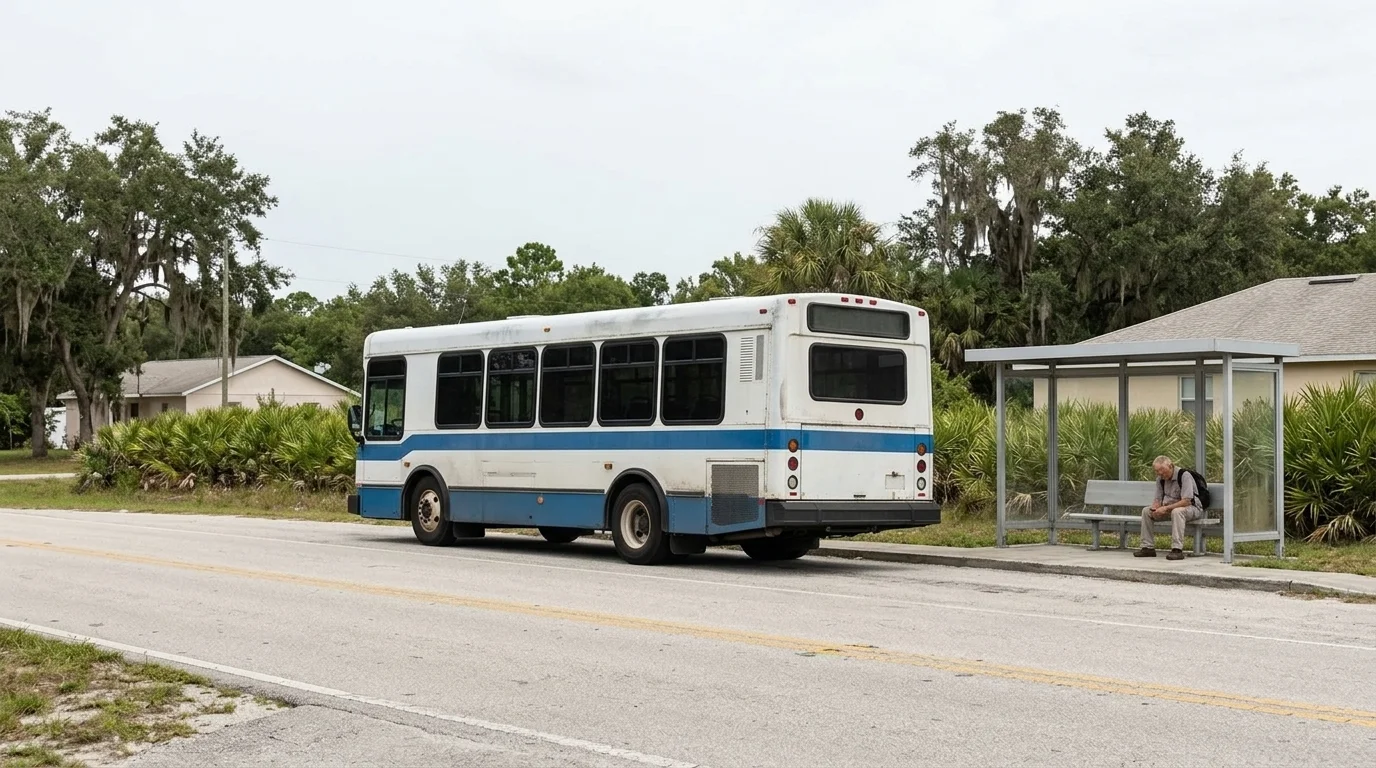
Florida's total estimated IIJA transportation formula allocation over the law's five years is $16.7 billion across all modes, according to the Florida Department of Transportation's tracking of the Bipartisan Infrastructure Law. Transit is a fraction of that figure, but it is the fraction most acutely felt by the elderly paratransit riders in Citrus County and the fixed-route bus passengers in a fast-growing metro like Port Saint Lucie, where a multimodal intersection project signals the kind of first-time federal procurement that the IIJA made possible.
The downstream procurement activity that followed the grant awards, the RFPs issued by localities in the past 30 days for bus purchases, facility upgrades, and planning contracts, reflects agencies converting paper grants into actual contracts. That activity will continue into 2027 because the grants signed this month have multi-year performance periods. But the grant-start pipeline itself closes today. Without a reauthorization bill, there is no mechanism for a comparable October surge.
The question for Florida's transit systems is what Congress does next. An extension of unknown length is the most likely near-term outcome, according to transportation policy analysts, but extensions typically hold funding at current nominal levels without the IIJA's additional authorized amounts. For Okaloosa County or Indian River County, systems that have just begun to build the institutional capacity to manage federal transit grants, the difference between an extension and a full reauthorization will show up in whether the bus they ordered this fall has a successor vehicle in the procurement pipeline five years from now.
The next signal to watch: whether Congress passes a continuing resolution that includes a surface transportation extension before the end of calendar year 2026, and whether that extension preserves the competitive bus and low-emission programs or lets them lapse while maintaining only the formula baseline.