More than $55 million in federal school mental health grants landed in Florida school districts starting January 1, 2026, the largest single-window infusion the state has seen since Congress created these programs in the aftermath of the 2018 Parkland shooting. The surge did not happen because Washington prioritized Florida. It happened because federal courts forced the Education Department to undo a cancellation it had already made, and because the department simultaneously ran a brand-new competition, and Florida was positioned to win under both.
The backstory runs through April 2025, when the Trump administration canceled roughly 260 school mental health grants across 49 states, citing DEI-related language in some applications. Sixteen states sued. By October 2025, a court had issued a preliminary injunction; in December, Judge Kymberly Evanson issued a permanent order requiring full reinstatement. The 9th Circuit upheld that order in March 2026. Simultaneously, the Education Department in December 2025 launched a separate $208 million new competition under revised Trump-era priorities, barring language around gender ideology or racial stereotyping. Florida received awards under both streams.
Florida did not join the 16-state lawsuit. It did not need to. Its grants were reinstated as part of the court's sweeping order, and its new applications cleared the revised ideological requirements because Florida's school safety grant infrastructure predates the Biden-era criteria the administration found objectionable. The state that generated the political pressure for these programs in the first place ended up an unintentional double beneficiary of the legal and bureaucratic collision that followed.
Source: NationGraph.
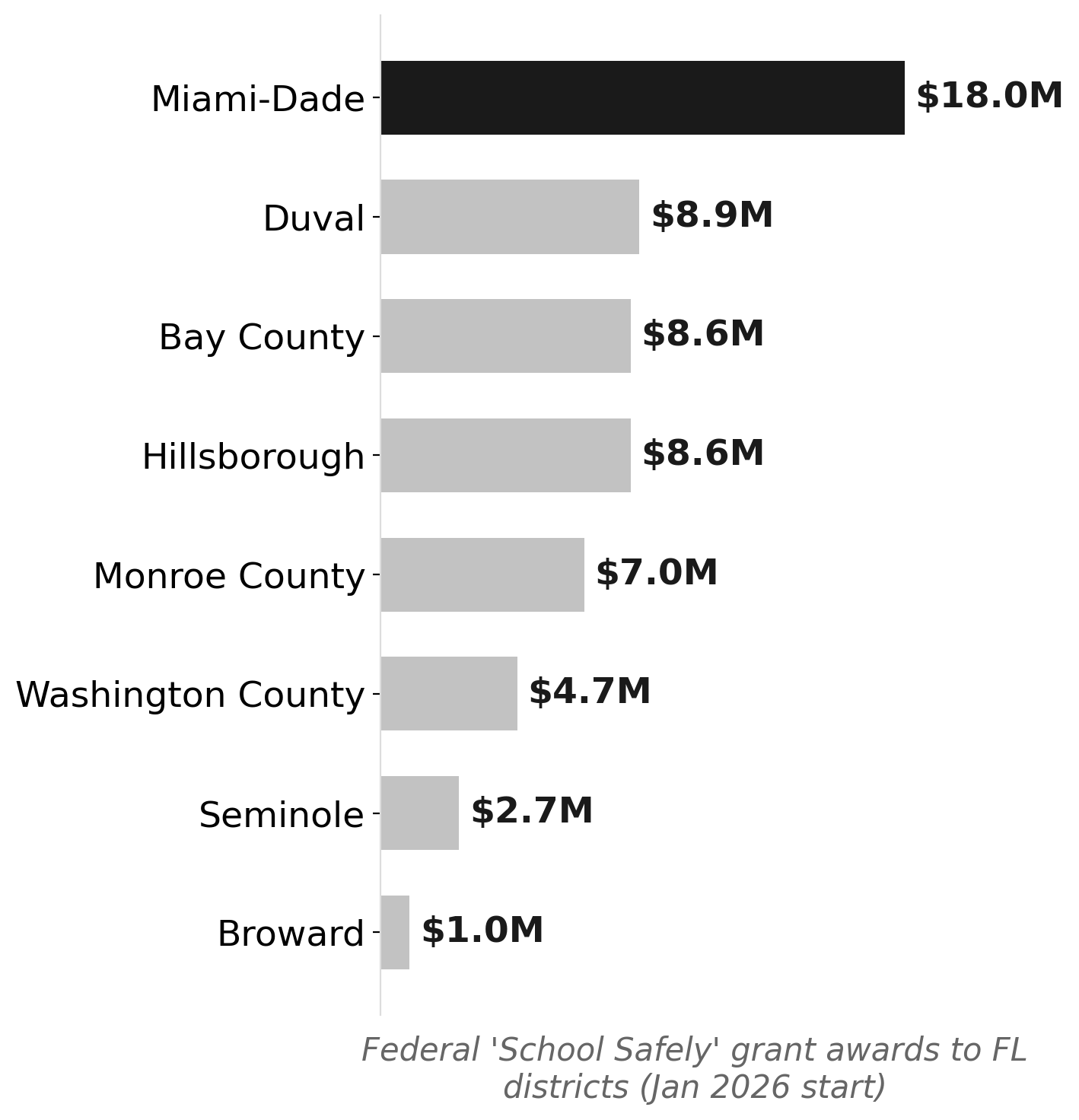
The numbers reflect that position. Miami-Dade County pulled in $18 million across two awards: a $15 million recruitment-and-retention grant to expand the pipeline of school mental health professionals and a $3 million school psychology grant. Hillsborough and Bay counties each received $8.6 million for school-based mental health services. Duval County captured $8.9 million across two awards. Monroe County, which covers the Florida Keys, received $7 million, and Washington County, a rural panhandle district, received $4.7 million. Seminole and Broward counties added $2.7 million and $1 million respectively. These are not incidental grants; they are multi-year awards under the Department of Education's School Safety National Activities program, created by Congress after Parkland and expanded after the 2022 Uvalde shooting.
Why Florida and not other states? Part of the answer is institutional depth. The state's own Mental Health Assistance Allocation, a state appropriation distributed by formula to all 67 school districts, has grown from $75 million at its 2019-20 launch to $180 million in fiscal year 2025-26. That investment built the administrative machinery, the trained staff, and the grant-writing experience that competitive federal awards require. Districts competing for a $8.6 million federal grant are not starting from scratch if they already operate a multimillion-dollar state-funded mental health program. Federal dollars land on infrastructure, not into a vacuum.
The December 2025 new competition also appears to have deliberately targeted rural and underserved districts. Monroe County's $7 million award and Washington County's $4.7 million are striking because smaller districts almost never win at this scale against urban applicants. If that targeting was intentional, it adds a separate policy dynamic to the Florida story: the same competition that barred DEI language may have redirected resources toward geographic equity.
For students and families, the practical effect is more counselors, psychologists, and mental health professionals in school buildings, funded through at least the term of each multi-year award. The state's parallel MHAA funding guarantees a floor regardless of what happens at the federal level. But a second round of grant-cancellation litigation filed in July 2026 by 15 states signals that the federal picture remains unstable. The Trump administration's posture toward these grants has not resolved; it has been overruled, and the legal standoff is ongoing.
For district administrators, that uncertainty is the most important signal to track. The court orders currently protecting reinstated grants are subject to further appeal. A new cancellation attempt, a different legal theory, or a congressional rider could alter the funding environment before multi-year awards reach their end dates. Districts that used federal grants to hire permanent staff are exposed to that risk in a way that formula-funded state allocations are not.
The next moment to watch is how the Education Department responds to the July 2026 lawsuit and whether it attempts another round of grant conditions or cancellations before the current court orders are fully litigated. Florida districts won this round. Whether that holds depends on proceedings in courts that have nothing to do with Florida at all.