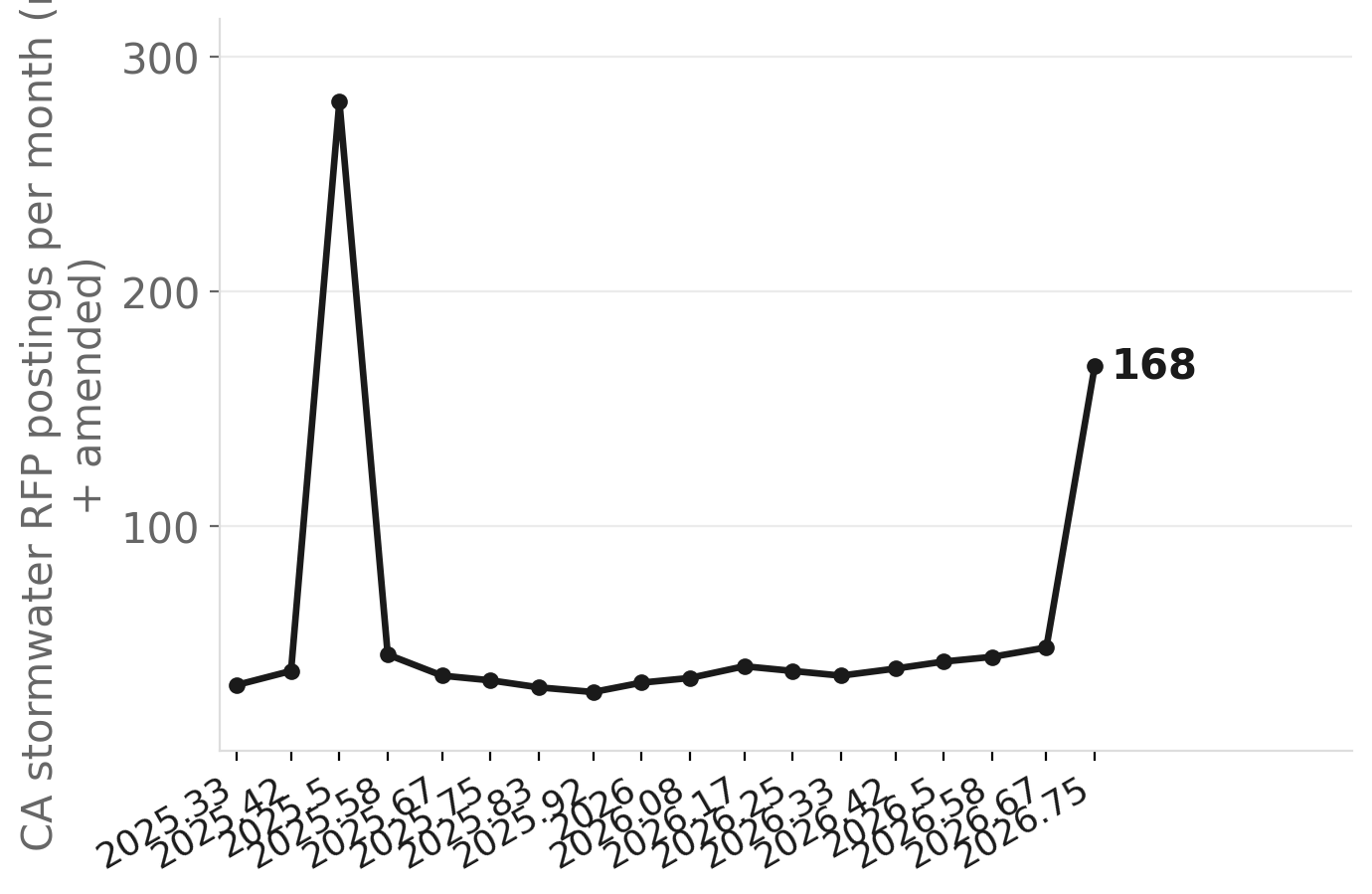
California municipalities posted 168 stormwater management solicitations in the trailing 30 days of October 2026, against a 12-month average of about 37 per month. That 4.6x spike is not a data artifact: 82 of those postings are net-new solicitations and 86 are amended or updated prior contracts, meaning both new and existing procurement pipelines are accelerating simultaneously.
The driver is regulatory, not financial. Three distinct permit actions are converging on the same compliance window, and none of them come with a guaranteed funding source attached.
The Santa Ana Regional Water Quality Control Board issued its final Tentative Order for a new watershed-wide MS4 permit covering Orange, Riverside, and San Bernardino Counties on May 5, 2026, with adoption targeted for July 24. That permit is notable for applying a watershed-wide framework rather than following municipal boundaries, a model other regional boards are watching. The State Water Resources Control Board separately released a formal draft of the reissued statewide Small MS4 General Permit on July 2, 2026, the first substantive update to a permit that has been on administrative extension since 2013, with a public comment deadline of September 2 and a revised draft heading to the board in 2027. The draft introduces new trash-capture requirements with a December 2030 compliance deadline, plus updated post-construction controls and TMDL provisions. And effective July 1, 2026, a new Standardized Cost Reporting Policy requires every MS4 permittee in California to begin tracking stormwater compliance costs for the first time, with first reports due in 2027.
Source: NationGraph.
That cost-tracking mandate is the practical squeeze. Cities that have not begun building their compliance infrastructure, drainage studies, master plan updates, on-call consulting contracts, are already behind on the paperwork that will define what they owe and when. The procurement board is the fastest way to catch up before the 2027 reporting window closes.
The geography of the current surge is statewide, which separates this moment from earlier spikes. Los Angeles County leads with 23 RFPs, followed by Ventura County (13), Sacramento County (12), Orange County (11), and both Santa Clara and San Mateo Counties at 9 each. The top issuing agencies include the cities of Richmond, Santa Maria, Thousand Oaks, and San Leandro, along with the San Francisco Public Utilities Commission. The procurement types span the full pre-compliance toolkit: stormwater master plans, green infrastructure plan updates, diversion and reuse projects, on-call consulting services, inspection programs, and drainage studies.
The cost picture is stark. A Beacon Economics analysis commissioned by San Bernardino County estimated that compliance with the Santa Ana regional permit alone would cost the county and 16 of its cities approximately $11 billion over 20 years, costs county officials called financially unworkable. Federal support is modest by comparison: EPA's active stormwater grants in California total roughly $11.7 million across two awards to the State Water Resources Control Board and an $8 million San Francisco Bay Water Quality Improvement Fund award to the City of San Pablo. Those figures do not approach the scale of what compliance will require.
Los Angeles County has a partial backstop that most of California lacks. Measure W, the Safe, Clean Water Program passed by voters in 2018, generates approximately $280 million per year from a local parcel levy and directs it toward MS4 compliance projects. That program explains why LA County's procurement volume is high but not panicked. Elsewhere, cities are largely on their own. Salinas, for example, reportedly spends more than $6.4 million annually on stormwater compliance with no state or federal reimbursement.
California's MS4 architecture makes the current moment particularly complex. The State Water Resources Control Board sets statewide standards, but nine Regional Water Quality Control Boards issue and enforce their own permits. The Santa Ana regional permit, the statewide Small MS4 reissuance, and the Central Valley Water Board's separately adopted regional MS4 permit (Order R5-2026-0043) are all moving on overlapping but distinct timelines. Cities in some counties face obligations from multiple permit layers simultaneously, with no single unified compliance framework and no shared funding mechanism.
The July 2025 procurement spike, 281 total RFPs, 142 of them net-new, coincided with early public discussion of the Santa Ana regional permit. The current surge, broader geographically and split almost evenly between new and amended solicitations, suggests cities have moved from watching to acting.
The next signal to watch is the Santa Ana permit's formal adoption vote, still scheduled for late July 2026 at the Regional Board. If the board adopts the order with the watershed-wide compliance structure intact, the procurement pressure in Orange, Riverside, and San Bernardino Counties will intensify further, and the statewide Small MS4 comment period, which closes September 2, will give the State Water Board its first clear read on how hundreds of smaller municipalities plan to meet requirements they have not faced since 2013.