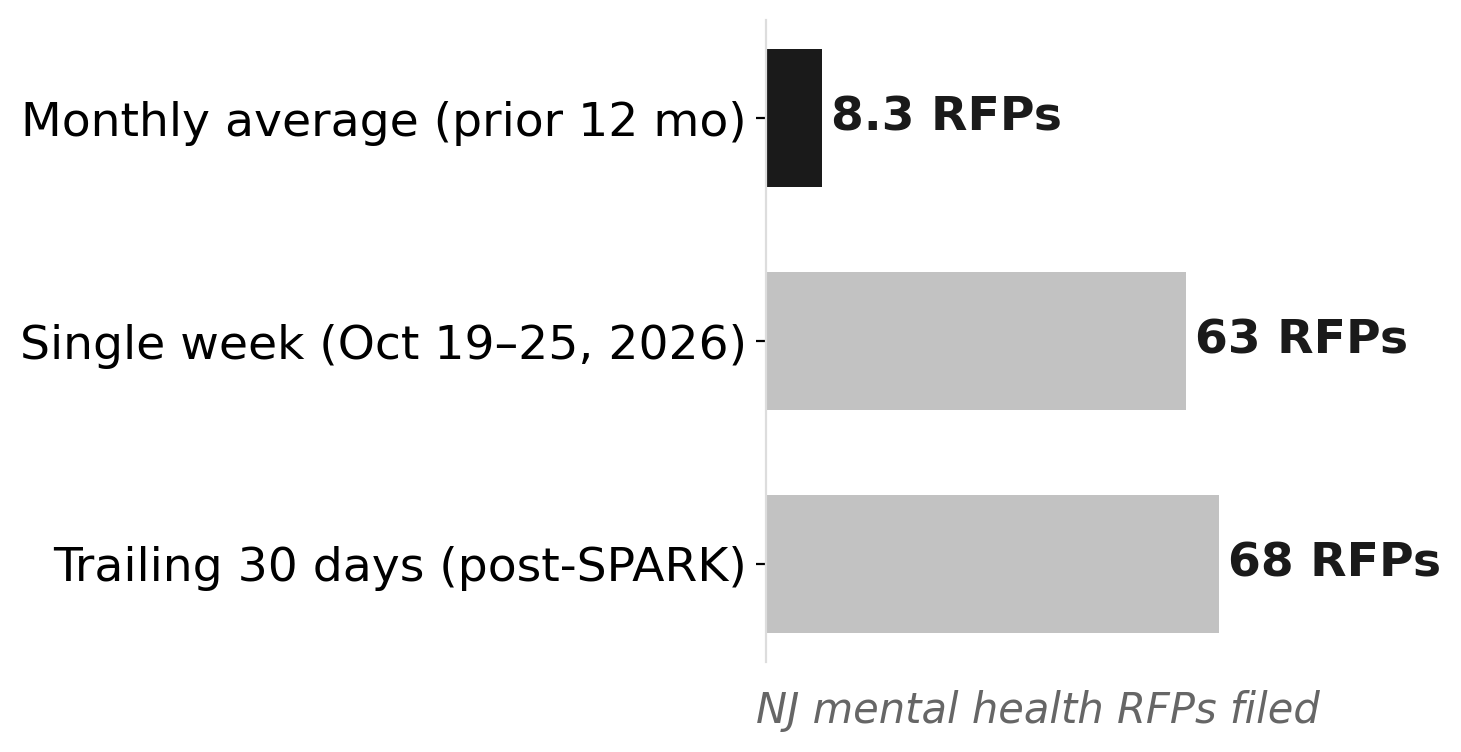
New Jersey school districts filed 68 mental health RFPs in the past 30 days, against a 12-month monthly average of 8.3. That is an 8.2x surge, and it did not build gradually: 63 of those 68 RFPs landed in procurement databases in a single week, October 19 through 25. That is not a market shift. That is a deadline.
The deadline has a name: S-2559/A-3924, signed by Governor Mikie Sherrill on September 28, 2026. The law does two things at once, and conflating them obscures why the procurement wave is so broad. First, it launches SPARK (School-Based Partnerships for Access and Resilience for Kids), an $8 million state-funded pilot that will place clinical mental health services, psychiatric consultations, assessments, triage, short-term stabilization, in up to 10 districts beginning in early 2027. SPARK creates winners. Second, and separately, the law imposes a universal mandate on all of New Jersey's roughly 600-plus school districts: every district must now have a designated mental health employee, a signed provider agreement, or active NJ4S membership. The mandate creates a compliance floor. The RFP wave is mostly the floor, not the competition for the pilot.
Thirty-one of the 68 RFPs came from school districts or boards of education, including Passaic Public Schools, Trenton Public School District, Franklin Township, Collingswood, and East Orange. County human services agencies account for 17 more, with municipal entities making up most of the rest. These are not districts angling for a SPARK grant, most of them will not be among the 10 selected. They are districts that read the statute and opened a procurement portal.
Source: NationGraph.
The urgency is sharpened by a concern the NJ Association of Mental Health and Addiction Agencies raised publicly: the shift toward district-by-district contracting, rather than the regional hub model NJ4S used, creates real risks for continuity of care for students already receiving services. That concern may itself be accelerating procurement timelines, as districts try to lock in provider relationships before the landscape reshuffles further.
NJ4S, the predecessor program, is not being eliminated. Governor Murphy invested nearly $90 million in it over two years; the program served more than 100,000 children in Essex County alone. Governor Sherrill preserved it rather than replacing it outright, as had been proposed earlier in 2026. The FY2027 state budget keeps NJ4S running alongside SPARK, which means districts that want to satisfy the mandate through NJ4S membership can do so, but districts that want more control over their services, or that are already in the SPARK application pipeline, are building their own provider agreements. The result is simultaneous mandatory and elective procurement pressure hitting at the same time.
The fiscal backdrop matters. New Jersey holds an active federal HHS Community Mental Health Block Grant of $28.8 million (running through September 2027), $7.6 million in School Safety grants administered through the DOE under the Bipartisan Safer Communities Act, and $4.6 million in 988 Behavioral Health Crisis infrastructure funding. These are pre-existing federal streams that districts and counties draw on to pay for contracted services. They are not new dollars triggered by the Sherrill legislation, but they mean that when a district executes a provider agreement, it often has a funding vehicle ready. Governor Sherrill's September 28 announcement framed the full FY2027 school mental health investment at more than $125 million, a figure that combines state appropriations across SPARK, NJ4S, and related programs.
There is also a second procurement vector coming. The governor's office noted at signing that a state RFP for a SPARK mobile app platform was forthcoming "in the coming weeks." That RFP had not yet appeared in the trailing 30-day window this analysis covers, which means the current 8.2x spike likely understates the total procurement activity this legislation will generate.
For families, the practical implication is that their district will soon have, or legally must have, a named mental health provider relationship. What that looks like in practice varies: a licensed counselor on staff, a telehealth contract with a regional clinic, or continued service through NJ4S's hub. The law sets the floor; it does not standardize the ceiling.
The next signal to watch is the SPARK district selection, expected ahead of the early-2027 service launch. The 10 districts chosen will receive state-funded clinical services and become the test case for whether district-level contracting produces better outcomes than the regional hub model it is designed to complement. The procurement wave happening right now is the before picture.