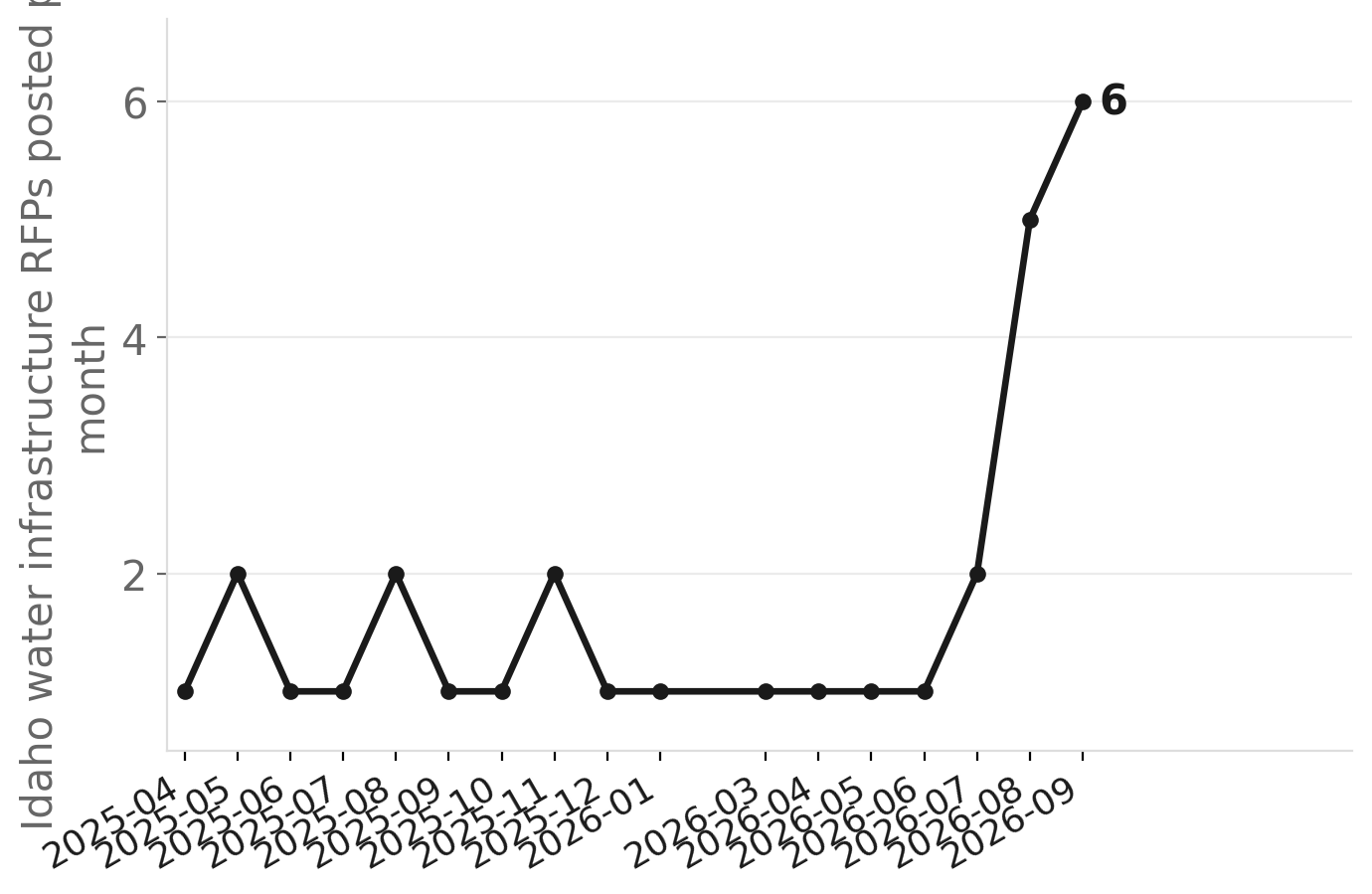
Idaho water infrastructure RFPs hit 6 in the last 30 days against a 12-month average of roughly 1.2 per month, a 5.1x spike that the underlying time series makes hard to dismiss as noise. August and September 2026 together produced 11 RFPs, the sharpest two-month run in an 18-month dataset, and the issuers stretch from Kootenai County in the north panhandle to Jefferson and Bonneville Counties in the eastern agricultural corridor. This is not a single city's capital program breaking loose. It is two distinct compliance clocks reaching their alarm in the same fiscal year.
The two mechanisms are different in design, funder, and target actor, and should not be confused. On the municipal side, Idaho DEQ's revised State Revolving Fund loan rules took effect July 1, 2026, activating a multi-year stack of EPA Bipartisan Infrastructure Law capitalization grants: $24.9 million in new Drinking Water SRF funds and $12.1 million in Clean Water SRF funds, both authorized starting July 2025. Those grants flow to cities as low-interest loans, but the loans carry spend-down timelines. Cities that have already committed to SRF financing now face a procurement window: issue design and engineering RFPs in the current fiscal year or lose ground on draw schedules. Across Idaho, EPA has obligated $174.6 million to 53 active water grants, the federal backdrop that is pushing local governments into market now.
On the agricultural side, the pressure is legal rather than financial. The November 2024 Eastern Snake Plain Aquifer Water Settlement Agreement resolved a curtailment standoff between junior groundwater users and senior surface water rights holders that had threatened to shut off pumping across the Magic Valley and eastern Idaho. The settlement requires groundwater districts to reduce consumption by 205,000 acre-feet per year averaged over four years. As the Idaho Capital Sun reported, the agreement's primary compliance mechanism is funded infrastructure: groundwater-to-surface-water conversions and aquifer recharge projects. Districts that do not build do not comply. Governor Brad Little and Lt. Governor Scott Bedke championed the legislative response, House Bill 445, which the 2025 Legislature passed to provide $30 million per year in state appropriations for ESPA Water Sustainability Projects, split evenly between eastern Idaho and the Magic Valley. That money is now in its first full execution year, which means procurement is happening now.
Source: NationGraph.
The geography of the RFP surge reflects this dual structure. Post Falls, a Kootenai County city of roughly 55,000, accounts for at least five of the recent postings, covering a new Public Works Operations Center, Water Reclamation Facility efficiency consulting, and multiple design service solicitations. The city is navigating a DEQ draft reuse permit for 1 million gallons per day of recycled water and is simultaneously planning a Phase 2 reclamation upgrade projected at roughly $40 million. Phase 1, a $3.1 million improvement, was approved by the Post Falls city council and begins in October 2026. The engineering RFQs now in market are the procurement vehicle for what comes next, and the EPA's phosphorus discharge limits on the Spokane River give the city no flexibility on schedule.
The eastern Idaho entries in the dataset, including RFPs from Rigby in Jefferson County and Idaho Falls in Bonneville County, reflect the ESPA settlement track rather than the municipal SRF track. Those communities sit within the aquifer's recharge zone and face both the consumption reduction mandate and the infrastructure timelines that come with state appropriations. The Idaho Water Resource Board has already approved $56 million across 90 aging infrastructure projects, with another $40 million scheduled through FY2027, a parallel state-appropriated grant program targeting agricultural conveyance and distribution systems.
For residents across Idaho, the immediate effect is a construction pipeline that was not visible a year ago. Water and wastewater rates in municipalities drawing SRF loans will reflect debt service over coming years, though at rates below what a conventional bond market would offer. Agricultural users in the ESPA corridor face infrastructure conversion costs offset by state funds, but also face the real consequence if projects are not completed on schedule: the settlement's curtailment backstop does not disappear.
The next signal to watch is Idaho DEQ's FY2027 Intended Use Plan, which will specify which SRF loan applications have been approved and at what scale. Cities that have issued design RFPs this fall are positioning for loan commitments in that plan. For the ESPA track, the four-year consumption reduction averaging period began with the 2024 settlement, meaning the midpoint accountability window arrives in 2026 and 2027. Districts that have not yet issued procurement for conversion or recharge projects are running short on time to demonstrate compliance. Whether the current RFP surge translates into awarded contracts and construction starts in the next two quarters will determine whether both compliance clocks are actually being met, or merely acknowledged.