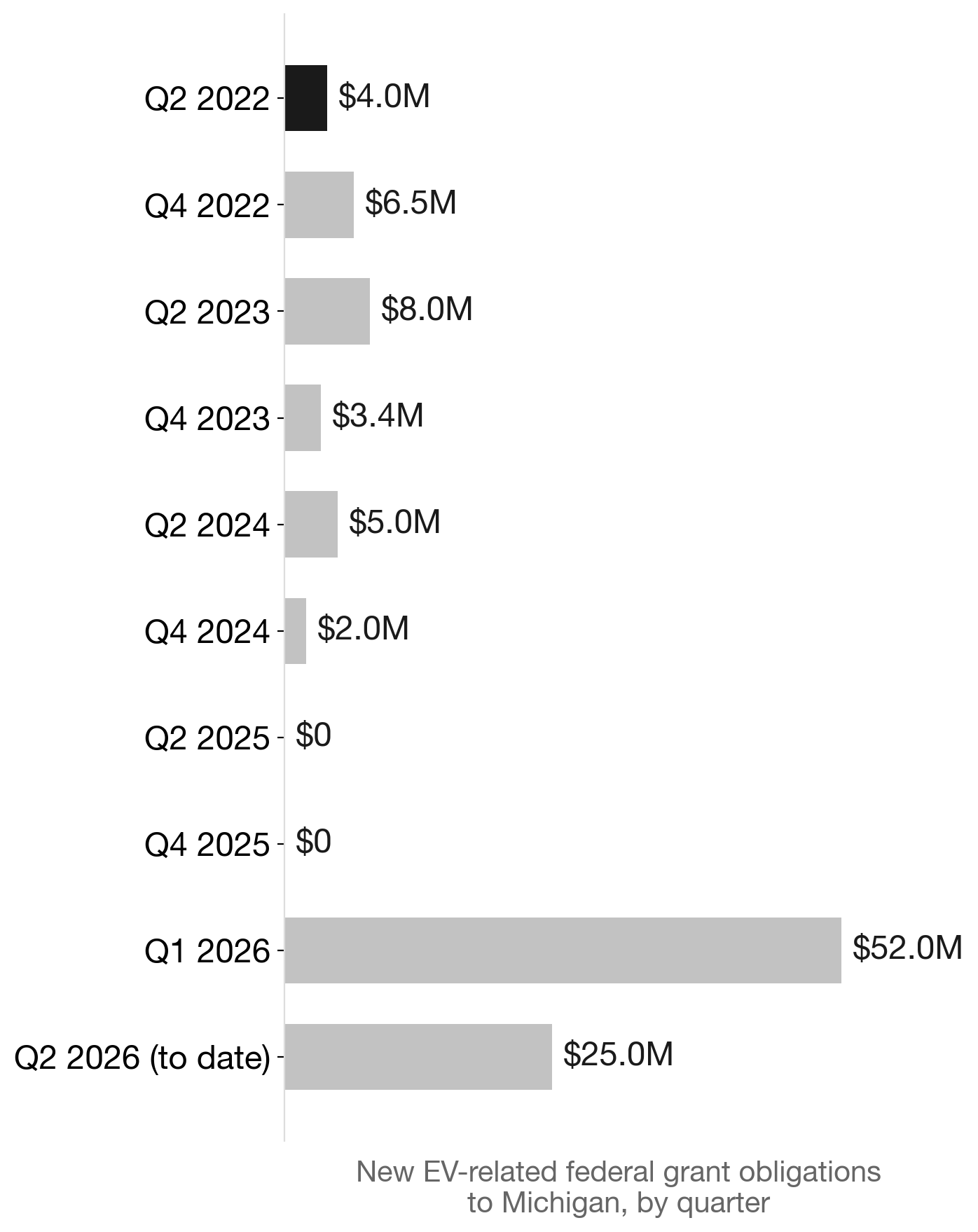
Federal EV grants flowing into Michigan hit $25 million in the last 90 days, a 637 percent jump from the $3.4 million recorded in the same window a year ago, and the money is moving this fast because a federal judge had to order it released.
The single grant driving that figure is a $25 million award the Federal Transit Administration obligated on July 27, 2026 to the Ann Arbor Area Transportation Authority, known locally as TheRide, under the Low or No Emission bus program. The grant runs through September 2030 and will fund zero-emission buses for a city that has already committed to full fleet electrification under its A2ZERO Carbon Neutrality Plan. On its own, that one commitment is 7.4 times what the entire state received in EV-related federal grants during the same 90-day stretch last year.
The backstory explains the velocity. In February 2025, the Trump administration froze disbursements under the National Electric Vehicle Infrastructure program, citing a January executive order directing federal agencies to wind down what it called "Green New Deal" spending. Seventeen states and the District of Columbia sued. A preliminary injunction in June 2025 unfroze roughly $1 billion for plaintiff states, and on January 23, 2026, Judge Tana Lin of the Western District of Washington granted summary judgment for the plaintiffs, ruling the freeze unlawful under the Administrative Procedure Act. The administration had blocked spending Congress had already appropriated and FHWA had already allocated to states.
Source: NationGraph.
Michigan moved quickly once the legal cloud lifted. On April 6, 2026, MDOT earned what FHWA calls "fully built out" certification, confirming the state had deployed charging stations at the required highway-corridor spacing under the original NEVI rules, a threshold that unlocked the remaining $51 million of Michigan's $106 million NEVI allocation. Two MDOT NEVI grants totaling roughly $47 million started in March 2026 and run through 2039. On June 8, MDOT issued a Round 3 RFP making that remaining $51 million available to private charging operators; applications closed August 7, with award notifications expected this fall.
The pace is not optional. MDOT must obligate all NEVI funds before the end of federal fiscal year 2026, a statutory deadline that is compressing what might otherwise be a multi-year deployment into a matter of months. The Q1 2026 figure captures how abruptly the logjam cleared: Michigan recorded $52 million in new EV-related grant starts in the first quarter alone, the highest single quarter in the dataset going back to at least 2022.
Among Midwest peers, the gap is stark. Illinois logged $10 million in new EV federal grants over the same trailing 90 days; Ohio recorded $3.4 million spread across seven separate grants. Michigan's single Ann Arbor commitment outweighs Ohio's entire recent portfolio.
The geography of that commitment carries its own logic. Ann Arbor has the highest EV adoption rate in Michigan, anchored by University of Michigan employment and a tech-sector workforce. Electrifying TheRide's bus fleet there is less a gesture toward future adoption than an attempt to meet demand that already exists. MDOT's stated target is 2 million EVs on Michigan roads by 2030, a number that requires both private vehicles and the public charging and transit infrastructure around them.
That infrastructure gap is the tension at the center of Michigan's EV moment. Ford, GM, and Stellantis are all headquartered in the state. Michigan builds more cars than anywhere else in the country, and an increasing share of those are electric. Whether consumers buy them depends partly on whether they trust that charging will work when they need it. The NEVI program exists precisely to close that gap, and for 14 months, the federal government declined to release the money Congress had set aside for it.
The FTA has also kept the procurement pipeline open beyond the Ann Arbor award. The FY2026 Low or No Emission NOFO makes $589 million available nationally, with applications due September 21, 2026. Michigan transit agencies beyond AAATA can still compete for a share of that round.
The next concrete signal to watch is MDOT's NEVI Round 3 award announcement, expected later this fall. That $51 million will name the private operators who will build the next generation of Michigan highway charging stations, and will show how much of the state's remaining federal EV infrastructure investment can be locked in before the fiscal year closes.