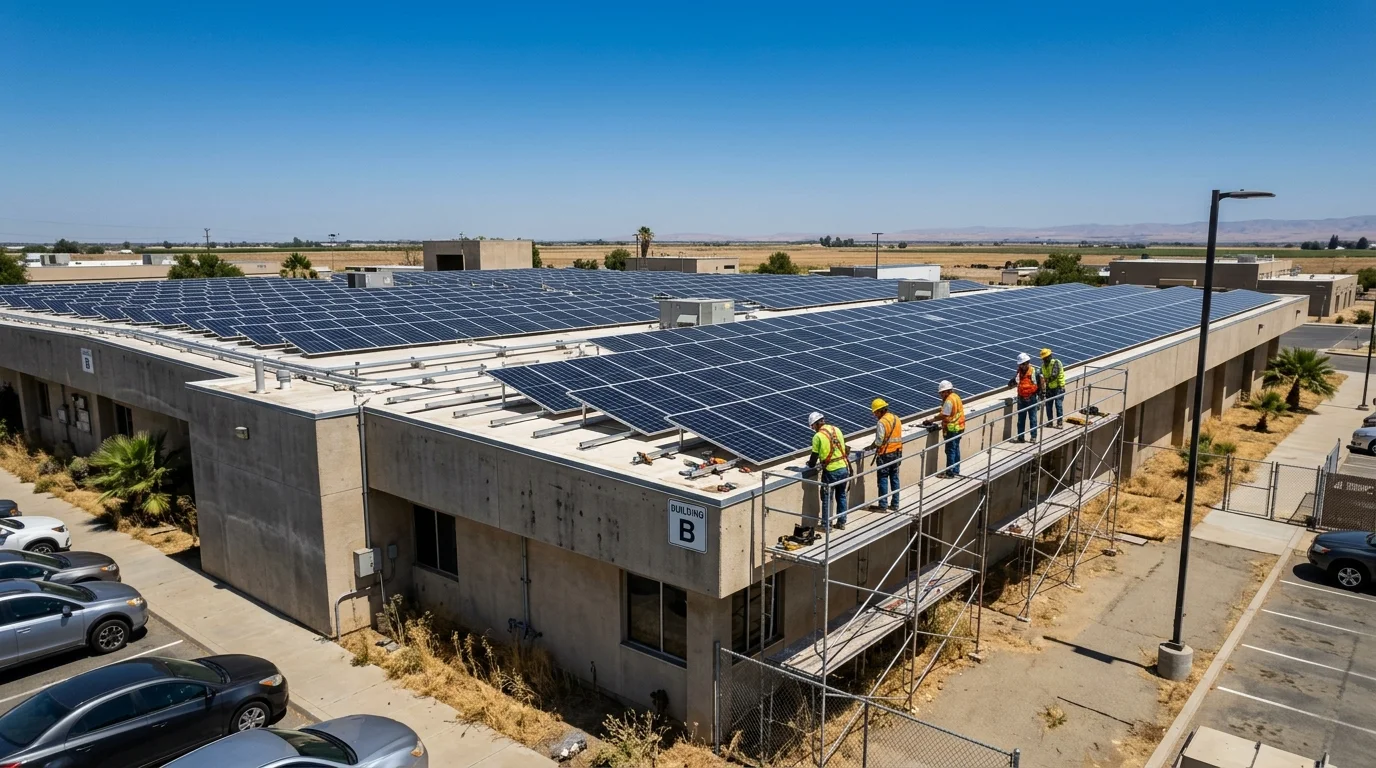
Thirteen California public institutions issued solar procurement RFPs for the first time in over a year during the past 30 days, not because the incentives got better, but because two of the most valuable ones just closed, and whatever window remains is shrinking fast.
The cohort spans school districts, community colleges, state universities, air quality agencies, and municipalities, including Chino Valley Unified, Chaffey College, CSU Bakersfield, CSU San Bernardino, the San Joaquin Valley Air Pollution Control District, and the cities of Vallejo, Santa Cruz, Corona, and Los Banos. Most are issuing Power Purchase Agreement structures or Solar-Plus-Battery SLPPAs rather than traditional direct-ownership bids, a structural shift that reflects exactly what changed this year.
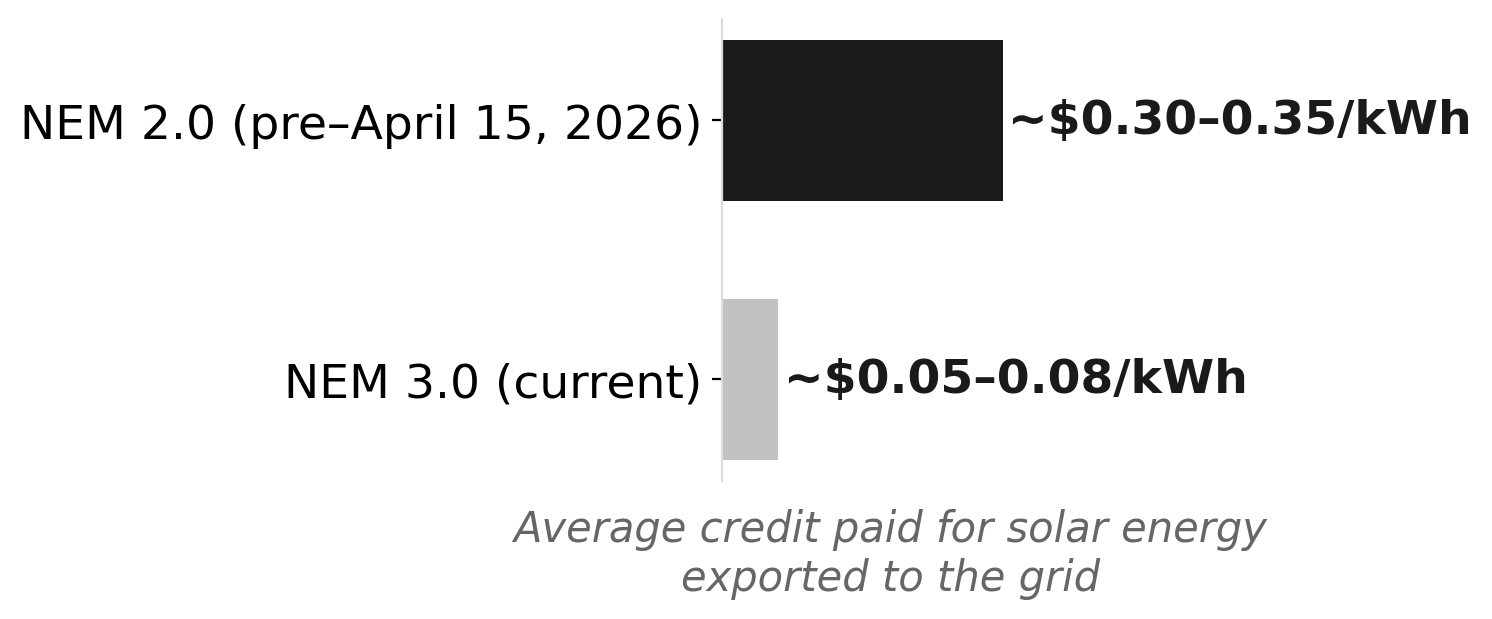
Two policies converged in a six-month window to upend the economics that had governed California public solar procurement for years. First, the NEM 2.0 grandfathering window closed April 15, 2026. Institutions that had applied for interconnection before April 14, 2023 were the last to lock in 20-year retail-rate export credits worth roughly $0.30 to $0.35 per kilowatt-hour. Everything new now falls under NEM 3.0, where export credits average $0.05 to $0.08 per kilowatt-hour, a reduction of 75 to 80 percent. That arithmetic makes standalone rooftop solar economically marginal in ways it simply wasn't before; battery storage is no longer optional if the numbers are going to work.
Source: NationGraph.
Second, the federal §48E Clean Electricity Investment Credit, the commercial successor to the 30% residential Investment Tax Credit, which expired December 31, 2025 under the One Big Beautiful Bill, required that projects begin construction before July 4, 2026 to capture the full 30% benefit. Public institutions cannot claim federal tax credits directly, which is exactly why PPA structures are essential: a third-party developer owns the system, claims the §48E credit, and passes the savings through lower contracted rates to the school or city. CSU Bakersfield named its solicitation an "Advanced Shovel-Ready SLPPA", a title that signals, with unusual directness, the construction-start urgency that drove the filing.
The rush of first-time RFPs in the past month represents a specific subset of the broader procurement calendar. California's solar RFP volume hit a peak of 38 institutions and 142 RFPs in May 2026, almost certainly capturing the pre-July 4 §48E construction-start wave. September's 14-institution, 18-RFP pace is lower, but the 13 institutions issuing their first RFP in over a year are a distinct group: lapsed or hesitant buyers who delayed past both deadlines and are now re-entering a market with fundamentally different rules.
Layered on top of both closures is a third, separate obligation. California's Title 24 2025 Energy Code, effective January 1, 2026, mandates solar PV and battery storage for most new commercial construction, including schools and offices. This is not an incentive; it is a compliance requirement that falls directly on the building owner. For institutions already planning capital projects, Title 24 converts solar procurement from a discretionary financial decision into a code obligation, removing one of the reasons procurement could be deferred.
These are three distinct policy mechanisms doing three different things simultaneously. NEM 3.0 is a CPUC tariff that reshaped the revenue side of every new solar installation in PG&E, SCE, and SDG&E territory. §48E is a federal tax credit claimed by developers and passed through PPA pricing to public entities, with a construction-start deadline that is now past. Title 24 is a building code mandate with no expiration and no opt-out for covered construction types. All three hit California public institutions in the same six-month window, a convergence specific to California's regulatory calendar and unlikely to recur in the same form.
Geographically, San Bernardino County is the most active cluster, with three institutions in the recent wave, followed by Sacramento, Yolo, and Riverside counties. California leads comparable states by a wide margin: 21 institutions and 31 RFPs in the past 30 days, versus Colorado at 5 institutions and 11 RFPs, and Texas and Nevada each at 6 institutions.
For institutions still on the sideline, the §48E construction-start deadline has already passed. The NEM 2.0 window is permanently closed. What remains is the NEM 3.0 landscape, the Title 24 compliance clock for any new construction, and a separate federal property tax exclusion for solar systems under 2 megawatts that is set to expire in December 2026 unless Congress acts. The CPUC is also required to conduct a three-year review of NEM 3.0 starting after April 2026, which could modify export rates, but the outcome and timeline of that review are uncertain.
The next signal to watch is how many of the RFPs issued in the past 30 days result in executed contracts before year-end, and whether the December 2026 property tax exclusion deadline produces another cohort of institutions discovering, once again, that the time to move was earlier than they thought.