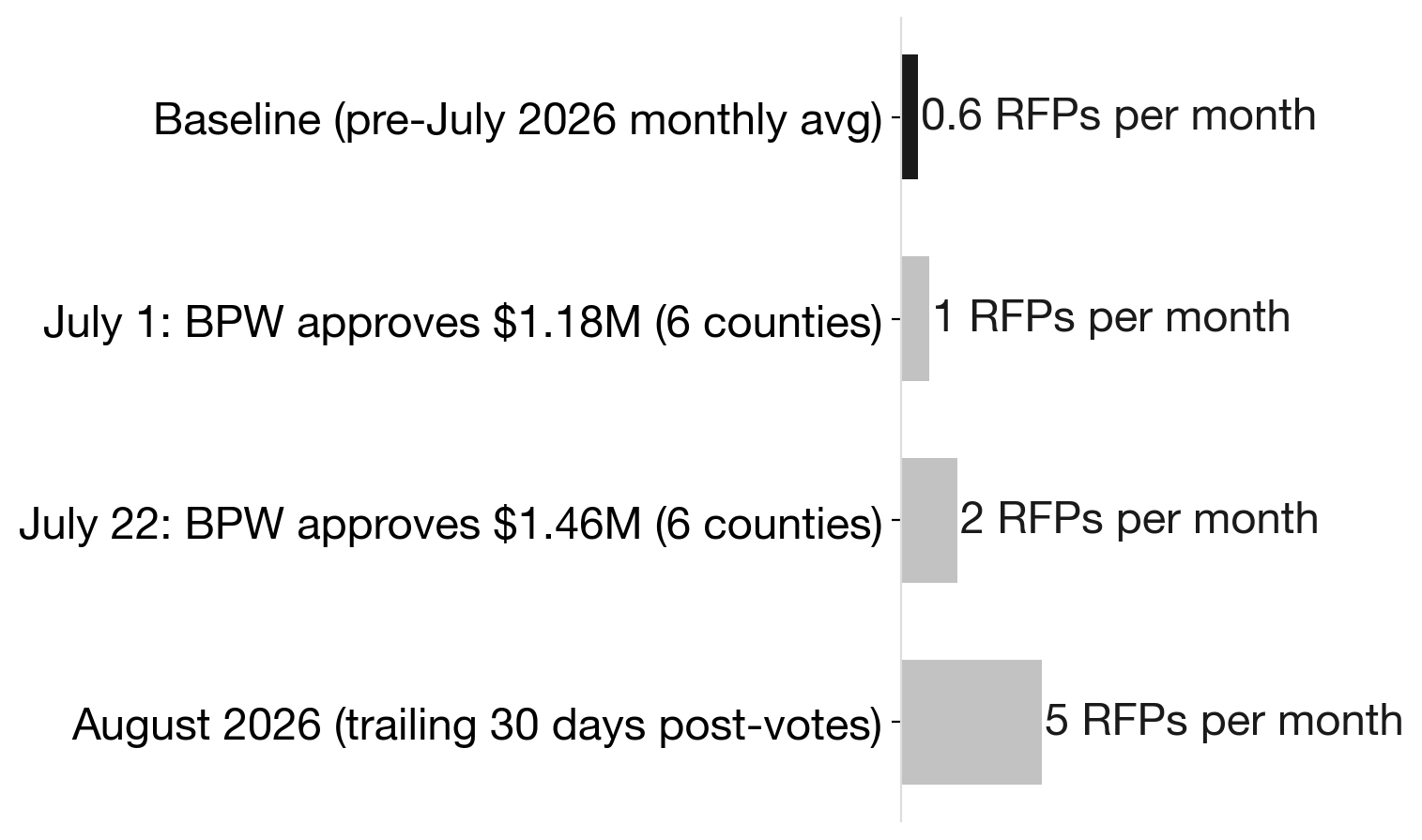
Maryland local governments issued five pickleball-related RFPs in the last 30 days, against a historical baseline of roughly 0.6 per month, an 8.6x spike that has nothing to do with a sudden enthusiasm for the sport and everything to do with two Board of Public Works votes held three weeks apart.
On July 1, the Board approved $1.18 million in DNR Community Parks and Playgrounds grants covering Allegany, Calvert, Dorchester, Frederick, Garrett, and Washington counties. On July 22, it approved another $1.46 million targeting Allegany, Carroll, Cecil, Garrett, Talbot, and Washington counties. Both resolutions explicitly named pickleball courts as deliverables. The procurement activity that followed, RFPs hitting public portals through August and into September, reflects the state's standard grant-to-bid lag of two to six weeks. When the BPW votes, local governments start writing specifications.
Dorchester County on the Eastern Shore alone accounts for three of the five RFPs: one for design and site preparation for six new courts, one for tennis-court resurfacing, and a third for a dedicated tennis-to-pickleball conversion at the Hurlock Athletic Complex. That concentration is not coincidental. Dorchester County Council approved the use of Program Open Space funds for the Hurlock conversion as far back as November 2024, making it one of the earliest jurisdictions to map a multi-year buildout. The July grant approvals gave the county the remaining financial runway to compress several projects into a single procurement window. Baltimore County issued the fourth RFP, for a Hereford Senior Center renovation that includes pickleball courts. Cumberland, in Allegany County, issued the fifth, covering the Fairmont Avenue Parklet.
Source: NationGraph.
The underlying grant machinery is Governor Wes Moore's Community Parks and Playgrounds program, administered by DNR Secretary Josh Kurtz. Moore's FY2026 budget allocated $5 million for 26 CPP projects across 15 counties, with pickleball courts named in Cumberland. His FY2027 budget repeated the $5 million commitment for another 26 projects. The BPW approvals this summer represent disbursements from that pipeline, not new appropriations, which is precisely why the procurement response is so fast. The funds were already authorized; the BPW votes were the release valve.
The cumulative scale of the CPP program helps explain why Maryland is outpacing its neighbors. The state has awarded more than $92 million across 880-plus projects since the program's inception. That institutional depth means grant recipients in Maryland have procurement templates, DNR liaisons, and legal counsel already familiar with the process, compressing the time between award and RFP issuance. Maryland's 30-day pickleball RFP count of five leads the entire Mid-Atlantic: Pennsylvania posted four, New Jersey three, Virginia one, New York one. Maryland also ties Florida and Illinois nationally, states with populations roughly four and six times larger.
The FY2028 application window closed August 19, 2026, meaning a third consecutive funding wave is now in DNR review. If the Moore administration maintains the $5 million annual CPP tranche and adds Greenspace Equity Program dollars, the DNR proposed $7 million in FY2027 for underserved communities, the next BPW approval cycle, expected in late fall or early winter, could produce a comparable procurement spike in counties not yet in the current round.
For residents in the eight counties named in the July approvals, the near-term consequence is straightforward: construction bids are open now, and courts are likely to break ground before the end of fiscal 2027. For localities that missed this round, the FY2028 CPP application window that just closed represents their earliest realistic entry point, with BPW approval and subsequent RFP issuance unlikely before late 2026 at the earliest.
The open question is whether local governments without existing plans, the Dorchester Countys of the next cycle, can move as quickly once grants clear. Dorchester's advantage was years of advance planning. Counties entering the CPP pipeline for the first time may find that the bottleneck is not funding but the unglamorous work of site assessment, court specifications, and contractor pools that takes months before an RFP can go out the door.