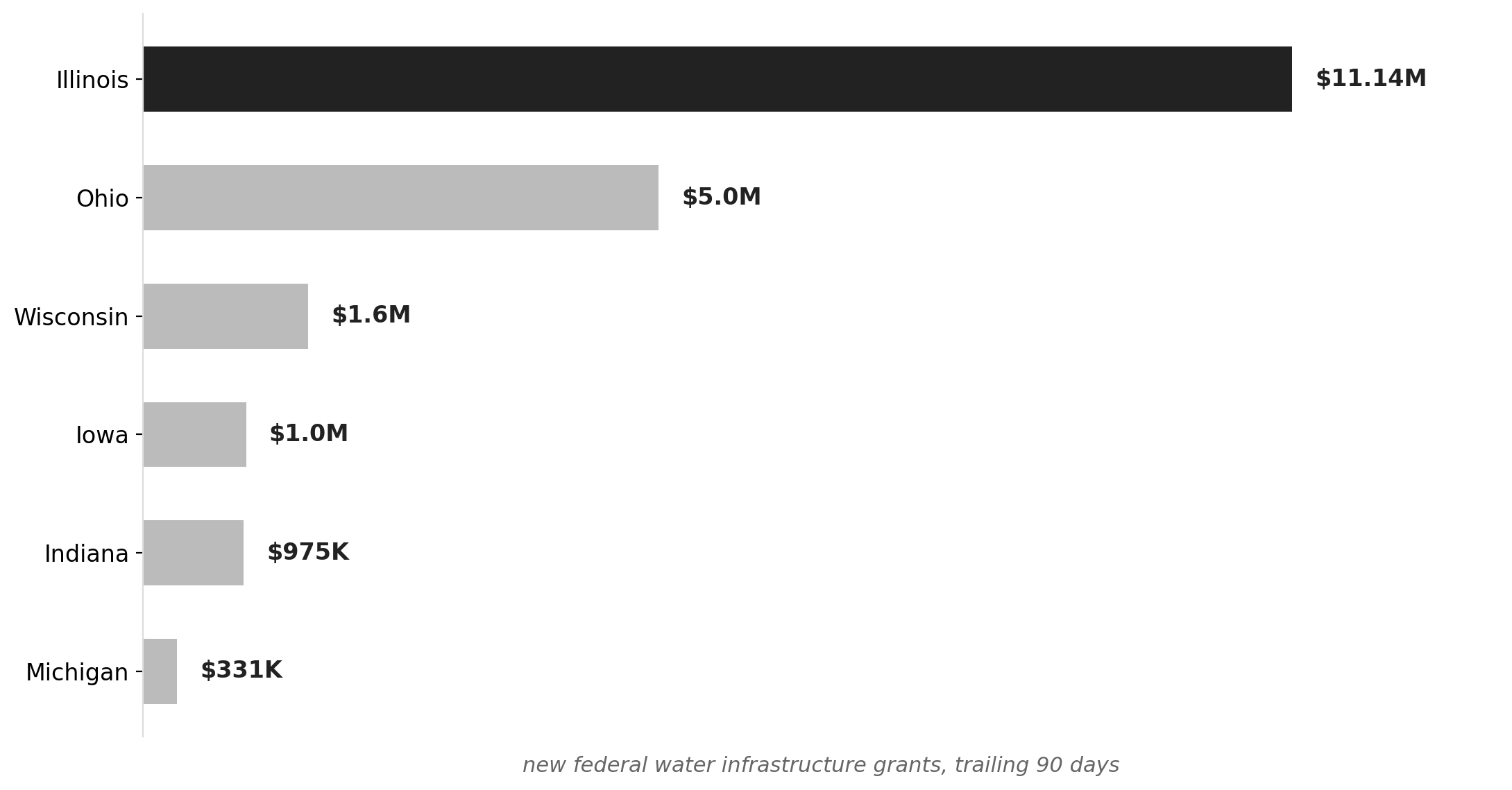
Federal water infrastructure grants newly awarded to Illinois have hit $11.14 million in the trailing 90 days, a 207% jump above the $3.62 million recorded in the same window one year ago. The surge is not coincidence: September 30, 2026 marks the expiration of the Bipartisan Infrastructure Law's five-year supplemental State Revolving Fund appropriations, and every water agency from Chicago to Cairo is in an obligate-or-lose sprint.
The three awards driving this year's figure are notably different in character from the seven smaller, dispersed grants that composed last year's baseline. Chicago landed a $5 million EPA SWIFR grant for solid waste and recycling infrastructure. America's Central Port District on the Mississippi received $4.14 million through the DOT Port Infrastructure Development Program to repair a breakwater. The University of Illinois collected $2 million in EPA Gulf of America water quality research funding. Last year's comparable window was dominated by congressional earmarks to suburban municipalities including Wood Dale, Long Grove, and Joliet. The shift from small earmarks toward larger, programmatic awards reflects where the IIJA pipeline now sits: the big SRF capitalizations have already been allocated, and what remains is the final discretionary layer.
Illinois leads every neighboring Midwest state in new water infrastructure grants over this window. Ohio recorded $5 million, Wisconsin $1.6 million, Iowa $1 million, Indiana $975,000, and Michigan just $331,000. That Illinois outpaces Michigan, which shares a comparable lead service line burden across its older industrial cities, speaks to how aggressively Illinois EPA has positioned itself in the final IIJA cycle.
Source: NationGraph.
The urgency is structural. According to EPA's own SRF program page, May 2026 marked the fifth and final annual allotment of DWSRF Lead Service Line Replacement funds nationally, closing the book on the $15 billion LSLR program created by IIJA. Illinois EPA's FY2026 Intended Use Plan includes a $111.4 million CWSRF supplemental capitalization grant application, described internally as the last guaranteed bite of IIJA SRF money. The Environmental Policy Innovation Center has documented that even with that full LSLR program, IIJA funding is expected to cover only 15 to 21 percent of replacement costs in the most heavily burdened Great Lakes states, Illinois among them.
Beneath the new awards sits a massive active portfolio. Illinois EPA holds $388 million in active DWSRF grants, $111 million in active CWSRF grants, and $40.7 million in WIIN emerging contaminants grants, all IIJA-backed and running through 2028 and 2029. That pipeline represents years of construction and compliance work already locked in. The question the current sprint is answering is what gets locked in after it.
The answer may be: considerably less. The White House's FY2026 budget proposes a 31.5% reduction to CWSRF and DWSRF post-IIJA, a cut that would push states to cover a larger share of water infrastructure financing through state revolving fund interest earnings and bond markets alone. Illinois is already adapting at the local level: Cook County's Technical Assistance Program has been actively guiding suburban municipalities through LSLR applications, and Cook County issued multiple emergency water infrastructure repair RFPs in May and June 2026. Lead service line replacement and metering contracts are actively out for bid in Lincolnwood, Geneva, Bloomington, and Western Springs.
For residents in Illinois's older cities and inner-ring suburbs, the immediate effect of this sprint is practical: water utilities drawing on IIJA funds are replacing lead service lines at a pace that would have been financially impossible under pre-2022 appropriations. Illinois EPA's SRF deputy manager has publicly urged communities to apply now, before funds are depleted. Cook County's TAP program has kept applications open until the money runs out, precisely because the post-IIJA replacement rate for those programs is unknown.
What the 90-day grant surge actually signals is that Illinois positioned itself early enough in the IIJA cycle to still be a significant claimant in the final round. States that moved slowly in 2022 and 2023 are finding the discretionary layer thinner now. Illinois's layered demand structure, a global city with century-old pipe networks, mid-sized industrial cities, and rural communities all drawing from different program tiers simultaneously, gave the state's water agencies multiple entry points into IIJA funding streams.
The next signal to watch is Illinois EPA's FY2026 CWSRF capitalization grant award, expected before September 30. If the $111.4 million application is approved in full, it will represent one of the largest single-year SRF capitalizations the state has received. If the post-IIJA EPA budget cuts take effect as proposed in FY2027, it will also be the last at that scale for the foreseeable future.