Thirteen Illinois housing institutions issued their first procurement requests in more than a year over the past 30 days, a burst of activity with a clear explanation: agencies that went silent when federal housing funding nearly collapsed in 2025 are now moving as fast as they can, because they believe the window may not stay open.
The institutions range from the Illinois Housing Development Authority, which reissued two stalled contracts, one for its Housing Locator Website and one for On-Site Asset Management Physical Inspection Services, to small downstate authorities like White County Housing Authority (HVAC work) and East Saint Louis Housing Authority (vacant unit turnaround and surplus land). McLean County is recruiting a new housing coordinator. The geographic spread matters: this is not a Chicago-metro story. The agencies re-entering procurement are concentrated in smaller, more financially constrained communities that have the least room to absorb a funding gap.
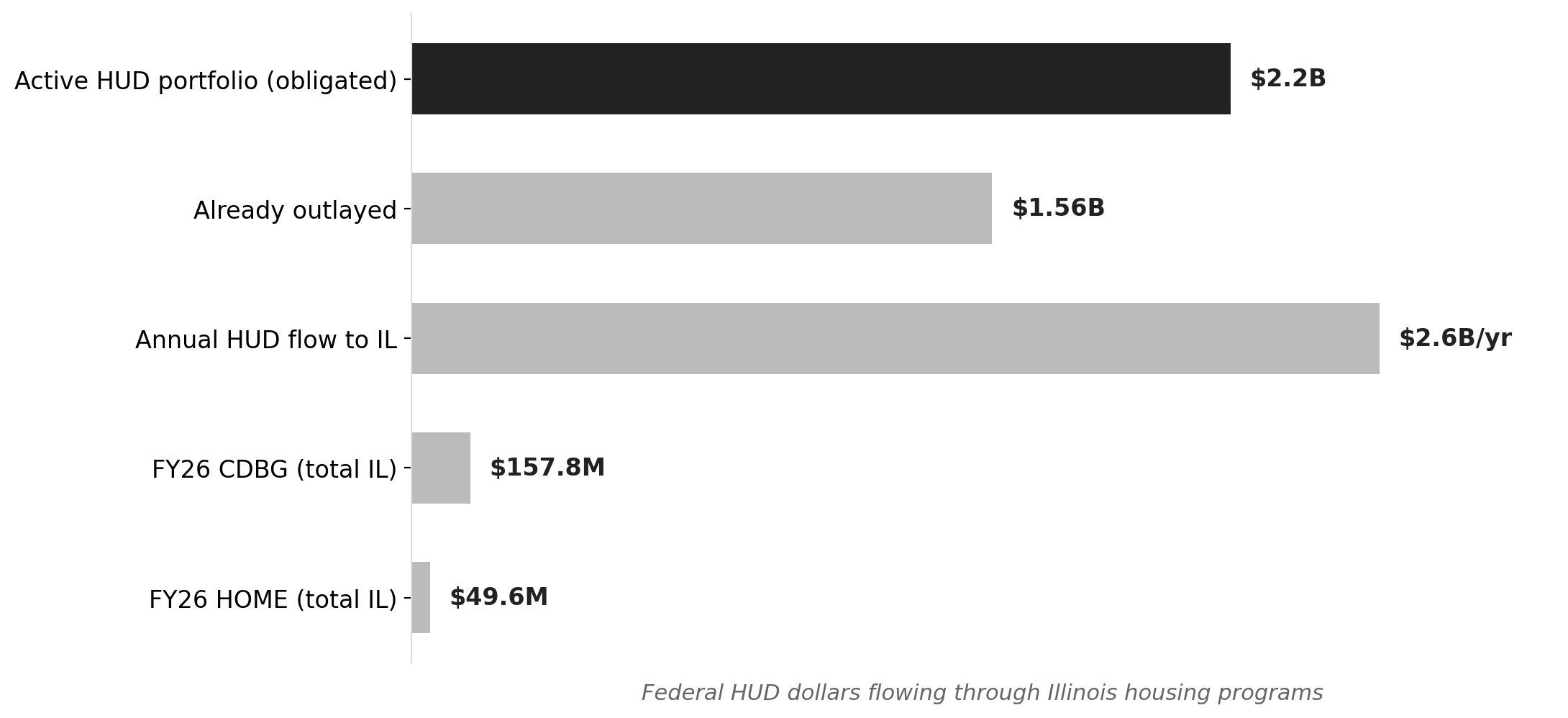
The trigger was the March 2026 Consolidated Appropriations Act, which rejected the Trump administration's proposed 44% cut to HUD's discretionary budget and preserved Community Development Block Grants at $3.3 billion and HOME Investment Partnerships at $1.25 billion nationally. That resolution unblocked procurement pipelines that had been stalled since mid-2025, when the scale of the proposed cuts became clear. IHDA Executive Director Kristin Faust and Board Chair King Harris had already put the threat on record in a June 2025 board resolution, warning that Illinois's estimated $2.6 billion annual HUD allocation, supporting roughly 400,000 households, was at risk. Once the appropriations question settled, IHDA finalized its 2026 Annual Action Plan, with a public comment deadline of May 28, 2026. That finalization created downstream procurement obligations for non-entitlement communities across the state. The RFPs now appearing are the result.
Source: NationGraph.
What agencies are buying tells the story as clearly as the timing. Almost none of the new contracts are for new construction. They are operational: HVAC systems, waste removal, physical inspections, vacant unit turnover. Authorities are getting existing stock into compliance before the regulatory ground shifts again. The urgency is to spend down what is already obligated, IHDA's active HUD portfolio carries more than $2.2 billion in currently obligated funds, with $1.56 billion already outlayed, not to start new programs that might be defunded mid-stream.
Rockford offers the clearest on-the-record version of the new calculus. The Rockford Housing Authority, marking its 75th anniversary this month, manages more than 1,100 properties and has issued active RFPs for both its North Main Manor redevelopment and the Burlington Oaks footprint. CEO Laura Snyder has said publicly that the community is "in desperate need for affordable housing", a phrase that carries weight in a city where a housing needs analysis projects demand for more than 9,000 new homes by 2033. That Rockford is moving on capital redevelopment while smaller downstate authorities are contracting for furnace replacements and trash hauling reflects the same underlying logic at different scales: use the money while the authorization holds.
The pressure is not evenly distributed. The Chicago Housing Authority operates on a $1.3 billion 2026 budget and is already drawing on reserves to cover a capital backlog that exceeds $1 billion over five years, a scale that makes the downstate procurement sprint look modest by comparison. But CHA has institutional capacity that White County does not. For smaller authorities, a single delayed appropriations cycle can mean deferred maintenance compounds into something unfixable.
The broader federal context hasn't resolved so much as paused. The Trump administration's original proposal included converting Housing Choice Vouchers to a state block-grant model, which Congress rejected for now. As Housing Action Illinois has documented, Illinois already had a voucher access crisis before the 2025 proposals arrived, more households eligible than slots available, waitlists effectively closed across the state. The March 2026 appropriations deal preserved the program structure, but next year's budget negotiations begin again in the fall.
IHDA recently committed $37 million in Low-Income Housing Tax Credits plus $39 million in subordinate resources across 22 developments, creating roughly 1,000 new homes. That is new construction, and it matters. But the 13 institutions issuing operational RFPs right now are making a different kind of bet: that the surest way to protect existing affordable housing in Illinois is to have it fully functional, fully contracted, and fully obligated before the next appropriations fight arrives.
The next signal to watch is whether this procurement pace holds through the fall. If federal FY2027 budget proposals arrive in September with another round of HUD cuts, the agencies that didn't move in this window may find themselves waiting again.