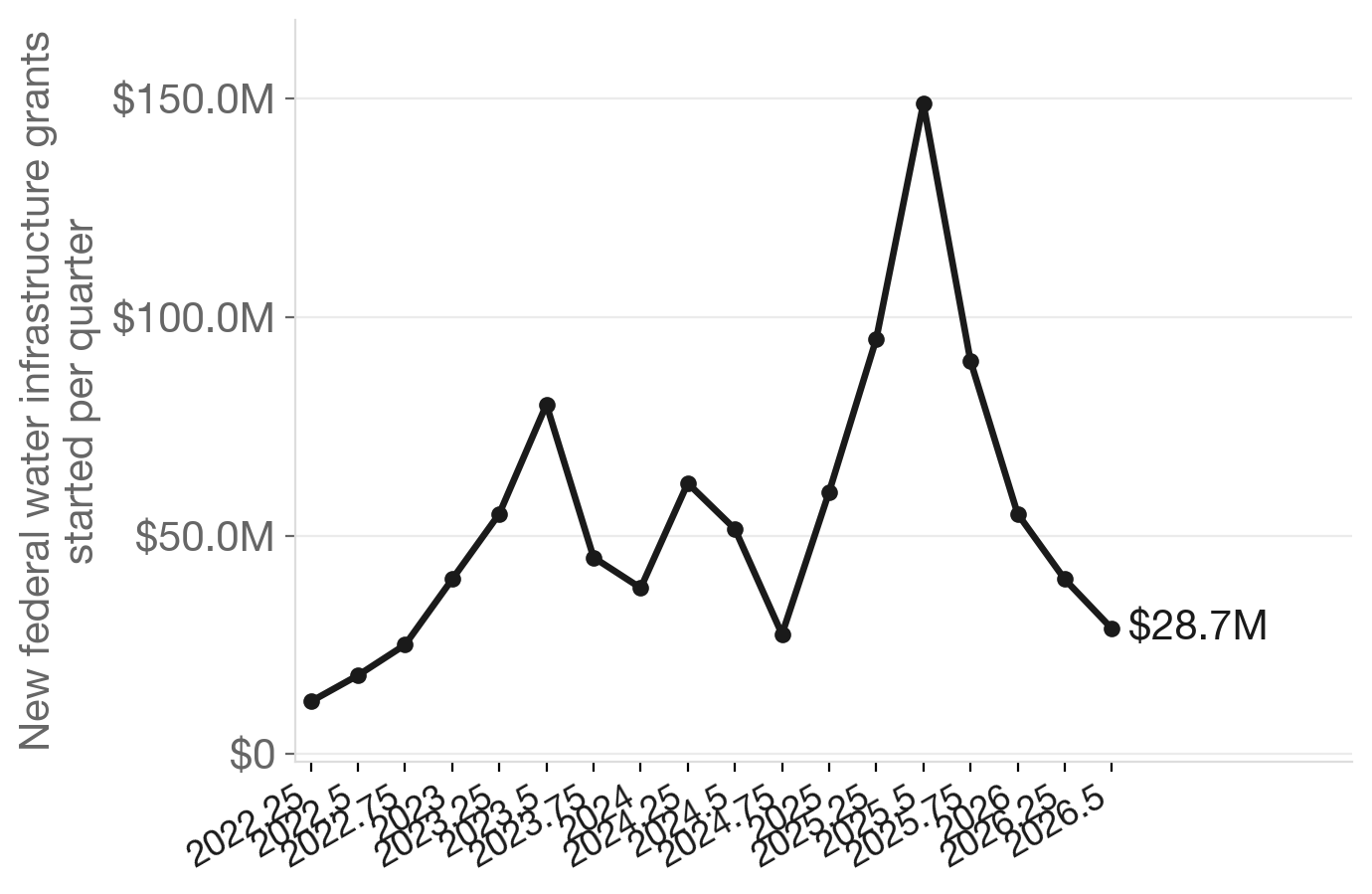
Federal water infrastructure grants flowing into North Dakota have dropped to $28.7 million in the past 90 days, down 83.5% from $173.8 million in the same window a year ago. The number looks alarming. It is not a crisis, it is the scheduled end of a five-year federal spending surge. What happens next is the part worth watching.
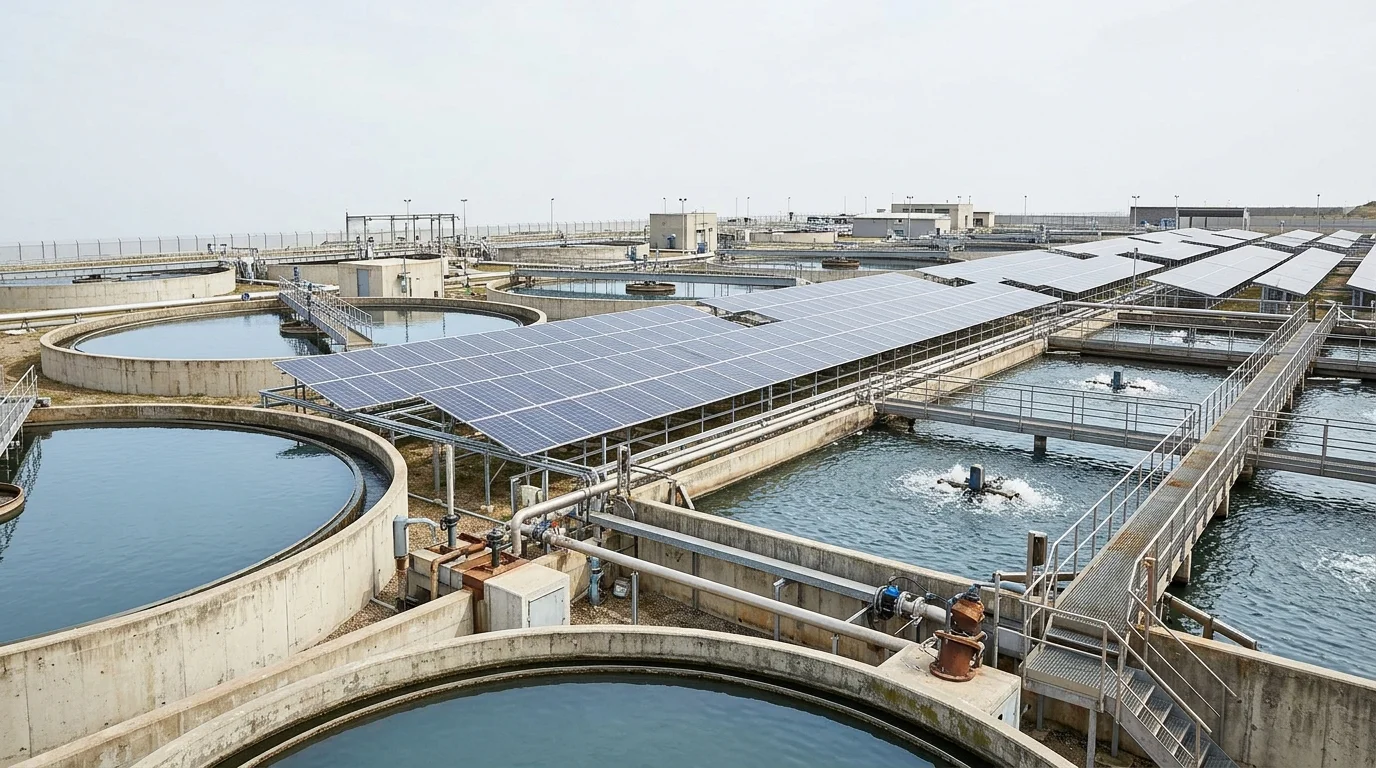
The collapse is almost entirely explained by a single program winding down. The Bipartisan Infrastructure Law (IIJA, P.L. 117-58) directed $8.3 billion to the Bureau of Reclamation in equal annual installments across FY2022 through FY2026. North Dakota captured an outsized share of that money through the Garrison Diversion Unit, a decades-old Bureau of Reclamation system that delivers drinking water to the Three Affiliated Tribes, Turtle Mountain Band of Chippewa, Spirit Lake Nation, and Standing Rock Sioux, as well as to rural non-tribal communities across the state. In FY2023 alone, Senator Cramer's office announced more than $80 million in BOR tribal water awards for those nations. A single $51.5 million IIJA tranche followed for Garrison Diversion Unit expansion. In July 2025, a $74.9 million Bureau of Reclamation grant to the Three Affiliated Tribes anchored the prior year's 90-day total, pushing Q3 2025 to $148.9 million, the apex of the entire IIJA cycle for the state.
FY2026 is the final year of those supplemental appropriations. The large multi-year BOR awards are effectively exhausted. What remains in the current 90-day window are two EPA Drinking Water State Revolving Fund grants, both to the North Dakota Department of Environmental Quality, totaling $28.7 million. That is a historically normal figure for North Dakota outside the IIJA surge. It just looks catastrophic measured against the windfall years.
Source: NationGraph.
Neighboring Great Plains states tell the same story. South Dakota, Minnesota, Montana, Nebraska, and Wyoming all show similarly thin 90-day water grant pipelines right now. This is a national IIJA wind-down, not a North Dakota anomaly.
The structural question is what fills the gap. The short answer, at the moment, is not much. The Trump administration's FY2026 budget proposed cutting the Clean Water and Drinking Water SRF programs by roughly 89% combined, a reduction of about $2.4 billion nationally, as the White House's own budget documents showed. Congress held base SRF funding flat at $3.04 billion nationally under P.L. 119-74, blocking the proposed cuts, but provided no new supplemental billions of the kind the IIJA delivered. The 'One Big Beautiful Bill Act' (P.L. 119-21) did include $1.0 billion for Bureau of Reclamation water storage capacity, though how much of that reaches North Dakota's Garrison Diversion system remains unresolved.
North Dakota's exposure here is sharper than most states. The Garrison Diversion tribal MR&I network has no obvious private replacement for federal capital grants, the communities it serves are rural, the infrastructure costs are large relative to local tax bases, and the program was explicitly designed around federal obligation to tribal water rights. The state also relies on the Red River Valley Water Supply Project for eastern communities, another system with no non-federal capital source at comparable scale.
The near-term picture is not as dire as the 83% headline suggests. North Dakota still holds more than $90 million in active EPA Drinking Water SRF commitments running through 2032 and 2033, money already awarded and disbursing, just not counted as new 90-day starts. Construction already underway on Garrison Diversion expansions continues. The cliff is not today; it is the next capital cycle, when communities need to fund the next phase of expansion or replacement and the federal pipeline that paid for the last one no longer exists at the same scale.
The signal to watch is the FY2027 appropriations process. If Congress does not restore supplemental BOR funding for tribal MR&I systems, or if the 'One Big Beautiful Bill' water storage dollars are directed toward large Western reservoir projects rather than Great Plains distribution infrastructure, North Dakota's tribal water systems face a planning gap with no clear federal backstop. State water officials and tribal authorities have until the end of this fiscal year to understand what the next cycle looks like. The numbers will not look anything like FY2023 regardless. The question is how far below that the new baseline lands.