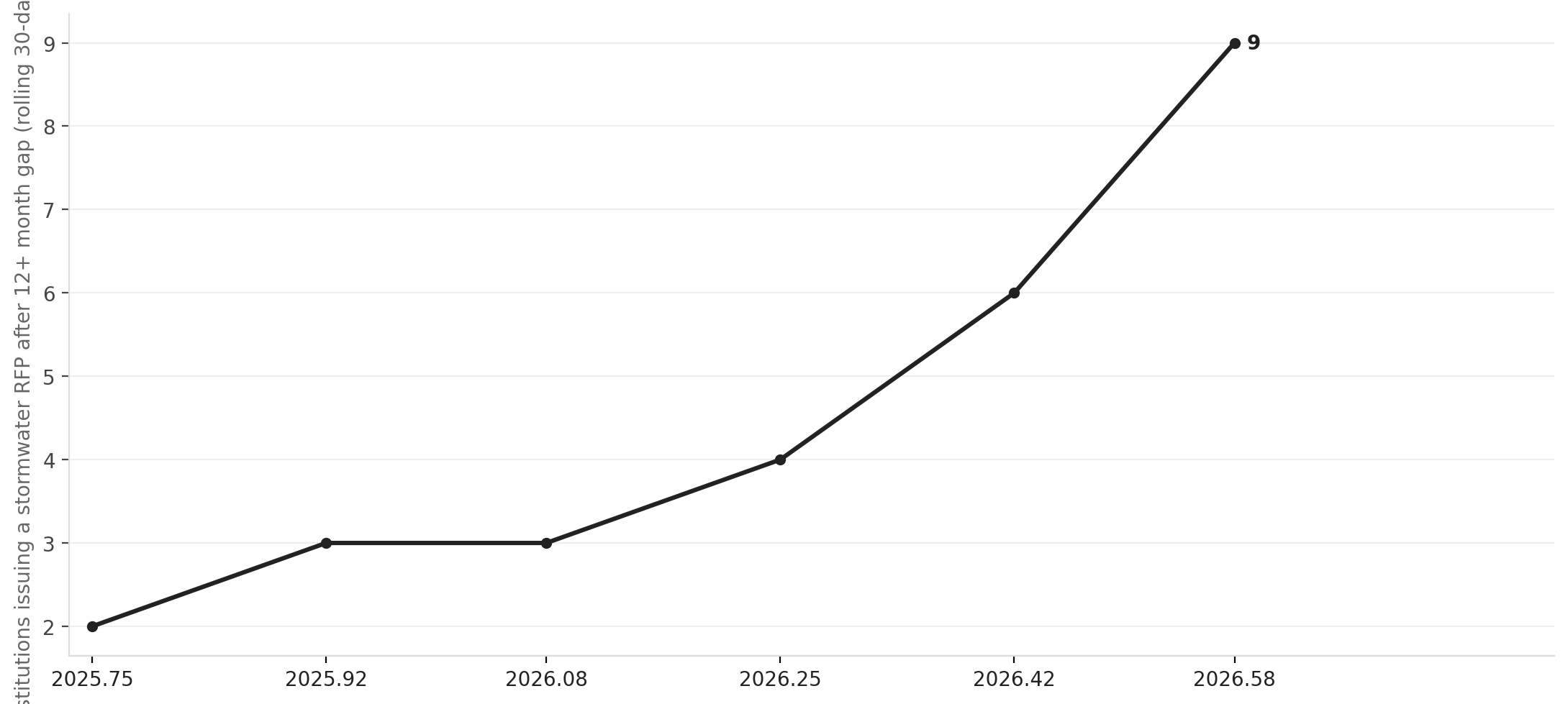
Nine New Jersey institutions issued their first stormwater management RFP in over a year during the 30 days ending July 28, 2026, up from zero in the same window a year earlier. The spike is not a sign of renewed municipal ambition. It is a compliance scramble, and the clock is running short.
The forcing mechanism is a single letter. On January 20, 2026, the New Jersey Department of Environmental Protection formally notified every municipality in the state of its obligation to update its Stormwater Control Ordinance and Municipal Stormwater Management Plan under the 2023 Tier A MS4 General Permit. The deadline is January 20, 2027, exactly 12 months. Municipalities that miss it face enforcement action from NJDEP's Division of Water Enforcement, which has flagged prior missed deadlines for potential action before. That letter converted a policy obligation most municipalities had been deferring into an immediate procurement problem.
The project types appearing in July's RFP wave confirm what's driving it. Cape May County, Cumberland County, and Piscataway Township, all confirmed first-timers with no prior stormwater RFP in the NationGraph database, issued MS4 infrastructure mapping and pipe-condition RFPs within days of each other. MS4 infrastructure mapping, which requires georeferenced shapefiles of every storm drain inlet, outfall, drainage area, and impervious surface in a municipality, was itself due January 1, 2026. That deadline has already passed. Municipalities that missed it are now simultaneously playing catch-up on mapping while facing the January 2027 plan-update deadline, two overlapping obligations that require the same scarce class of stormwater engineering consultants.
Source: NationGraph.
The procurement crunch is structural, not incidental. New Jersey has 564 municipalities, and the 2023 permit collapsed the prior two-tiered system that had given smaller communities a lighter compliance load. All former Tier B municipalities were reclassified as Tier A in July 2022, meaning the full technical requirements now apply uniformly whether a jurisdiction is Bergen County (population 966,564) or Cumberland County (population 128,834). The pool of qualified stormwater engineering firms did not expand when the compliance universe did. Rural counties competing for mapping contracts in July 2026 are bidding against the same suburban municipalities that have been Tier A for years and are now revising plans rather than writing them from scratch.
A bureaucratic lag embedded in the process further compresses real timelines. Updated stormwater ordinances require county approval before they become effective, which means municipalities cannot simply finalize a plan in December and call it done. Engineering work, municipal review, and county approval all have to complete before the January 20 hard stop. For most of the institutions issuing RFPs now, mid-2026 was already the practical deadline for awarding a contract. Several appear to have let that window slip.
The 2023 permit also introduced a planning deliverable that most small New Jersey municipalities have never produced: a climate resilience strategy. Under the new rules, updated plans must assess sea level rise projections, increased flooding frequency, and intensified rainfall intensity. For a township that last updated its stormwater plan a decade ago, this is not a revision, it is a new document. New Jersey's coastline, its position on Raritan Bay and the Delaware River, and its heavily impaired inland waterways make these assessments technically demanding in ways they would not be in a drier, flatter state.
Federal grant dollars are available to fund this work, though access is uneven. NJDEP holds a $72.5 million NOAA Coastal Management grant running through 2029 and a $2.3 million EPA Sewer Overflow and Stormwater Reuse Municipal Grant through 2028, resources that can flow to municipalities undertaking qualifying compliance work. Smaller EPA Congressionally Mandated Project awards have reached individual municipalities directly. But accessing those funds requires grant-writing capacity that many of the smaller, fiscally constrained municipalities now rushing to hire engineers do not have in-house.
The number to watch now is not how many RFPs are issued but how many result in awarded contracts before September. Municipalities that cannot secure an engineering firm by early fall face a compressing timeline: plan drafting, internal review, public comment, and county approval all have to complete before January 20. NJDEP has not announced any extensions, and its compliance advisory record suggests it will not offer them quietly. The institutions that moved in July still have a path. Those that haven't started procurement yet are running out of one.