New Jersey municipalities have issued 42 pickleball-related procurement requests in the last 30 days, more than eight times the baseline rate of roughly five per month, and more than any other state in the country over the same window. Illinois is second with 35; California third with 29. The gap is not explained by New Jersey's love of the sport. It is explained by a single policy change that took effect this year.
The Murphy Administration's 2026 Green Acres funding round, administered by the New Jersey Department of Environmental Protection, made all 564 New Jersey municipalities eligible for a minimum 25% matching grant for park development. Before this round, 402 of those towns were limited to loan-only support. Grants change the math entirely, particularly in a state where the average municipality covers roughly seven square miles and park budgets are perennially thin. The application window closed February 27, 2026. Towns awarded in that cycle are now moving to construction procurement, and the RFP wave is the result.
The Green Acres Program draws its funding from New Jersey's Corporate Business Tax set-aside under the Preserve NJ Act, a state appropriation mechanism. It is not a federal program. A parallel federal stream, the Land and Water Conservation Fund State and Local Assistance Program, flows through NJDEP alongside Green Acres and provides matching grants of up to 50% of eligible project costs. NJDEP received a $7.75 million LWCF grant beginning October 2025 for outdoor recreation acquisition and development. Municipalities may stack the two sources, but they are distinct programs with different eligibility rules and different federal strings attached. LWCF-assisted land must remain public recreation in perpetuity; Green Acres grants carry their own deed restrictions. The state program is the primary engine of this procurement surge; the federal layer adds capacity for individual projects.
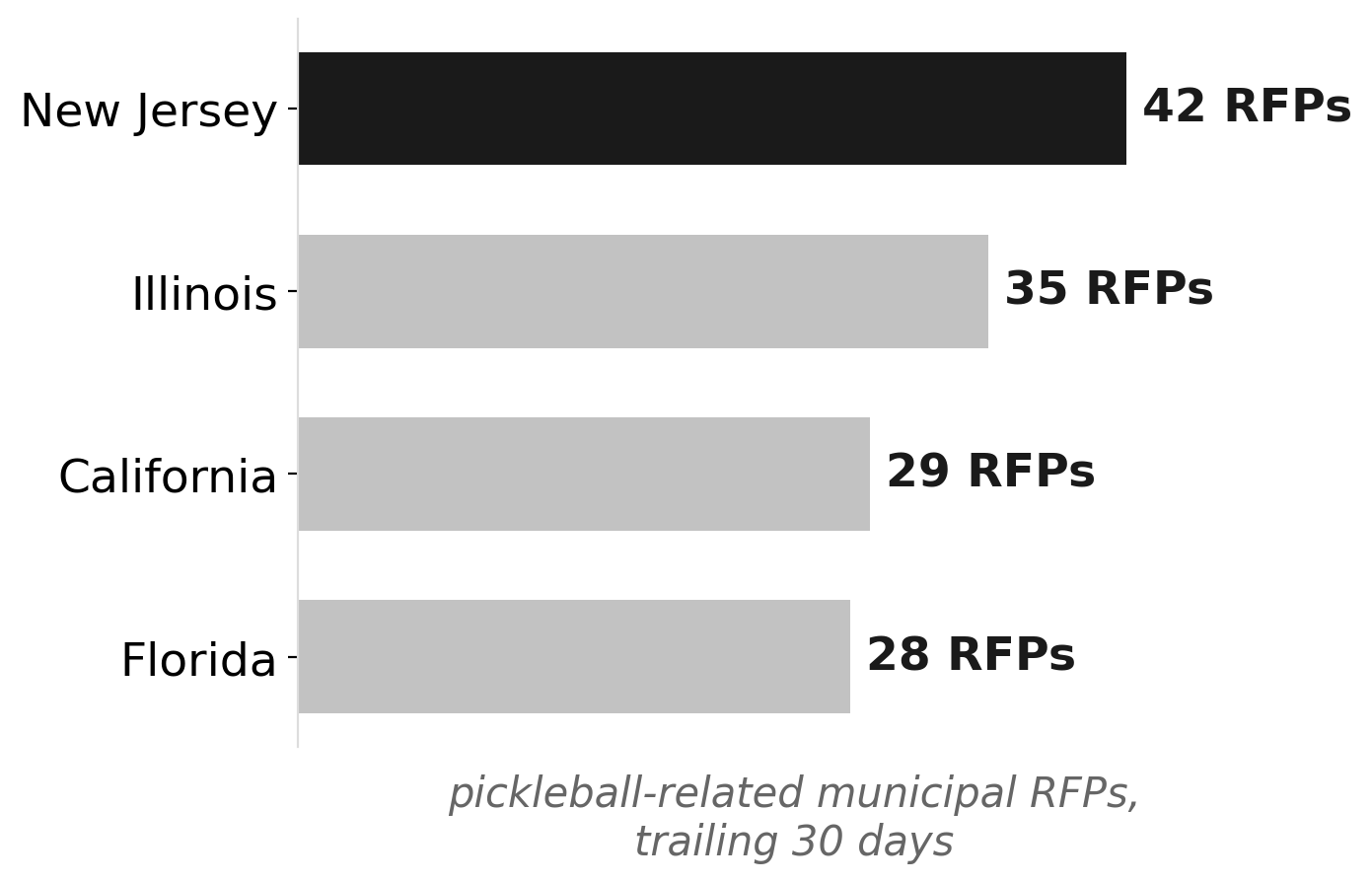
Source: NationGraph.
Under Governor Murphy, New Jersey has committed more than $510 million through Green Acres, more than any previous governor. The 2026 funding round formalized what officials described as the broadest eligibility expansion in the program's history. For the first time, even the smallest and fiscally constrained municipalities could access direct grant dollars rather than taking on debt for a playground or a set of courts.
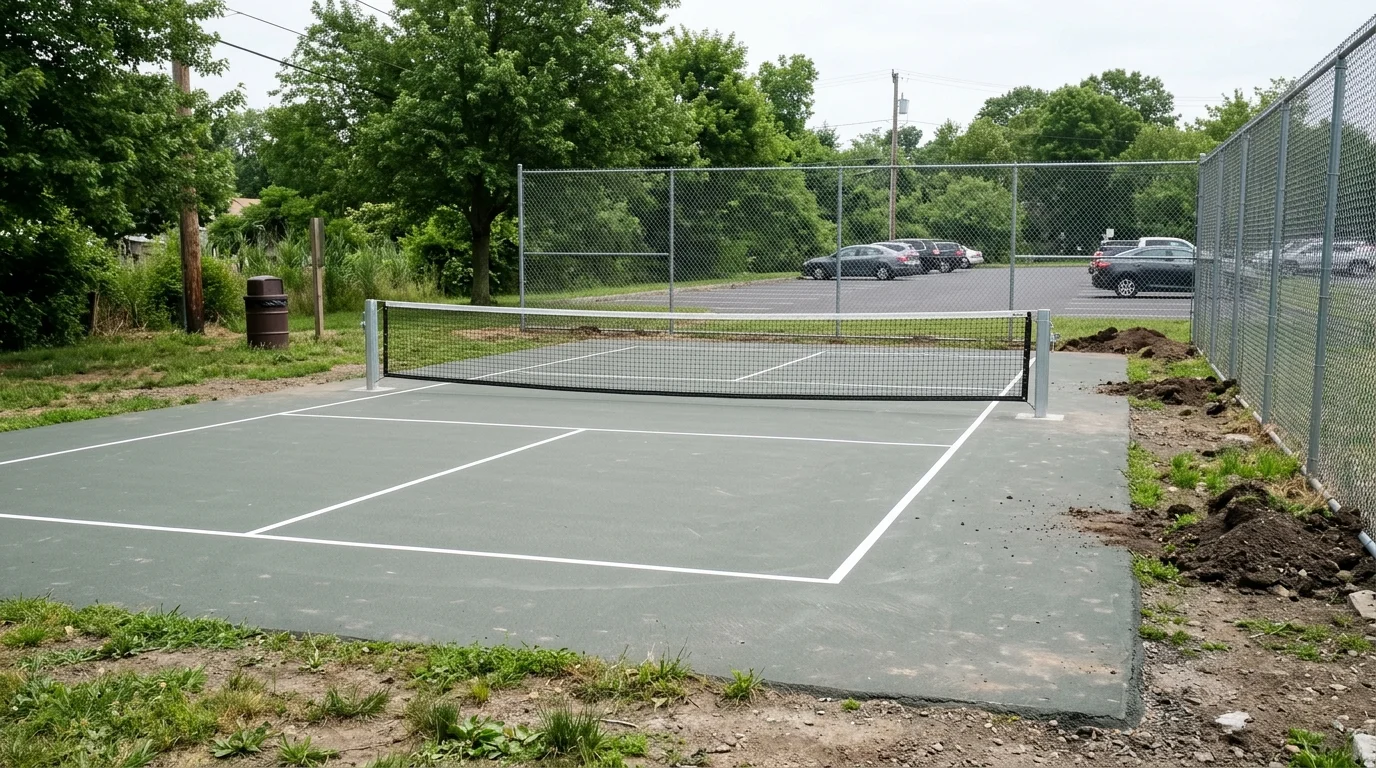
Pickleball is the amenity that keeps appearing in these applications, and the reason is not arbitrary. The sport's core demographic, older adults and suburban households with disposable time, maps closely onto New Jersey's population profile. For a local official in a dense, land-scarce town, a set of pickleball courts occupies a compact footprint, generates visible constituent goodwill, and now qualifies for state grant reimbursement. That combination explains why the sport shows up from Camden County's Timber Creek Park improvements to Hudson County's dual projects at Shetik Field and West Hudson Park, and across all 21 counties in the state.
Two project-level examples illustrate the range. Beachwood Borough received a $337,335 Green Acres award for Mayo Park renovations that include a new pickleball court. Eatontown applied for a $576,002 grant to add six upgraded courts to Wolcott Park. Burlington County moved independently, committing $5 million in county park funding that explicitly named pickleball courts in Riverton and Shamong. The procurement activity visible in the RFP data is the downstream consequence of decisions made at the application stage earlier this year.
The political visibility of these grants is already showing up at public hearings. In Montclair, a February 2026 hearing on a nearly $3 million Green Acres application drew significant community attendance, with debate focused on where the pickleball courts should be placed within the park, not on whether the town should pursue the money. That kind of local engagement, over a state grant application, is a measure of how consequential the program has become at the neighborhood level.
For residents in towns that received 2026 awards, the next visible signal will be construction starts through the winter and into 2027. For towns that missed the February deadline or were not awarded in this cycle, a second opportunity is already open: NJDEP is administering a competitive LWCF Outdoor Recreation Legacy Partnership round (Round 8), with a National Park Service application deadline of November 1, 2026, focused on park renovation in low-income urban communities. A further Green Acres local funding cycle is expected to follow.
What the RFP volume makes plain is that the procurement wave is not at its peak yet. Awards are still being processed, construction timelines vary, and not every winning municipality has issued a contract solicitation. The 42 procurements visible now represent towns that moved fastest after awards were announced. The rest are still in the pipeline.