One hundred and four local governments, fire districts, and conservation agencies issued wildfire-related procurement requests in the last 60 days, more than 3.4 times the prior bimonthly baseline of roughly 30 institutions. October 2026 alone produced 121 wildfire RFPs across 26 states, the highest single-month count in at least 14 months. California led with 50 institutions, Colorado followed with 16, and Washington, Oregon, and Utah added another 18 combined. But the number that most demands attention is the geography at the edges: Kansas, Maine, Massachusetts, and Hawaii are all issuing these same requests in the same 60-day window.
The dominant procurement is unglamorous but load-bearing: the Community Wildfire Protection Plan, or CWPP. A current CWPP is the admission ticket to the USDA Forest Service's Community Wildfire Defense Grant program, which carries roughly $200 million per funding round and offers up to $10 million per applicant for mitigation projects, funded under the Infrastructure Investment and Jobs Act. Without an up-to-date plan on file, a locality cannot apply. That eligibility requirement, combined with the worst wildfire season in at least a decade, is what is driving the clock.
The 2026 fire season has supplied the urgency. Nearly 63,000 wildfires have burned more than 9 million acres nationally, roughly 164 percent of the 10-year average. Oregon shattered its all-time acreage record, topping 2.3 million acres. Washington Governor Bob Ferguson issued an emergency declaration and the state subsequently doubled its fire budget to $120 million through the Washington Wildfire Alleviation Support Act, a state-level revenue mechanism separate from any federal program. Colorado, with 16 institutions now in procurement, has $164 million in active USDA and Infrastructure Investment and Jobs Act wildfire grants already running, suggesting that its procurement surge reflects both new demand and an established infrastructure for absorbing federal dollars.
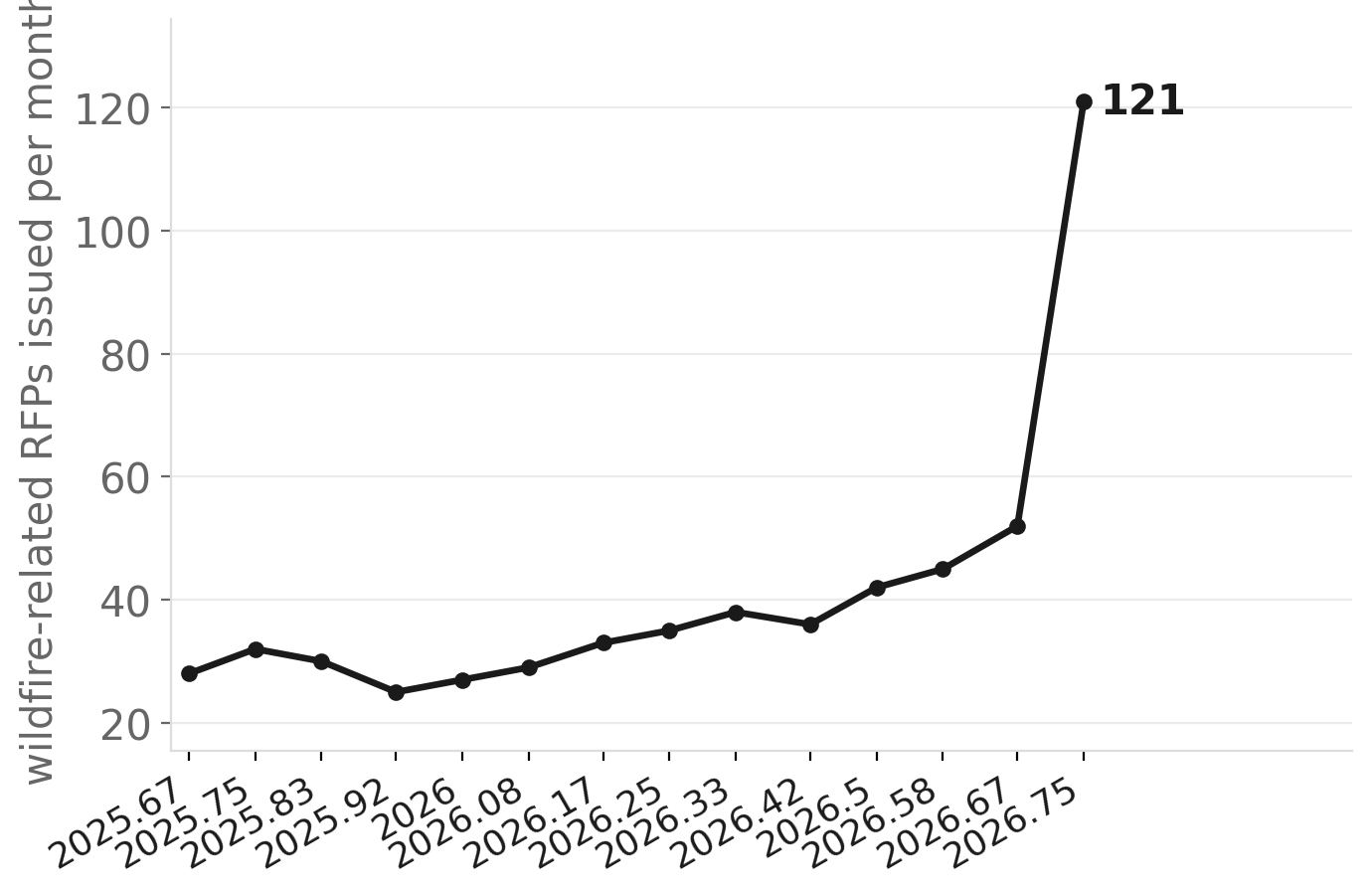
Source: NationGraph.
For most of the localities now drafting RFPs, the CWDG program is the direct trigger. The grant awards up to $250,000 specifically for CWPP creation or updates, and up to $10 million for mitigation project implementation, with a 25 percent local match required for the larger awards. A community that gets its plan written and submitted before the next award cycle closes is positioning itself for a meaningful capital infusion. A community that waits is not. That math is visible in the procurement data: the categories showing up most often are CWPP creation, CWPP 10-year updates, and hazardous fuels reduction planning, with supplementary bids for wildfire mapping and, in Montana, a Type 1 heavy helicopter.
A second policy driver is building behind the first. The Fix Our Forests Act passed the House 279 to 141, cleared the Senate Agriculture Committee 18 to 5, and received a White House endorsement on August 10, 2026. If it clears a Senate floor vote, it would create a new $100 million per year Community Wildfire Risk Reduction Program and streamline existing CWDG-type programs. Critically, the Fix Our Forests Act is not yet law and is not the current funding trigger. But it gives localities a second reason to have a current CWPP on file now: eligibility under a potential future program is easier to demonstrate if the paperwork already exists.
There is also a complication in the pipeline. Federal workforce reductions at the Forest Service, including more than 100 employees cut in Minnesota alone, have slowed some grant disbursements. That friction has added its own urgency: localities that complete their CWPP documentation earlier are better positioned to move quickly once award cycles open, regardless of administrative delays at the federal level.
The geographic spread of the October surge is where the structural shift becomes legible. Community Wildfire Defense Grants are available to any "at-risk community" as defined by the USDA, a designation that is not confined to the West. Hawaii received a $4.6 million CWDG award in the trailing 90 days, a five-year commitment reflecting the vulnerability exposed by the 2023 Maui fires. Maine and Massachusetts, both issuing CWPP RFPs, sit in a region where drought cycles and forest composition are creating conditions that did not historically require this kind of formal planning infrastructure. Kansas, which experienced its own significant fire activity in 2026, is now doing the same.
The active grant portfolios reflect where the money has historically flowed: California holds $440 million in active wildfire grants, Oregon $180 million, Colorado $164 million, Washington $158 million, and Montana $112 million. Those figures represent years of compounding investment in fire resilience infrastructure. The October procurement spike suggests a second tier of states and localities is now trying to build the same foundation, under deadline.
The next signal to watch is the Senate floor schedule for the Fix Our Forests Act. If it passes, the $100 million annual Community Wildfire Risk Reduction Program will extend the eligibility logic that is already driving this procurement wave, and localities without a current CWPP will face a second missed opportunity. The CWDG award cycle timeline is the more immediate deadline for the 104 institutions already in procurement.