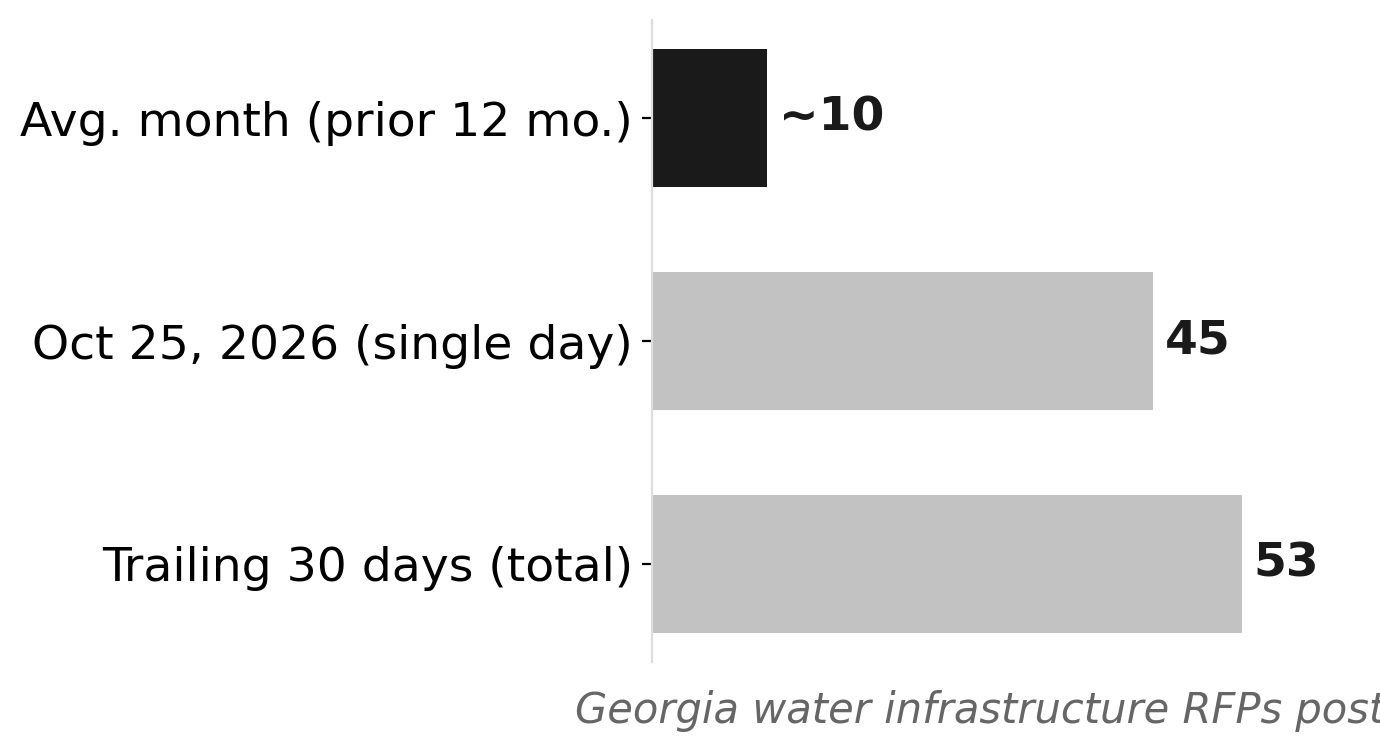
Forty-five Georgia municipalities posted water infrastructure procurement solicitations on a single day, October 25, 2026, pushing the state's 30-day RFP count to 53, against a 12-month average of roughly 10 per month. That is a 5.1x spike, and its shape matters as much as its size: this was not a gradual build driven by local budget cycles. It was a batch release, the visible signature of the Georgia Environmental Finance Authority disbursing a coordinated tranche of federal water funds to dozens of small towns at once.
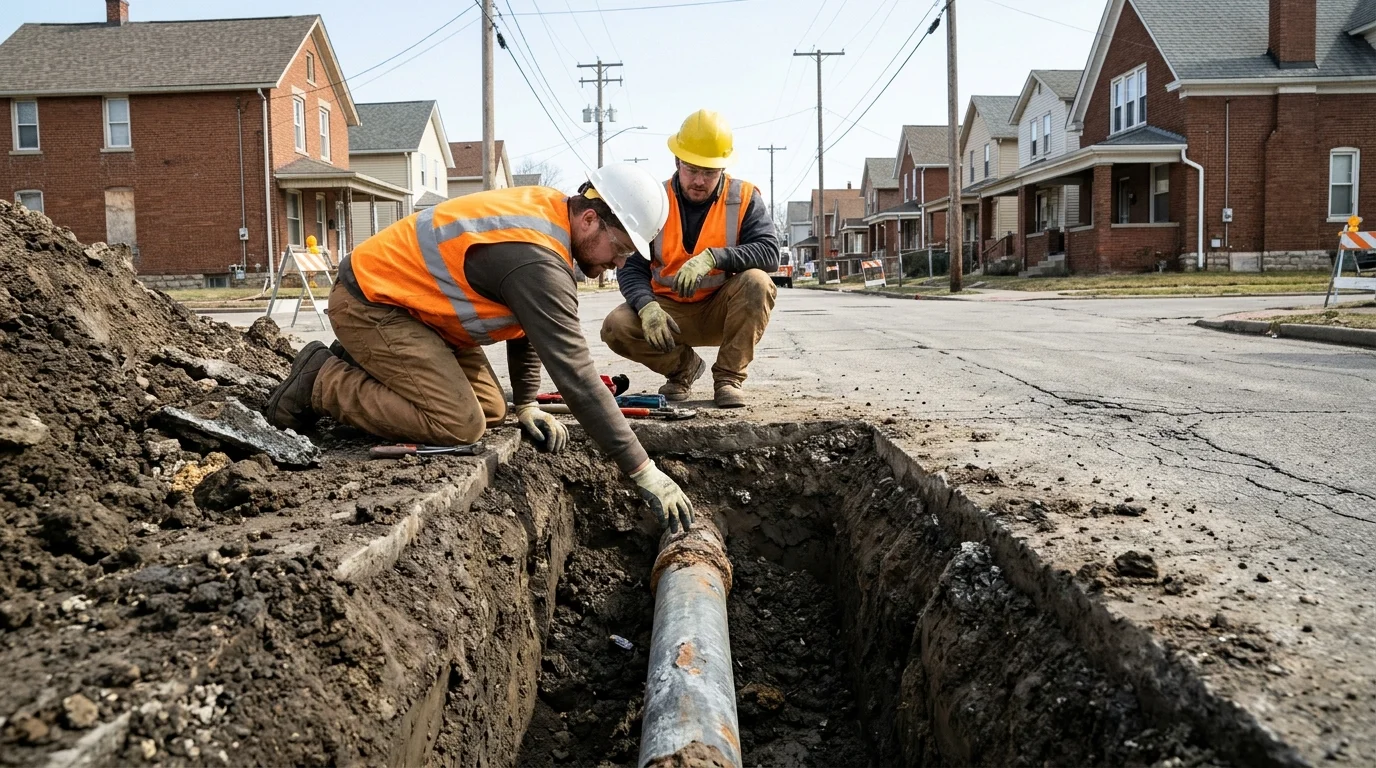
The towns doing the procuring are not Atlanta. They are Wadley, Manchester, Louisville, Zebulon, Griffin, and Montezuma, each soliciting engineering design and qualification services for clean water or wastewater system upgrades. Atlanta does appear in the data, with three RFPs including on-call diving services for its water system, but the weight of the surge sits firmly in rural Georgia, in counties like Appling, Jefferson, Monroe, Pike, Taliaferro, and Walker.
The reason these communities are moving now, together, comes down to two deadlines arriving at the same moment.
Source: NationGraph.
First, GEFA's Helene Resilience Funding cycle. After Hurricane Helene's disaster declarations, GEFA designated a supplemental tranche of its Clean Water and Drinking Water State Revolving Fund programs as "Helene Resilience Funding" to improve outreach clarity for affected communities. That Intended Use Plan went through a public comment period closing September 21, 2026, and once finalized, it triggered award notifications to small communities that must now hire engineering firms before year-end to keep the funds in motion. The RFP language reflects this directly: solicitation titles across the batch cite "Clean Water Infrastructure Resilience Projects" and "Public Infrastructure Improvements," mirroring GEFA's own IUP framing almost word for word.
Second, the federal funding cliff. The Infrastructure Investment and Jobs Act's water infrastructure authorization expired September 30, 2026. Congress has not passed reauthorization, and the President's FY27 budget proposes cutting Clean Water and Drinking Water SRF capitalization grants by nearly 90%, from $2.7 billion to $305 million nationally. For Georgia, which has received $571 million in DWSRF allotments and $232 million in CWSRF allotments since 2022 under IIJA, that ceiling does not reopen at anything close to current levels once it closes. Communities that have been waiting in GEFA's pipeline now have a hard stop.
GEFA sits at the center of all of this. The authority administers $1.03 billion across 29 active federal water grants, all flowing from EPA capitalization grants that GEFA then re-lends or re-grants to local governments. Several of those programs, the base SRF cycles, the Helene supplemental IUPs, and the distinct Emerging Contaminants in Small or Disadvantaged Communities grants, are funded under IIJA and are reaching their final disbursement cycles simultaneously. Earlier this year, GEFA disbursed $39.3 million in SRF infrastructure loans to 12 communities in February and $34.3 million in PFAS and emerging contaminant grants to 16 communities in March. The October procurement wave is the downstream consequence of those awards: money has been committed, and engineering contracts have to follow.
Georgia is not alone in this sprint. Florida logged 63 water infrastructure RFPs in the same 30-day window, North Carolina posted 34, Alabama 20, and South Carolina 19, confirming a Southeast-wide end-of-IIJA procurement surge. But Georgia's concentration among small towns is distinctive, and it reflects a structural problem that predates Helene. Senator Jon Ossoff cosponsored the bipartisan Clean Water Allotment Modernization Act on September 23, 2026, citing Georgia's $12.5 billion drinking water investment gap and arguing that the existing CWSRF formula systematically underweights the state's population and infrastructure demand. The bill targets the same chronic underfunding that made the IIJA window so consequential for Georgia in the first place.
The open question is whether these communities can actually execute. Rural municipalities procuring engineering services in a compressed window face a shallow bench of qualified local firms, rising construction costs, and staff capacity limits that make project management difficult. GEFA's grant terms require engineering milestones to proceed before disbursement continues, so a community that wins an award but fails to contract and scope a project on time risks losing the funding. The batch-release design may help coordination across communities, but it also means dozens of small towns are competing for the same regional engineering firms at the same time.
The next signal to watch is how many of the October 25 solicitations result in executed engineering contracts by year-end. That conversion rate will indicate whether Georgia's rural water systems can absorb the procurement surge or whether the funding cliff claims projects that were technically awarded but never built.