Federal AI grants newly committed to Virginia institutions have hit $16.9 million in the last 90 days, a 252% jump over the $4.8 million that arrived in the same window a year ago. That surge is real, and it reflects genuine momentum at the University of Virginia, Virginia Tech, Old Dominion, and George Mason. But the number that matters most right now is not $16.9 million. It is one: the number of awards the National Science Foundation will make per state under its new $100 million AI Infrastructure Hubs program, with full proposals due November 4, 2026.
The surge in recent commitments flows from two federal programs that launched in 2026, both driven by the same policy document. White House OSTP Director Michael Kratsios released "Science: A New Golden Age" in July 2026, declaring AI-enabled scientific discovery a national mission and directly prompting NSF's hub initiative. The NSF State and Regional AI Infrastructure Hubs program (NSF 26-513), announced August 4, will distribute $4 million to $12 million per award over five years, with NVIDIA, AMD, Intel, and Dell listed as private-sector partners. One state, one check.
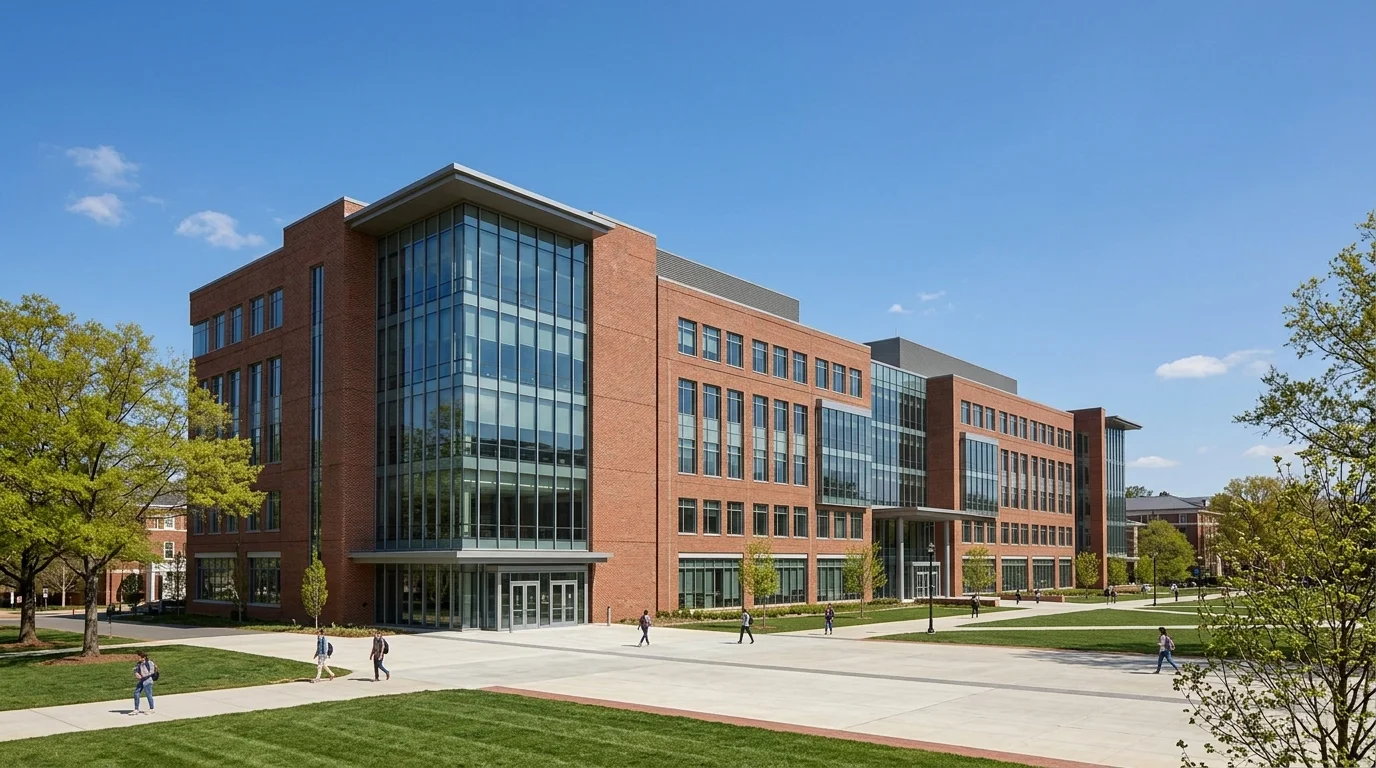
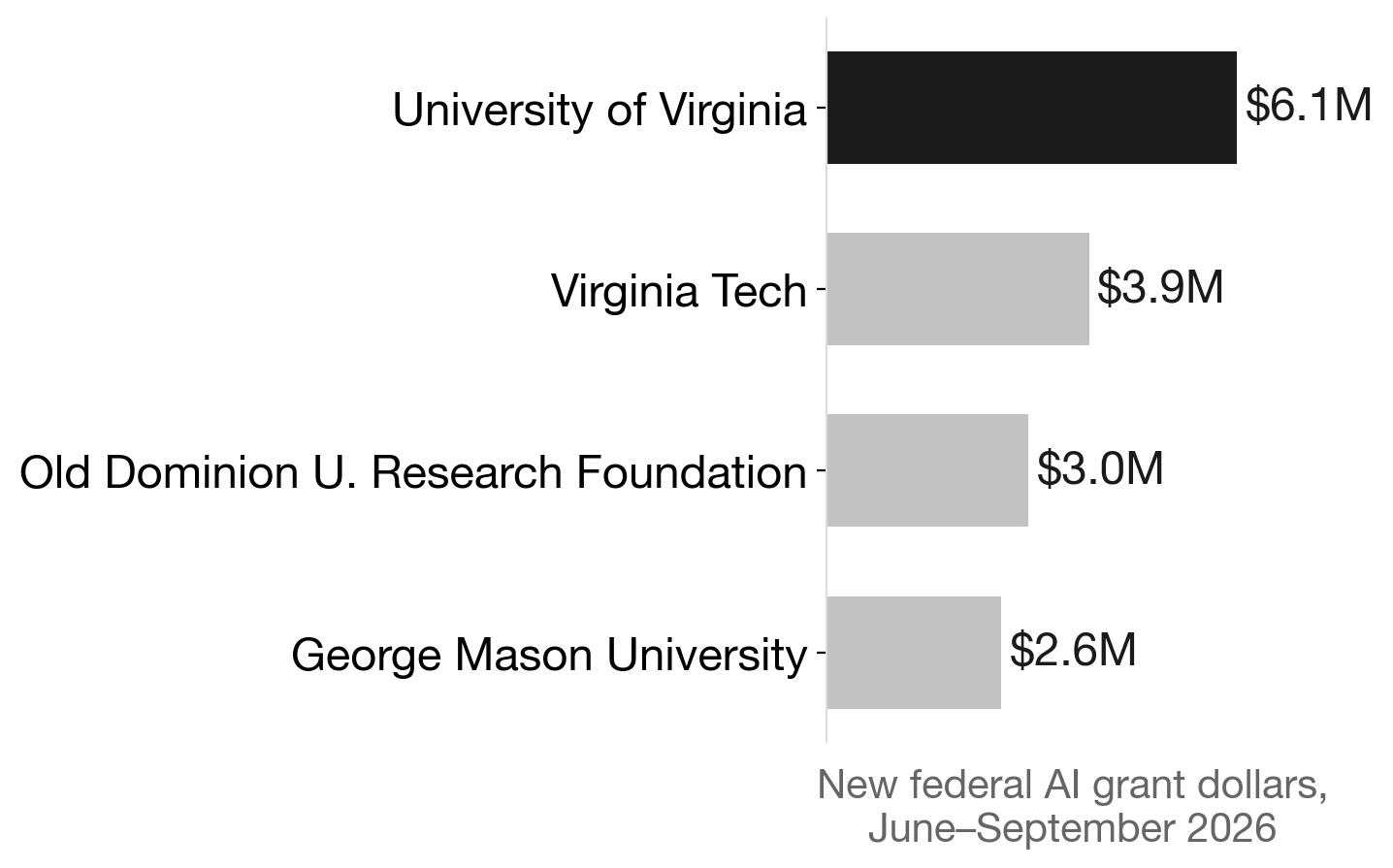
NSF accounts for $13.9 million of Virginia's 90-day haul across 30 awards, with a single $3 million ARPA-E award to the University of Virginia in late July adding the remainder. UVA leads all Virginia recipients at $6.1 million across six awards. Virginia Tech follows at $3.9 million across ten. Old Dominion's research foundation received $3 million across three awards, and George Mason captured $2.6 million across seven. The breadth here is the point: four institutions are each building independent track records and independent relationships with program officers, which is exactly the configuration that makes assembling a unified consortium difficult.
Source: NationGraph.
Virginia Tech's position is worth examining closely. The university secured three Phase I awards from the DOE's Genesis Mission, selected July 22, 2026 from more than 5,000 applications across 278 funded projects. The Genesis Mission, which activated its formal RFA in March 2026 and carries $298 million in total funding, covers quantum computing, climate AI, and a third discipline in Virginia Tech's case. Each Phase I award runs $500,000 to $750,000, but the Phase II tier carries $6 million to $15 million per project. Virginia Tech's three selections represent a quiet windfall in progress, and they signal that the university's research profile aligns well with federal AI-for-science priorities.
UVA, meanwhile, is not starting from scratch. Beneath the new 90-day commitments sits a substantial active portfolio: a $37.8 million HHS AI-related grant running through 2027 and a $2.1 million DOE Office of Science award. George Mason carries a $5 million NSF Technology, Innovation and Partnerships grant through late 2026. These are institutions with demonstrated capacity to manage large federal AI investments. The question the NSF hub deadline forces is whether they can direct that capacity collectively rather than independently.
Virginia ranks fifth among peer states in raw 90-day AI grant volume, trailing California ($60 million), Texas ($38 million), New York ($30 million), and Massachusetts ($22 million). But its 252% year-over-year growth rate leads the peer group. That gap between volume and velocity is the clearest way to read Virginia's position: the state is gaining ground faster than any comparable competitor, but the competitors still hold more ground.
The structural argument for Virginia is genuine. The state's corridor of research universities, from Charlottesville to Fairfax to Norfolk, sits adjacent to the Pentagon, DHS, and NSA in Northern Virginia, a geography that has historically made the state a natural home for dual-use research blending academic and national-security applications. The NSF hub program's emphasis on regional infrastructure and private-sector partnership fits that profile. What does not fit neatly is the one-bid requirement. Virginia's universities have not faced a coordination problem at this scale before: a single November deadline that rewards consolidation over competition, with no consolation award for the runner-up.
For researchers and administrators at any of the five major Virginia research universities, the immediate signal to watch is who surfaces as the lead institution on the NSF hub proposal. That choice will effectively define the state's AI research hierarchy for the next five years. For Virginia residents and policymakers, the downstream question is simpler: whether a state with this much momentum and this much structural advantage manages to translate a 252% surge in annual grant receipts into durable infrastructure, or whether the November deadline arrives with five incomplete proposals and one missed opportunity.