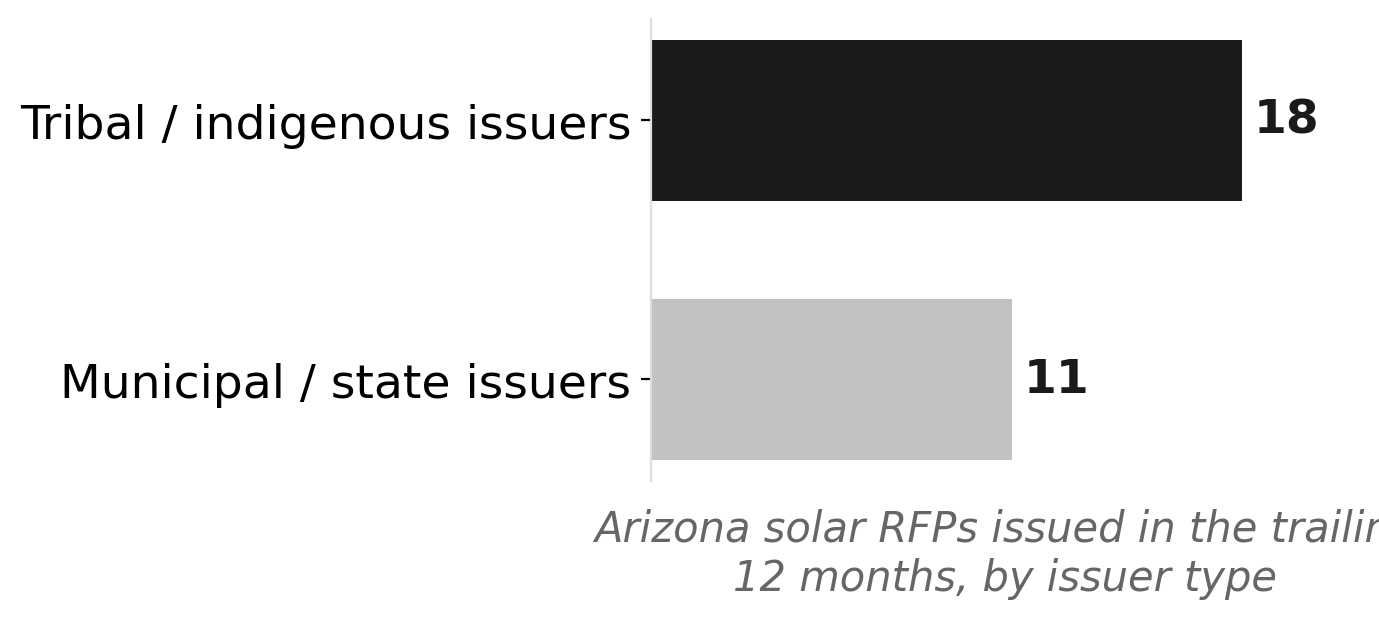
Arizona logged five solar procurement requests in the past 30 days, roughly double the state's monthly baseline, but the more consequential number is 18 out of 29. That is how many of Arizona's solar RFPs over the past 12 months originated from tribal and indigenous agencies, nearly twice the count from cities and state offices combined. The agencies moving fastest on solar in Arizona are not Phoenix or Tucson. They are the Navajo Tribal Utility Authority, the San Carlos Apache Tribe, the Gila River Indian Community, and the Cocopah Tribe, and they are doing it with federal deployment capital that municipalities cannot access.
Three active federal grants are currently funding tribal solar construction across the state: a $4 million DOE renewable energy grant to the San Carlos Apache Tribe, a $5 million DOE grant to the Cocopah Indian Tribe, and a $9.75 million EPA Climate Pollution Reduction Grant to the Salt River Pima-Maricopa Indian Community, totaling roughly $18.75 million now flowing into tribal solar infrastructure. On March 25, 2026, the DOE issued a new $50 million tribal energy funding notice, with individual community deployment grants up to $7.5 million, for which Arizona tribes with existing DOE relationships are well-positioned applicants. This is sovereign capital operating outside state regulatory frameworks, and it is moving at a speed no city permitting office can match.
The urgency for municipalities is different in kind but arriving at the same moment. Salt River Project raised fixed residential service charges 50 percent in November 2025. APS has filed for a rate increase of roughly 14 percent. Both utilities are under pressure from the same source: Arizona's data center buildout. The state had more than 2,000 MW of existing data center load as of the Arizona Corporation Commission's April 2026 workshop, with more than 10,600 MW of additional planned capacity in the pipeline. SRP's own Integrated System Plan concludes it will need to at least double its generation capacity within a decade. SRP's February 2026 All-Source RFP seeking up to 2,900 MW of new capacity is the clearest public signal of how large that gap has become. APS set a new peak demand record of 9,164 MW on August 2, 2026; SRP hit 9,072 MW on July 24.
Source: NationGraph.
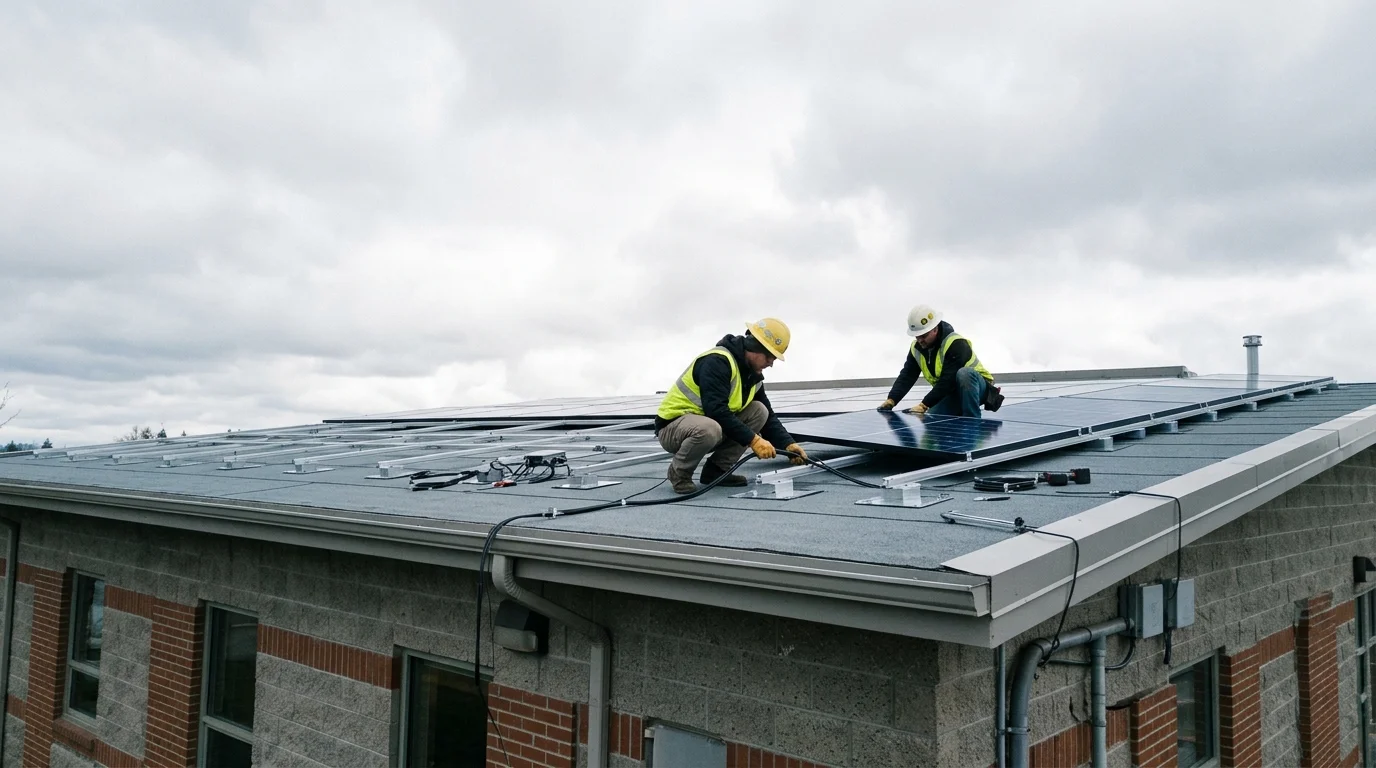
For municipal budget officers watching those numbers, the calculation has changed. Self-generation is no longer primarily an environmental commitment; it is a hedge against utility rates driven by customers their cities did not invite. The current 30-day procurement cohort reflects exactly this logic. Tempe is running a residential solar and energy storage group purchasing program aimed at letting homeowners lock in generation costs before the next rate cycle. The town of Kearny is installing solar at its wastewater treatment plant using federal funds, with prevailing-wage requirements attached. These are financial decisions dressed in sustainability language.
Three distinct policy levers are accelerating this activity, and they should not be mistaken for a single coordinated Arizona solar initiative. DOE tribal energy grants fund deployment capital directly for sovereign utilities operating outside the state's regulatory structure. Arizona HB 2033, effective January 1, 2026, mandated instant online solar permitting for municipalities, eliminating the engineering-stamp requirement and compressing timelines for cities that have adopted SolarApp+, including Mesa, Gilbert, Chandler, and Scottsdale. Arizona SB 1419, effective June 19, 2026, added residential solar consumer protections but does not fund construction. Each lever moves a different part of the market. The tribal procurement wave and the municipal rate-hedge wave are parallel responses to the same grid stress, not branches of the same program.
The political environment is sharpening the urgency further. Governor Hobbs' April 2026 Energy Promise Task Force report warned that proposed data center loads could require up to 29,000 MW of new generation statewide, a figure that reframed the conversation from climate policy to grid solvency. Arizona Attorney General Kris Mayes has called for pausing new data center approvals, a position that reflects how contested the load-growth question has become at the state level. Neither position resolves the underlying math: Arizona averages 270 sunny days per year and ranks second nationally for solar potential, but the question of who captures that resource, and who pays for the transmission that data centers are consuming, remains open.
The next signal to watch is DOE's award decisions on the March 2026 tribal energy NOFO, which could send another round of deployment capital to Arizona nations already mid-construction. For municipalities, the clock is the APS rate case, with a decision expected no earlier than late 2026. Cities that have not yet issued solar RFPs will face a different cost environment when that order lands.