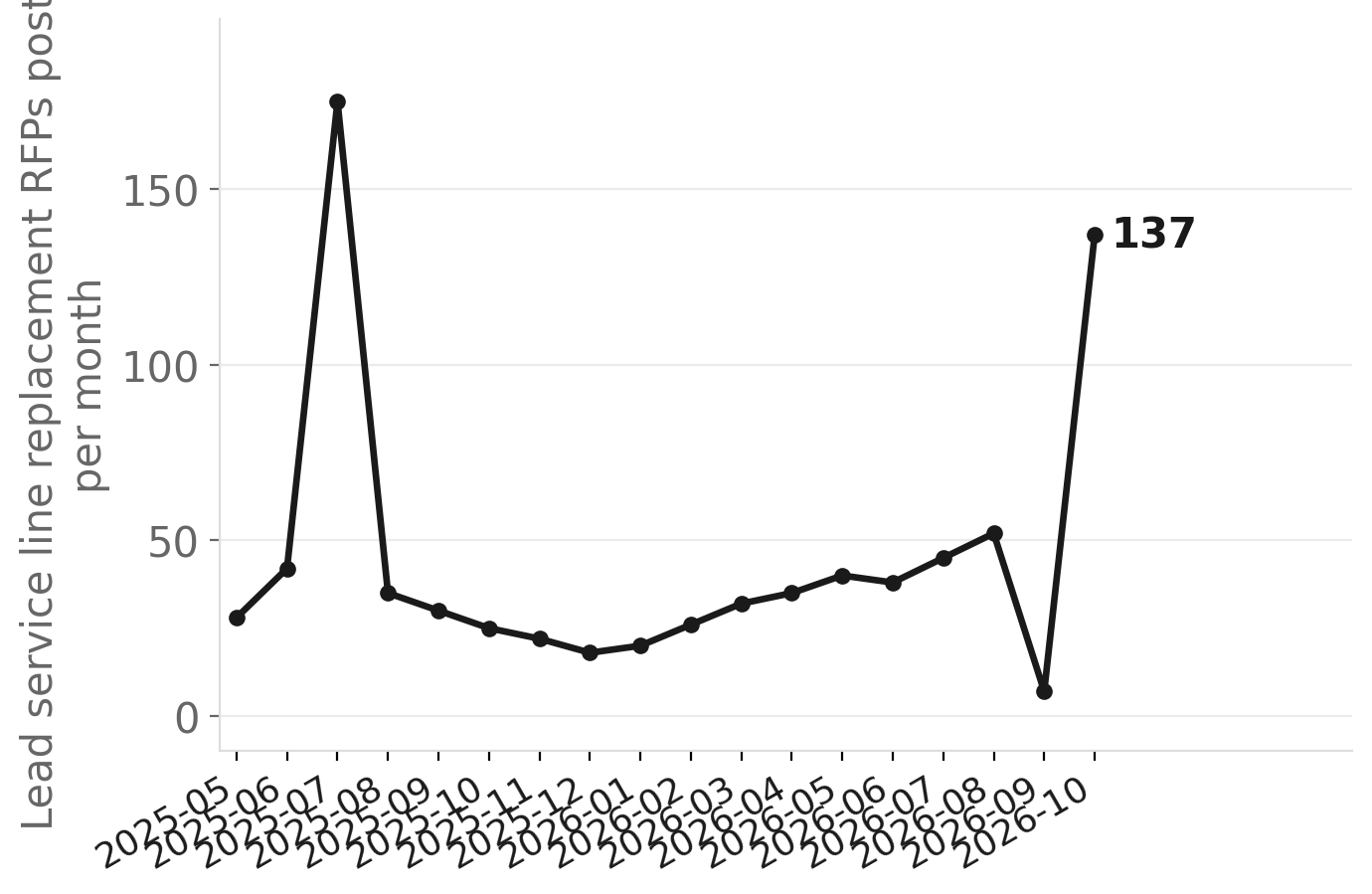
Water utilities across 16 states issued 144 lead-pipe replacement RFPs in the past 60 days, a spike roughly 3.9 times the prior 12-month bimonthly average of about 28. October 2026 alone produced 137 of them, the largest single-month volume in 18 months of data. The institutions behind those procurements are not doing routine maintenance. Their contract language says so explicitly: "Lead Service Line Replacement Phase 11B," "2026 Lead Service Line Improvements." These are compliance projects, and they are on a clock.
Two separate federal instruments created the clock. The Infrastructure Investment and Jobs Act dedicated $15 billion over five fiscal years to lead service line replacement through the Drinking Water State Revolving Fund. On May 20, 2026, EPA announced the final $2.875 billion allotment, the fifth and last annual round of that appropriation, with no successor funding authorized. States have until September 30, 2027 to apply for their share; unused portions get reallocated. Separate from the spending, EPA's Lead and Copper Rule Improvements set a regulatory mandate under the Safe Drinking Water Act: water systems must finalize their baseline lead-pipe inventories and replacement plans by November 1, 2027, with full replacement required by December 31, 2037. The IIJA money helps utilities comply; the LCRI compels them to comply regardless of whether the money exists. That combination, a finite federal grant program expiring at the same moment a binding federal rule kicks in, explains why procurement offices are moving at the same time.
Illinois and Michigan lead the surge at 13 procuring institutions each, followed by California and Minnesota at 11, and Wisconsin at 10. The geographic concentration is not accidental. Great Lakes and Northeastern states carry the highest density of aging lead service lines, most of them in pre-1950s industrial cities where lead pipe was the standard for decades. Illinois is also the single largest FY2026 DWSRF recipient, receiving 10.76 percent of the total national allocation, which maps directly onto its top-ranked procurement volume. Michigan's political urgency around lead pipes has been acute since Flint, and the state has adopted replacement standards stricter than the federal baseline. The active federal DWSRF awards currently running in the top states total at least $334 million, with Michigan holding $24.6 million and New Jersey $16.5 million.
Source: NationGraph.
Named procuring entities illustrate the scale of individual commitments. Battle Creek, Michigan, is working against an $18.3 million active DWSRF grant. Brainerd, Minnesota, has two concurrent 2026 LSLR projects in procurement simultaneously. Rockford, Illinois, is soliciting bids for Phase 11B of a replacement program that has been running long enough to have ten predecessors. These are not first-time projects; they are utilities that have been in the replacement pipeline for years and are now accelerating to capture the last available federal dollars.
California's appearance at third nationally (11 institutions) stands out. The state has a comparatively younger water infrastructure base than the Rust Belt but a large number of smaller water systems and an aggressive state-level enforcement posture on lead. Its strong showing suggests the DWSRF surge is not purely a Great Lakes phenomenon.
A third pressure point is adding urgency beyond the funding deadline and the regulatory calendar. AWWA v. EPA, the industry trade group's challenge to the LCRI's 10-year replacement mandate, was argued at the D.C. Circuit on September 30, 2026, with no ruling yet. The American Water Works Association contends the mandate is technically infeasible and that EPA exceeded its statutory authority. Notably, the Trump administration defended the Biden-era rule in oral arguments. A decision could arrive as late as early 2027. Utilities that wait for the ruling before signing contracts risk losing both federal money and months of construction season. The rational response is to procure now and adjust if the court modifies the rule, rather than pause and find the funding window has closed.
Even at full deployment, the $15 billion IIJA commitment covers only a fraction of the problem. The Environmental Policy Innovation Center estimates it amounts to 15 to 21 percent of total replacement costs in the most burdened states, against a national total estimated at $45 to $60 billion for the approximately 4 million lead and galvanized service lines still in use. Congress proposed cutting $125 million in additional LSLR funding in a January 2026 spending package, a signal that future federal appropriations for this work are not guaranteed.
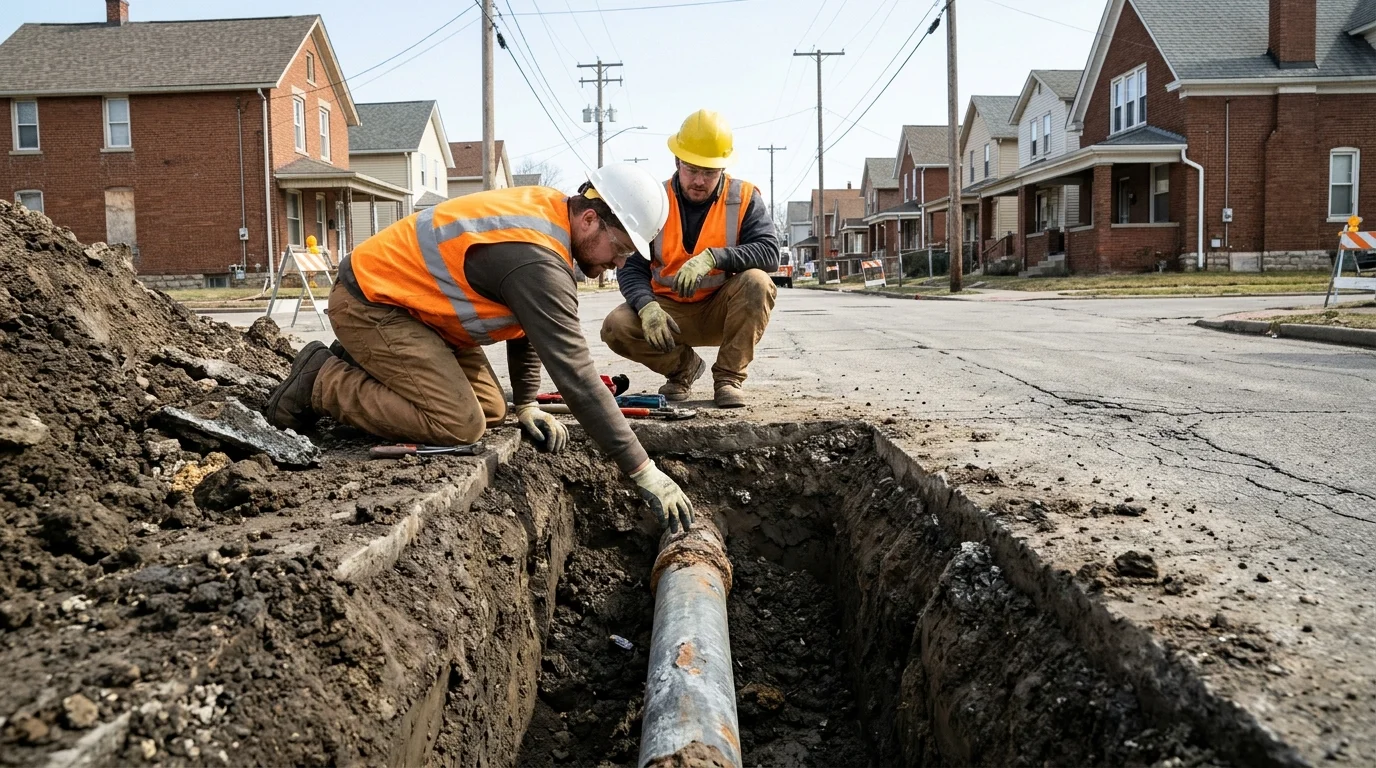
For residents in the cities now advertising bids, the immediate effect is straightforward: street excavation, service disruptions, and, if the work goes to plan, a pipe connecting their home to the main that does not leach lead. For utilities that miss the procurement window, the LCRI mandate does not disappear, it just arrives without a federal grant to help pay for it. The next signal to watch is the D.C. Circuit ruling. If the court upholds the LCRI in full, the November 2027 deadline firms up and any utility that has not yet cut contracts will face intense pressure to act in an already crowded construction market. If the court vacates or narrows the mandate, the calculus shifts, but the federal money will already be spoken for by the utilities that moved first.