Broadband procurement RFPs filed by public institutions reached 197 across 43 states in October 2026, roughly seven times the prior 12-month monthly average of 27. The surge was not driven by any single governor's priority or regional spending push. It was driven by a calendar: two unrelated federal broadband programs, administered by two different agencies, hit their procurement triggers in the same week.
The first clock belongs to the E-Rate program, the Federal Communications Commission's $4.4-billion-per-year subsidy that connects K-12 schools and libraries to broadband. USAC opened the FY2027 EPC Administrative Window on October 21, 2026, the mandatory starting gun for school districts to post competitive bidding requests (FCC Form 470s) before they can apply for funding in the Form 471 filing window expected in early 2027. Any district that wants E-Rate dollars for the year beginning July 1, 2027 must run a 28-day competitive bidding period first. Thousands of them started that clock simultaneously.
The second clock belongs to BEAD, the $42.45-billion broadband infrastructure grant authorized under the Infrastructure Investment and Jobs Act and administered by NTIA within the Department of Commerce. By May 2026, NTIA had approved Final Proposals from 54 of the 56 eligible states and territories, clearing the last bureaucratic gate before states could issue subgrant procurements for network construction, program administration, and environmental compliance work. That approval pipeline had been building for two years. When it cleared, the downstream procurement wave was immediate.
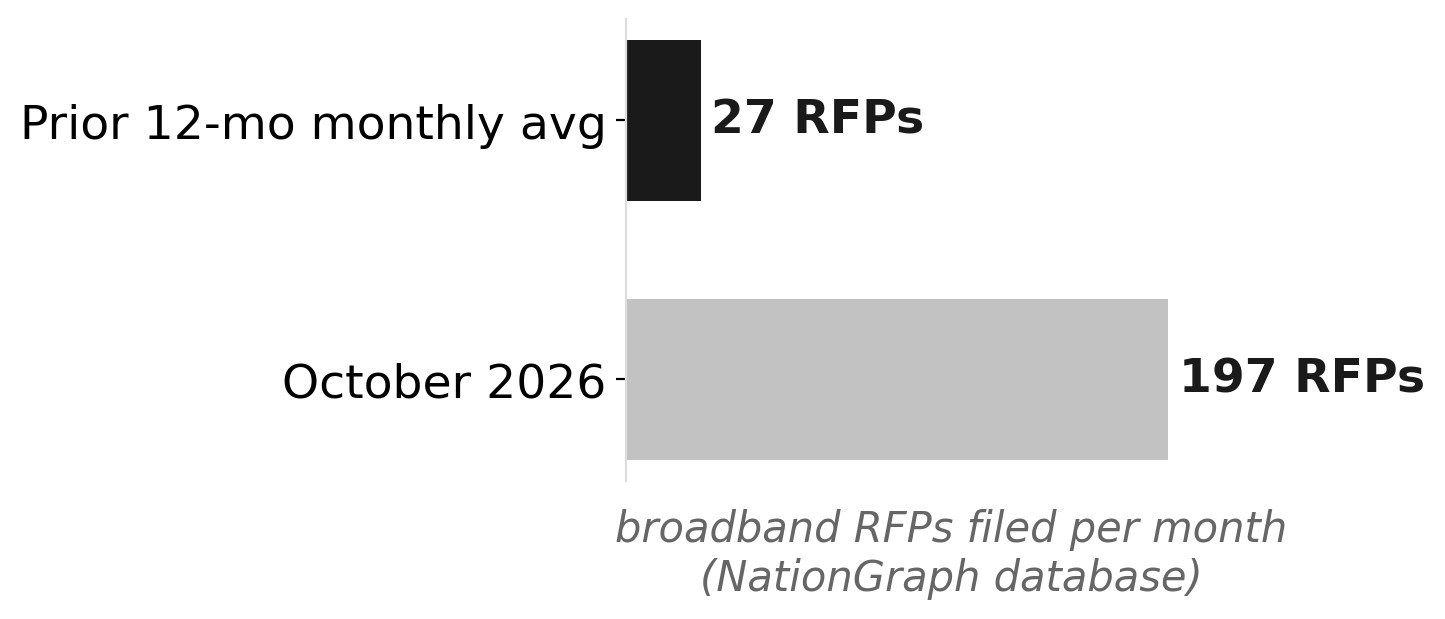
Source: NationGraph.
These are distinct programs with no shared mechanism. E-Rate is an annual cycle subsidizing school and library connectivity, funded through Universal Service Fund contributions from telecom providers. BEAD is a one-time infrastructure grant aimed at unserved and underserved locations, flowing through state broadband offices to ISPs and municipalities. They share only the accident of timing.
The October data shows how differently the two programs show up in the public record. Oklahoma's 18 institutions in the 60-day window are almost entirely school districts, including Tulsa Public Schools, Jenks ISD, Stillwater ISD, Duncan, Shawnee, and Enid, each posting Form 470s for WAN services and Category 2 internal network equipment. Wisconsin's seven institutions are similarly school districts, all filing on October 25. These states are E-Rate-dominant in the current surge.
California runs both tracks at once. Individual school districts filed E-Rate MIBS (Managed Internal Broadband Services) RFPs through October, while the California Public Utilities Commission issued separate RFPs for BEAD Program Administration and Oversight and a Digital Divide Grant Program Round 4. California holds $1.86 billion in BEAD funds; Texas holds $3.31 billion, the largest single-state allocation in the program. Missouri ($1.74B), Michigan ($1.56B), and North Carolina ($1.53B) round out the top five. All are in active performance and driving downstream procurement activity now.
The BEAD footprint extends beyond network construction. Alaska's Department of Commerce posted an Environmental Support Services for BEAD Projects RFP in October, a procurement category that would not have existed before the program's compliance requirements kicked in. Oakland filed its OaklandConnect Last-Mile Broadband Project RFP on October 29, one of the clearest examples of municipal last-mile deployment now moving from planning to vendor selection. These are not school districts chasing annual subsidy cycles. They are state and local governments spending one-time federal infrastructure capital.
A June 2025 NTIA restructuring notice reshaped the BEAD competitive landscape by allowing satellite and fixed wireless providers to compete alongside fiber for subgrant awards, with NTIA estimating roughly $21 billion in cost savings and faster deployment timelines as a result. That policy change, combined with the wave of Final Proposal approvals this spring, is what converted a slow-moving grant program into an active procurement market.
Texas offers a caution about what the data can and cannot show. Despite holding the program's largest BEAD allocation, it appears in only 14 institutions in the 60-day window. The Texas Comptroller of Public Accounts manages the state's BEAD subgrant process, and much of that procurement may be flowing through channels not yet captured in standard RFP feeds. The actual volume of broadband contracting activity in Texas is almost certainly higher than the headline count suggests.
For school technology directors, the immediate deadline is the Form 471 filing window expected in early 2027. Districts that did not post Form 470s in October now have a shrinking window to complete the mandatory 28-day competitive bidding period and remain eligible for FY2027 funding. For state broadband offices still finalizing BEAD subgrant competitions, the pace of peer states issuing construction and oversight RFPs sets an implicit benchmark. The procurement wave that started in October will produce vendor selections, contract awards, and eventually construction schedules over the next 12 to 18 months. What happens after that, at both the school and the last-mile level, is the story the current numbers are just beginning to tell.