Six New York municipalities issued stormwater management RFPs for the first time in over a year during the last 30 days, and the timing is not a coincidence. A three-year compliance milestone embedded in NYSDEC's 2024 stormwater general permit lands in January 2027, and towns that have not yet hired engineers are now doing so with roughly four months left on the clock.
The permit at the center of this scramble is GP-0-24-001, issued by NYSDEC in December 2023 and effective January 3, 2024. It replaced a permit that had governed New York's Municipal Separate Storm Sewer Systems since 2015 and added substantially tougher requirements: comprehensive stormwater system mapping, expanded illicit discharge detection and elimination programs, updated enforcement response plans, and a set of phased deliverables that get progressively more demanding over the permit's five-year term. Coverage is non-optional for more than 500 qualifying communities across the state. The January 2027 milestone, the permit's three-year mark, requires operators to have completed stormwater system mapping, monitoring-location inventories, facility prioritization, and updated Stormwater Management Programs. Environmental consulting firms flagged this milestone publicly in August 2026 as a "major step-up in program maturity," noting that municipalities must be "actively implementing, documenting, training, inspecting and updating" their programs by that point.
The RFP record shows that many municipalities absorbed that message months ago. New York stormwater procurement peaked at 39 RFPs in May 2026 and 24 in April, a wave driven by early-moving towns that recognized the 2027 deadline with time to spare. The six communities entering the queue now, the Village of Rhinebeck in Dutchess County, the Village of Pulaski in Oswego County, the Town of Carmel in Putnam County, the Town of East Greenbush in Rensselaer County, the Town of Corinth in Saratoga County, and the City of Albany, represent the last-mover tail of that wave. None had a stormwater RFP in the database before this month.
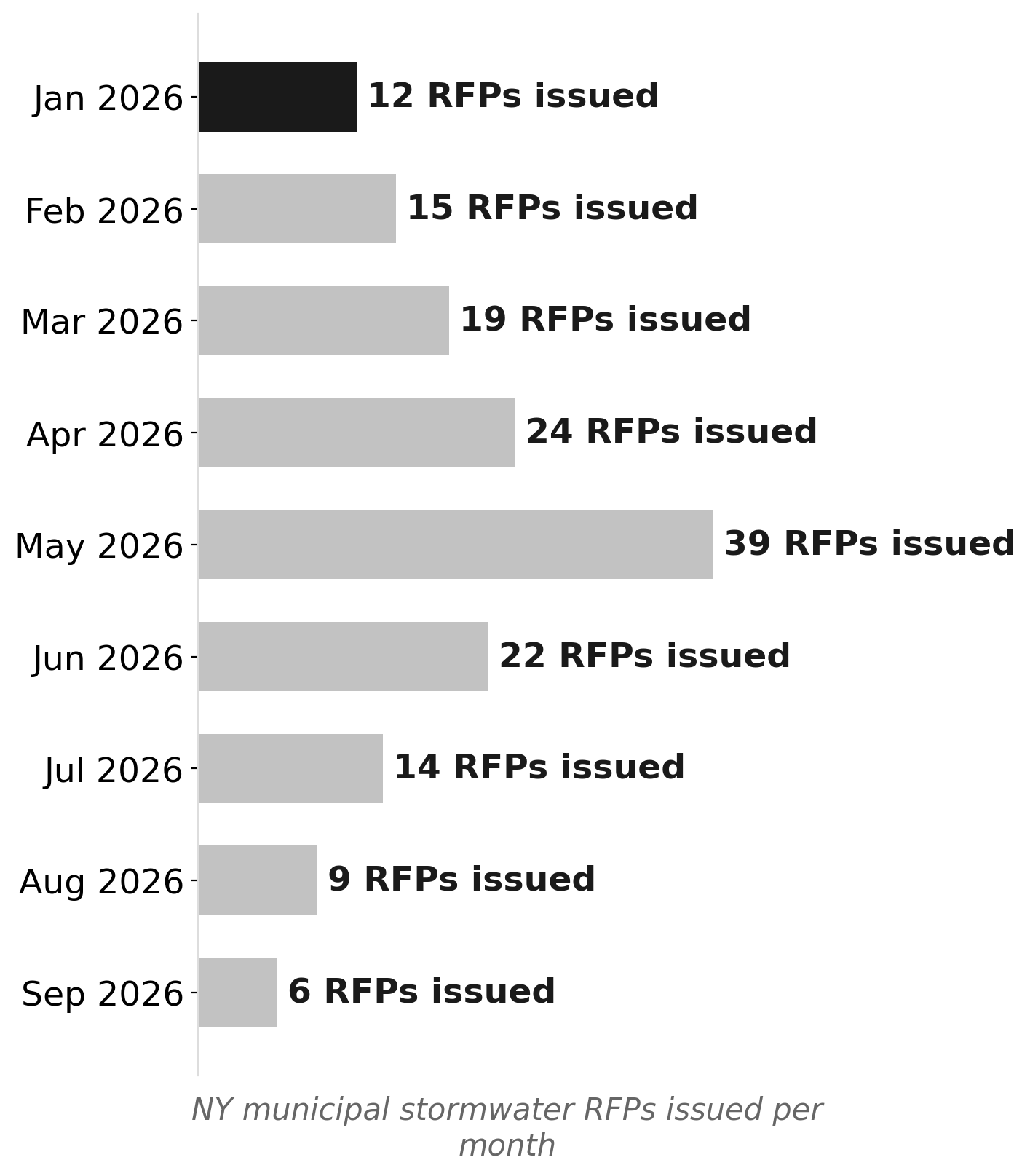
Source: NationGraph.
The RFPs themselves span the full range of what GP-0-24-001 demands. East Greenbush posted a broad "Stormwater Management Program" RFP, the kind of planning-and-assessment engagement that typically precedes everything else. Rhinebeck went narrower, seeking bids on drainage improvements at Lions Mini Park. Carmel posted a construction retrofit RFP (Carmel-CF-703), the most capital-intensive category, which likely reflects a separate catalyst: the town received a $2.36 million FEMA Public Assistance disaster grant in January 2026 for repair of disaster-damaged public facilities, with that grant expiring in September 2026. The concurrent permit deadline and expiring disaster funds created unusual urgency for one municipality in the group.
Funding is not uniformly available across the six, but there are concurrent federal resources in play for some. The EPA's Sewer Overflow and Stormwater Reuse Municipal Grant Program has two active awards totaling $6.87 million administered through the NY State Environmental Facilities Corporation as subawards to municipalities, one tranche of $4.3 million was set to expire in September 2026, and a second of $2.57 million runs through September 2028. Putnam County, home to Carmel, holds a separate $3.5 million EPA Congressional earmark for riparian and stormwater restoration active through December 2027. These are distinct programs with different eligibility and purposes; they provide cost-offsets for some municipalities, but they do not create the compliance obligation. That obligation comes from the permit alone.
The geographic spread of the six communities, Hudson Valley, Capital District, North Country, Oswego, suggests the compliance pressure is not regionally concentrated but broadly distributed among towns that deferred engagement with the new permit after it took effect in January 2024. The Hudson Valley and Capital Region concentration in this particular cluster may partly reflect the resources and awareness campaigns maintained by the Albany County Stormwater Coalition, which has been one of the more active municipal coordination bodies in the state.
The procurement pressure is unlikely to ease soon. New Jersey's comparable MS4 permit, which took effect in January 2023 and is now further along in its compliance cycle, is generating proportionally higher RFP volume, 14 in NJ versus 11 in NY over the same 30-day window. That gap suggests New York's compliance procurement wave has more runway ahead, particularly among the hundreds of small towns and villages that have limited public works capacity and no dedicated stormwater staff. For those communities, the consultants they hire now will effectively be writing their compliance programs from scratch.
The next signal to watch is whether NYSDEC begins issuing notices of non-compliance or violation referrals as January 2027 approaches. Towns still without a consultant engagement by late fall will be hard-pressed to complete mapping and SWMP documentation in time. The RFP clock and the permit clock are now running together.