Six California flood-control agencies that had gone quiet for more than a year issued procurement solicitations in the last 30 days alone, not because a new disaster struck, but because the state's biggest infusion of flood money in a generation has a clock running on it.
Proposition 4, the $10 billion climate bond California voters approved in November 2024, dedicates $3.8 billion to water and flood resilience. The 2026–27 state budget proposes $232 million from that pool for three DWR flood programs specifically: a $141 million Flood Control Subventions Program to help local agencies cover their share of Army Corps of Engineers projects, a Small Communities Flood Risk Reduction Program targeting disadvantaged areas, and a $153 million Watershed Resilience Program. DWR announced the new assistance programs in May 2026, releasing draft guidelines and scheduling public workshops through the summer. That announcement is what moved agencies off the sidelines.
The agencies now filing flood RFPs for the first time in over a year are not rebuilding from a fresh emergency. They are racing a grant application clock. Prop 4's competitive cycles are opening right now, and expert guidance to prospective applicants is blunt: in the near term, funding is expected to flow mainly through existing programs, which means agencies already enrolled in DWR partnerships are positioned to move first. Agencies that miss this cycle will wait years for another.
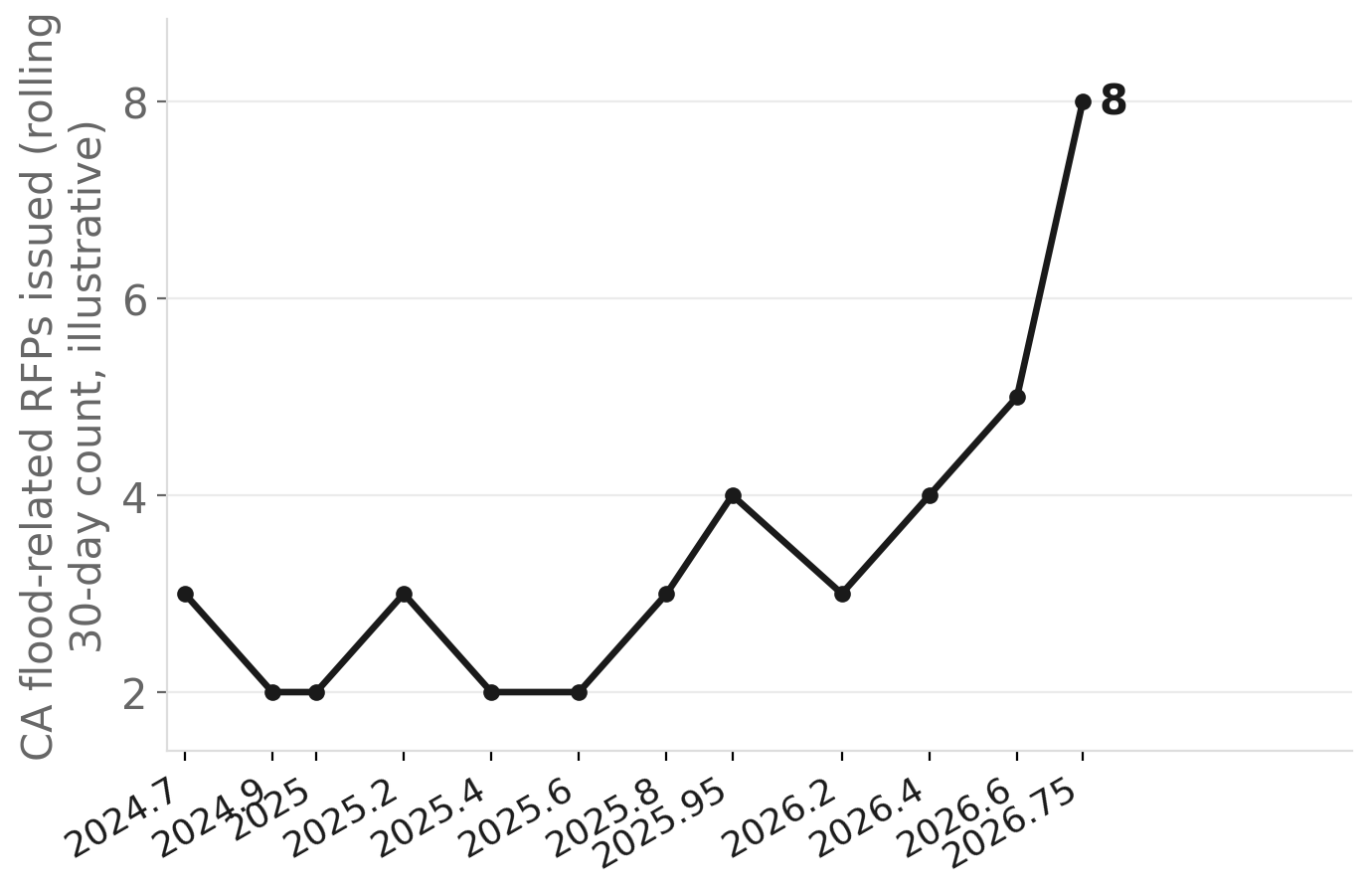
Source: NationGraph.
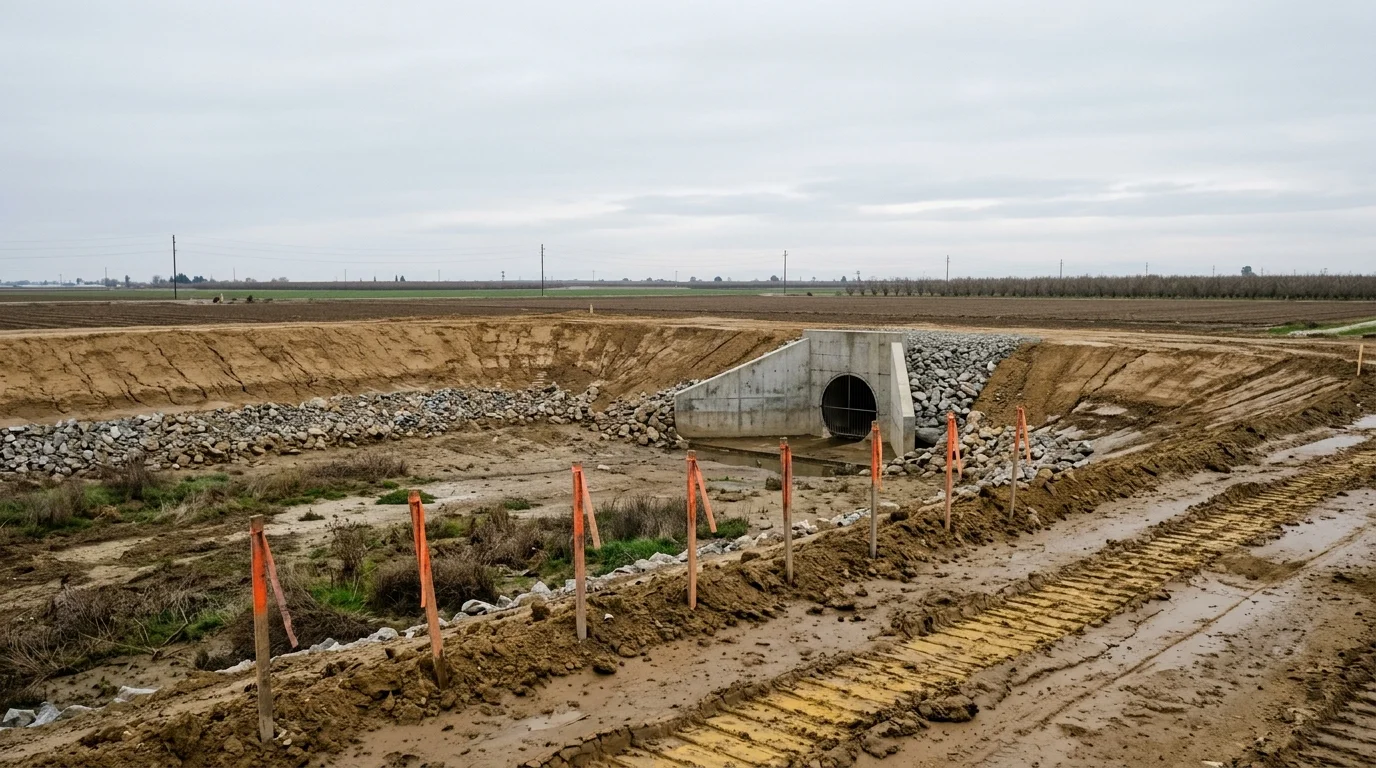
The most active single project illustrates how procurement readiness and funding alignment converge. Merced County, ground zero for the catastrophic 2022–23 atmospheric river flooding that caused $4.6 billion in statewide damage, has spent years permitting the Black Rascal Creek Flood Protection Facility, a detention basin project serving some of the county's most vulnerable communities. That project cleared its CEQA review in February 2024 and received a 2026 Senate earmark from Sen. Adam Schiff for construction. Construction bids closed September 16, 2026. Merced County's return to the procurement market is not coincidental timing, the project is shovel-ready precisely because the permitting work was done before the funding window opened.
The same pattern holds across the state, at different stages of readiness. The Pajaro Regional Flood Management Agency in Santa Cruz County, Pajaro Valley flooded catastrophically in March 2023, issued a culvert replacement solicitation. Napa County Flood Control District issued a vegetation monitoring contract for a major flood protection project. Marin County is procuring engineering services for the Corte Madera Creek Flood Risk Management project. These are not emergency responses. They are project-readiness investments timed to Prop 4's eligibility requirements.
Caltrans added a planning dimension to the procurement surge with a Salton Sea West Flood Resilience Study solicitation, a signal that state agencies are using this window to advance feasibility and design work alongside construction bids. DWR itself has a Flood Partnership solicitation open through June 2027, funding real-time telemetry for reservoir monitoring at dams with ungated spillways. That program grew directly out of the 2022–23 atmospheric rivers, which exposed how little real-time data emergency managers had during the storms.
The funding structure matters and is worth keeping clear. Prop 4 is a California state general obligation bond, it is state money, not federal. The Flood Control Subventions Program, one of the three programs drawing the most procurement activity, is specifically designed as a bridge: it covers local agencies' non-federal cost share on Army Corps of Engineers-authorized projects, linking state bond dollars to federal construction programs. The two funding streams operate separately, but the Subventions Program is what makes many USACE projects financially feasible for small and mid-sized counties.
Federal flood money is already flowing into California, more than $288 million in active federal flood-grant obligations across 20-plus agencies, but the Legislative Analyst's Office analysis of Prop 4 confirms that most individual federal grants are under $7 million. The binding constraint has never been federal commitment. It has been local agencies' capacity to meet matching requirements, complete environmental review, and submit competitive applications. Prop 4's Subventions Program is designed to remove the first barrier. The flood of RFPs hitting the market right now is evidence the second barrier, project readiness, is being cleared.
What this means practically: California's roughly 1,600 flood-prone communities, more than 70 percent of them unincorporated, are not all positioned equally to compete for this money. The agencies now procuring consultants and construction contractors are the ones that did permitting work during the lean years. The ones that didn't are watching a window open for which they are not ready.
The next signal to watch is DWR's finalization of program guidelines, expected before the end of 2026. Once those drop, the first formal application cycles open, and the gap between agencies that prepared and those that didn't will become measurable.