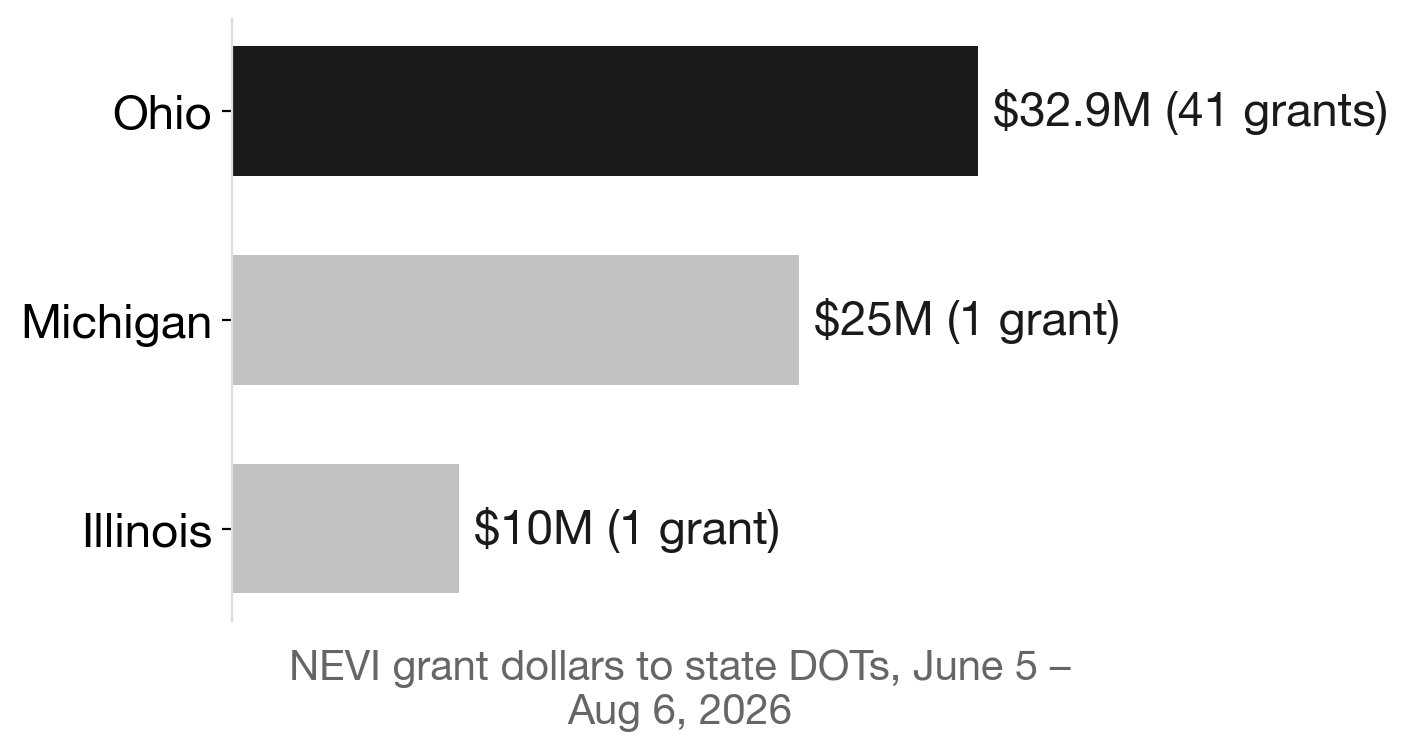
Ohio has collected $32.9 million in federal electric vehicle infrastructure grants over the past 90 days, a 187% jump from the $11.5 million it received in the same window a year ago. The surge is not a sign of renewed federal enthusiasm for EVs. Consumer purchase tax credits expired on September 30, 2025, and the administration that froze this money in the first place is still in office. What changed is that a federal judge ordered the government to give it back.
In January 2025, FHWA rescinded all state deployment plans under the $5 billion National Electric Vehicle Infrastructure program, acting on President Trump's 'Unleashing American Energy' executive order. Available state obligations dropped from roughly $1.5 billion to zero almost overnight. Fourteen states sued. A preliminary injunction followed in June 2025, but the decisive moment came on January 23, 2026, when U.S. District Judge Tana Lin issued a summary judgment finding that DOT and FHWA had acted "outside the law" when they froze the funds. DOT declined to appeal. FHWA released new interim guidance and an $885 million FY2026 national NEVI apportionment in October 2025, and states began drawing down awards as their obligation paperwork cleared.
Ohio cleared it faster than almost anyone. The state received 41 individual NEVI grants between July 21 and August 6, 2026, all flowing to the Ohio Department of Transportation, in amounts ranging from roughly $745,000 to $1.4 million each. The clustering of those start dates points to a batch-processed obligation push: ODOT had approved deployment plans already on file through FY2025, institutional capacity to process awards quickly, and a political incentive to move. Ohio was among the first nine states to open new NEVI funding solicitations after the freeze lifted, and it had been the national program pioneer before the freeze hit, becoming the first state to break ground on a NEVI station back in October 2023.
Source: NationGraph.
The contrast with Midwest peers is stark. In the same 90-day window, Michigan received $25 million in a single grant and Illinois received $10 million in one award. Ohio's 41 grants against their combined two reflects both ODOT's processing speed and Ohio's deeper pipeline of shovel-ready corridor projects. The state entered 2026 with 19 NEVI stations already operating and 12 more under construction, giving it the site infrastructure to absorb rapid grant obligations.
None of this means the money is spent. Ohio's full active EV grant portfolio now stands at 77 grants totaling $291 million in obligations, but only $42.7 million has actually been disbursed. The gap between committed and flowing is a feature of how NEVI works: federal dollars are obligated when grants are awarded, then reimbursed as construction milestones are hit. The $32.9 million awarded in the past 90 days will pay for charging infrastructure that in many cases hasn't broken ground yet.
The urgency driving Ohio's obligation sprint is fiscal, not logistical. A pending Congressional FY2026 FHWA funding bill would transfer approximately $879 million in NEVI funds into other transportation programs. Once funds are formally obligated to a specific state project, they are significantly harder to recapture through reappropriation. States that move slowly risk seeing unobligated balances swept into the general FHWA pot before they can lock them down. Ohio's batch awards in late July and early August look, in that light, less like routine grant administration and more like a deliberate race to the wire.
For Ohio drivers, the practical effect will materialize over the next 18 to 24 months as new charging sites come online along interstate corridors. EV registrations in Ohio crossed 126,000 and hit 5% of new vehicle sales for the first time in September 2025, a consumer base that has been adding cars faster than public fast-charging capacity has grown. The stations funded by this burst of NEVI awards are meant to close that gap, particularly for drivers outside the Columbus and Cleveland metro areas where charging access remains thin.
What Ohio residents won't get is the federal purchase credit that once knocked $7,500 off the price of a new EV. That program expired last fall, concentrating all remaining federal EV investment on the infrastructure side. The political coalition behind EV subsidies has narrowed considerably; what remains is a court-ordered obligation to spend money Congress already appropriated, moving through the pipeline as fast as state agencies can process it.
The next signal to watch is whether the pending FHWA bill clears committee before FY2026 closes. If it does, states still sitting on unobligated NEVI balances could lose them. If it stalls, Ohio and other fast-moving states will have locked in funding for a charging network that took a year-long detour through federal court to reach them.