San Rafael, California is moving to put mental health workers on the front lines of crisis response, joining a national wave of cities that have concluded armed police officers are often the wrong tool for behavioral health emergencies.
The city is seeking a service provider to operate an Alternative Response Team, a civilian crew that would handle a range of 911-style calls, including people in mental health crisis, homeless residents in distress and welfare checks, without dispatching police. The program is structured as a three-year pilot, with the option to extend if it proves effective.
The push comes after a bruising stretch for San Rafael's police department. In January 2022, an officer was charged with assault following a violent arrest of Julio Jimenez Lopez, a Latino man, that was caught on video and drew national attention. The incident intensified pressure on city leaders to offer an alternative to armed response for calls that don't require it.
Source: NationGraph.
San Rafael, the county seat of Marin County with about 62,000 residents, is wealthier on average than most California cities, but it carries a disproportionate share of the county's homelessness. The Canal neighborhood, a predominantly Latino, working-class community, and the encampments along the Mahon Creek path have been flashpoints for exactly the kind of calls the new team would handle.
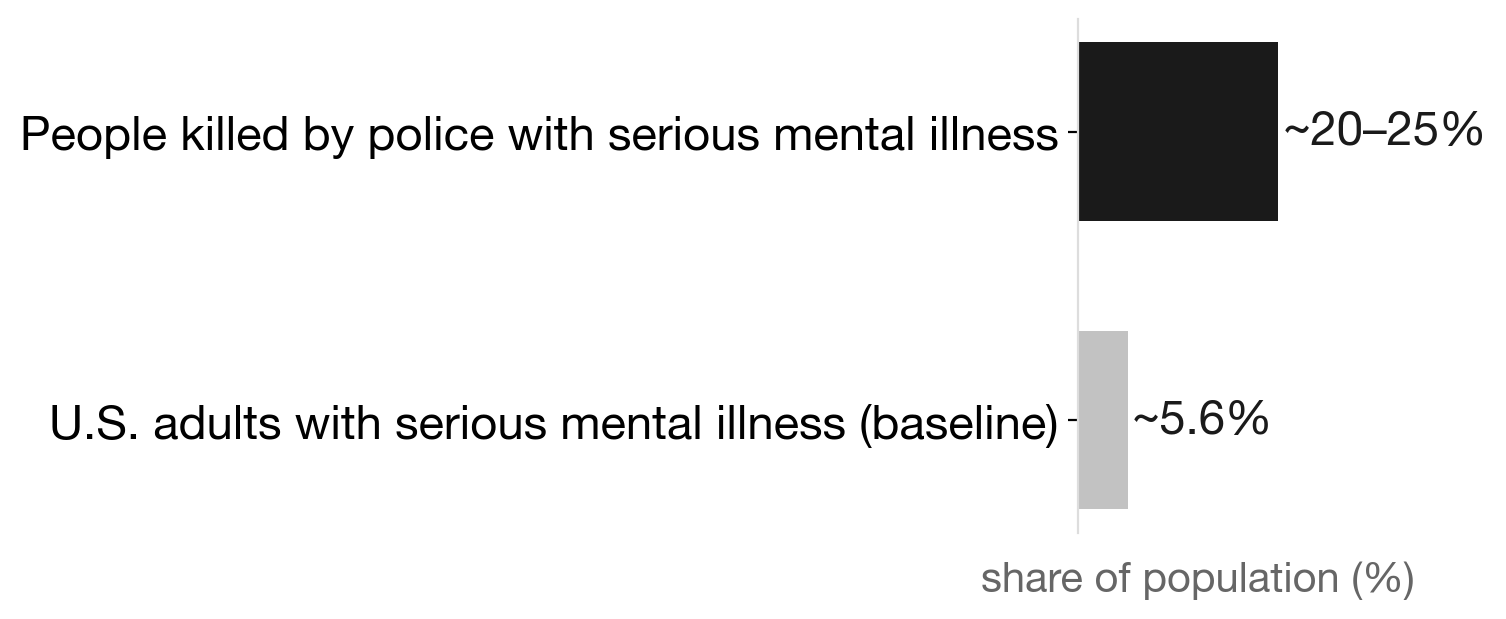
The city joins a long list of Bay Area and California jurisdictions that have built similar programs since 2020. San Francisco, Oakland and Berkeley all launched civilian crisis response teams in the two years following George Floyd's murder in Minneapolis. The model most cities draw on is Eugene, Ore.'s CAHOOTS program, which has handled roughly 20% of the city's 911 volume since 1989 with unarmed responders. Nationally, an estimated 20% to 25% of people killed by police have a serious mental illness, a figure that has driven broad interest in diversion programs.
The federal launch of the 988 Suicide and Crisis Lifeline in July 2022 added urgency to the effort. Federal policy now assumes that calls to 988 will trigger a mental health response rather than a law enforcement one, which requires cities to have mobile crisis teams ready to deploy.
Marin County already operates its own Mobile Crisis Response Team through Behavioral Health and Recovery Services, giving San Rafael an existing county-level infrastructure to work alongside.
Proposals are due by 5 p.m. local time on Nov. 11, 2022. How many hours per day the team will operate and what call types it will handle have not been publicly detailed beyond the 12-hour daily operational model outlined in the city's budget planning documents.