Arkansas is building the largest solar-plus-storage project in its history, a 600 megawatt array with 1,400 megawatt-hours of battery storage in Jefferson County, and the customer it was designed to serve is not an Arkansas resident. It is Google.
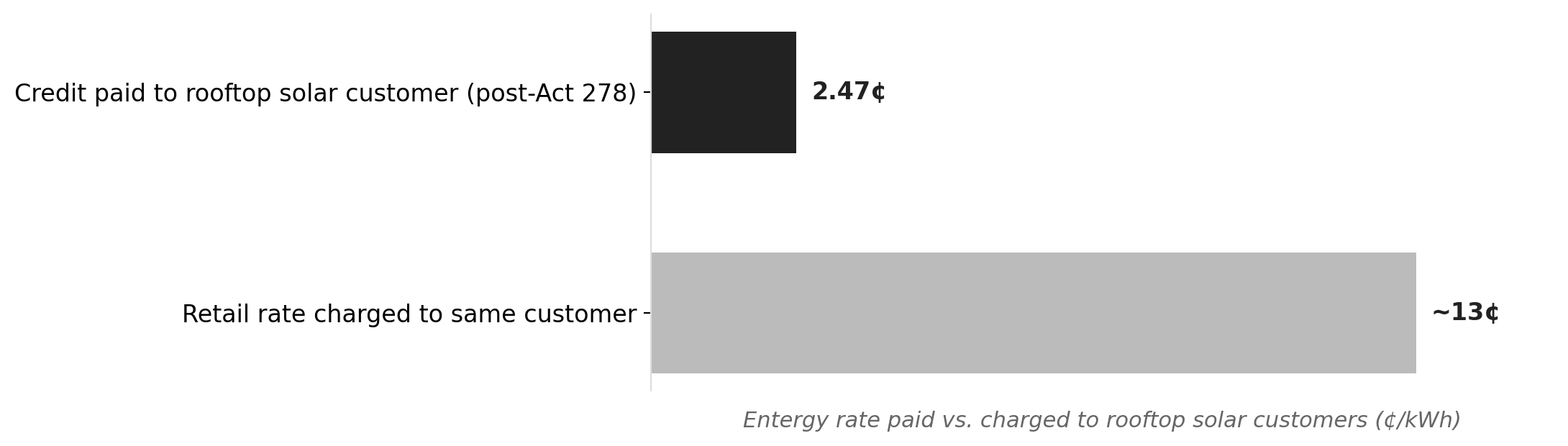
The contradiction at the center of this story starts in 2023, when the state legislature passed Act 278, slashing what utilities must pay rooftop solar owners from retail rates to 2.47 cents per kilowatt-hour, while those same homeowners still pay more than 13 cents per kilowatt-hour to draw power back from the grid. That single change effectively ended the economics of residential solar for most Arkansas households. No state tax credit softens the math. No meaningful retail incentive exists to replace what was taken.
Then, on October 2, 2025, Google announced a $4 billion data center campus in West Memphis, and the legislative calculus reversed itself at utility scale. The Arkansas Public Service Commission approved Entergy's Cypress Solar project that same month: 600 MW of solar plus 350 MW of battery storage near Pine Bluff. According to PV Magazine, this marks the first time Google has financially supported construction of a solar project rather than simply signing a power purchase agreement. The company is not just buying the electricity. It is helping build the plant.
Source: NationGraph.
Three months later, in January 2026, AVAIO Digital announced Project Leo, a $21 billion hyperscale data center in Little Rock that, at full buildout, would consume roughly one gigawatt of power, about 5 percent of Arkansas's entire generating capacity. That project comes with a contractually backed 75 MW on-site solar array. Together, these two announcements have triggered a wave: five major data center projects have been announced statewide since the 2025 Generating Arkansas Jobs Act, known as SB 307, overhauled energy permitting to attract exactly this kind of investment. Two are already under construction.
SB 307 also handed utilities a tool that consumer advocates have called the sharper edge of the same blade: the ability to bill ratepayers for power plants while they are still being built. An Arkansas Times investigation published in April 2026 described the sequence as a deliberate two-step, eliminating retail competition through Act 278 and then shifting construction costs onto the customers who lost that competition. SWEPCO customers in northwest Arkansas absorbed a 23 percent rate increase in January 2026. Entergy customers have seen a $6.08 monthly increase with another $5.77 pending.
The gap between what is happening at utility scale and what shows up in public procurement databases illustrates how thoroughly this buildout bypasses the consumer market. Of the seven solar-related RFPs filed in Arkansas in the past 30 days, only one involves actual power generation: Hope Water and Light Commission's June 2026 solicitation for a 1.9 MW solar array paired with 8 MW of battery storage. The rest are street lights and traffic signals. The Cypress Solar project and the AVAIO arrays do not appear in public RFP feeds at all. They were negotiated directly between utilities, tech companies, and regulators. Hope Water and Light, a small municipal utility, is the only institution in the public record where the pressure from data-center energy demand is visibly trickling down to smaller buyers.
Arkansas's geography makes it a logical target for this kind of investment. Its solar resource is comparable to parts of Texas and Georgia, its land costs are low, and its regulatory environment, now reshaped by SB 307, has been explicitly tuned to move large infrastructure projects quickly. What the Arkansas Advocate has called the data center boom is, in energy terms, a demand shock the state's grid was not built to absorb.
For Arkansas residents, the immediate signal to watch is the pending Entergy rate decision, which would add another $5.77 per month to residential bills. The longer signal is whether any of the solar capacity being built to serve corporate campuses eventually creates enough grid surplus to pressure regulators into revisiting the net metering structure that was dismantled in 2023. So far, there is no legislative movement in that direction. The same majority that passed Act 278 passed SB 307. The beneficiaries are different. The votes were the same.