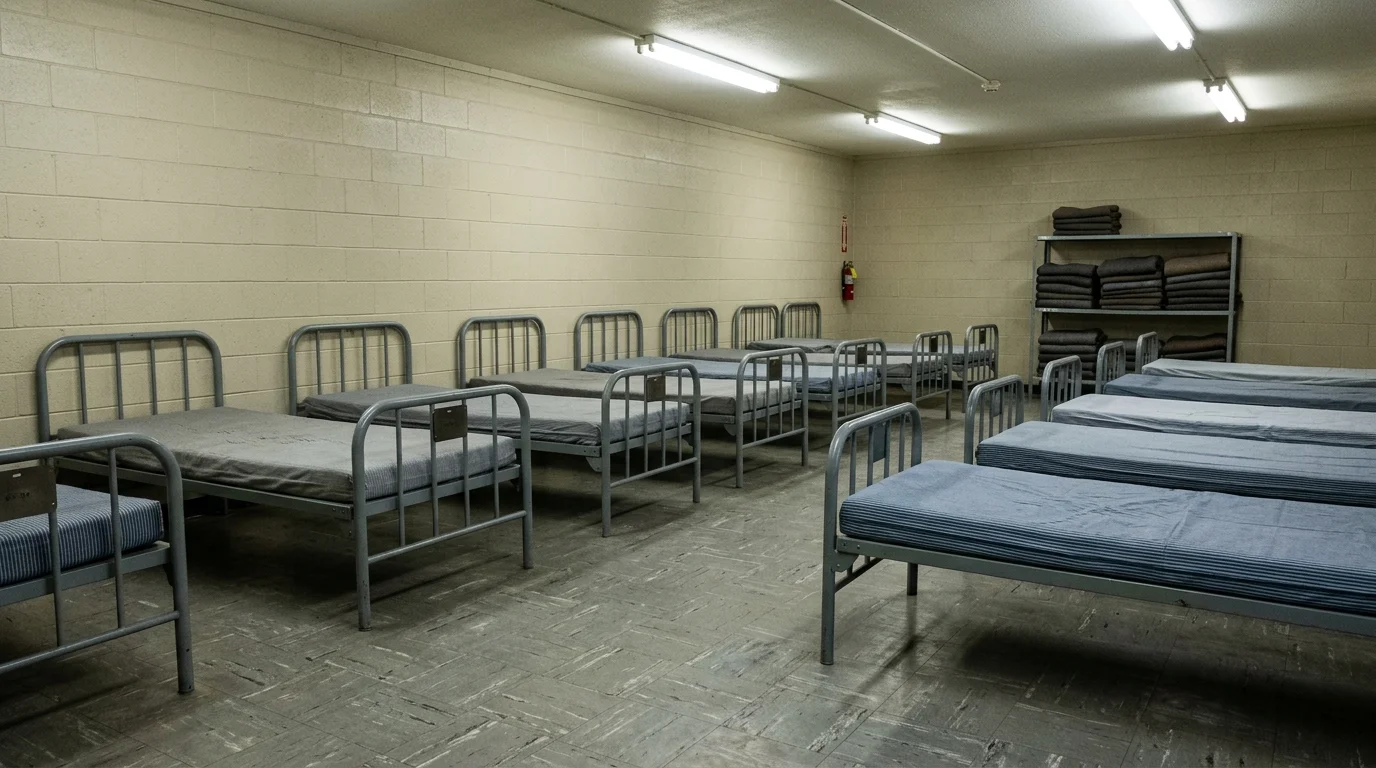
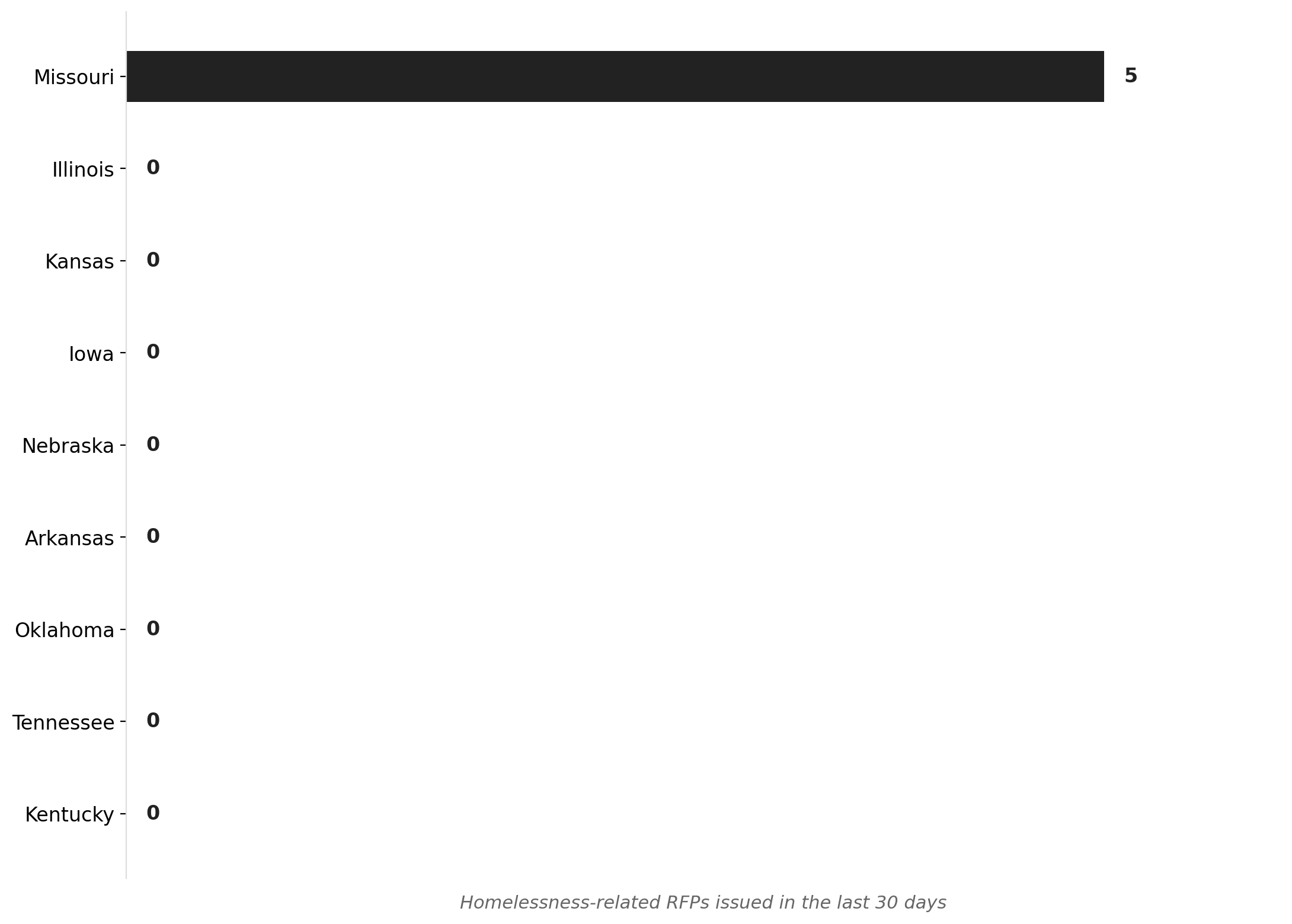
Missouri issued five homelessness-related RFPs in the last 30 days against a trailing 12-month average of 0.9 per month, a 5.5x spike with no parallel in any of the eight neighboring states, all of which recorded zero comparable solicitations in the same window. The number tells a strange story: a state known for pushing to criminalize public camping is suddenly in a rush to build shelters.
The reason is written directly into the law. Under §67.2300 of Missouri Revised Statutes, the re-enacted standalone camping ban, a misdemeanor citation can only be issued if an open shelter bed has first been offered to the individual. Shelter capacity is not a humanitarian complement to enforcement. It is a legal precondition for it. Counties that want to clear encampments must first prove they have somewhere to send people.
That sequence explains why four of the five RFPs came from a single jurisdiction: Camden County, the rural resort economy anchored by Lake of the Ozarks. The county solicited an operator for a temporary homeless shelter at the Regan Building/Lakeland Complex on June 17, then issued the same solicitation again on July 7, a ten-day reset that signals the first round produced no viable respondent or an expired bid, not fresh demand. For a county where Lake Area Helping Hands functions as the primary shelter operator, securing a contract-ready operator willing to manage a publicly designated facility is its own obstacle. Without one, the camping ban is functionally unenforceable.
Source: NationGraph.
This is the hidden cost structure that the Cicero Institute, the think tank that drafted the original legislation, described plainly after the law's passage: a citation would only be issued if there is an open bed in a local shelter. What reads as a policy safeguard functions, in practice, as a procurement mandate. Every county that wants enforcement authority has to build and contract the infrastructure that makes enforcement legal.
The background to this moment is a legal whiplash. Gov. Parson signed HB 1606 in June 2022, and the camping-ban provisions took effect in January 2023. The Missouri Supreme Court struck the entire bill down in December 2023 on single-subject constitutional grounds, creating a year-long vacuum. The legislature responded by re-enacting the camping-ban language as a standalone section, §67.2300, which now sits in the Missouri Revised Statutes without the procedural defect that doomed its predecessor. Counties that assumed the law was dead are now realizing it is operational, and that compliance infrastructure takes time to acquire.
The fifth RFP, from Joplin, runs on a separate logic. Issued July 15 and due August 28, it solicits developers to build and operate HOME-ARP-funded affordable rental units with supportive services aimed at reducing homelessness. HOME-ARP is a federal pipeline, channeled through HUD and Missouri's Continuum of Care network, and Joplin's solicitation reflects spending obligations that exist regardless of the state camping law. Missouri routes its primary CoC funding through the Department of Mental Health rather than a city housing authority, an unusual arrangement that concentrates grant management at the state level and can leave county governments without direct access to federal dollars when they need to move quickly. The Department currently holds six or more active HUD CoC grants, while the City of St. Louis carries roughly $3.1 million in active Emergency Solutions Grants.
For residents of Camden County, the practical consequence is a jurisdiction in procurement limbo: a camping enforcement mechanism that is legally active but operationally dormant until a shelter operator signs a contract. Two solicitation rounds in three weeks suggest the county is not finding the market response it needs. Rural counties with thin nonprofit ecosystems and limited affordable housing stock face a version of this challenge that urban jurisdictions with established CoC networks do not.
The broader Missouri housing picture makes the timing harder. A June 2026 assessment describes the state's affordable housing crisis as worsening, with a federal housing bill still unsigned as of mid-July 2026, adding uncertainty for the developers Joplin is now trying to recruit. The operators Camden County needs to make its camping ban enforceable are competing for resources and attention in a market already under strain.
The deadline to watch is Joplin's August 28 RFP closing date. If Camden County issues a third solicitation for the Regan Building shelter, that will be a clear signal that the compliance gap is widening, not closing. Either outcome will test whether §67.2300 functions as designed or remains, for rural Missouri, a law on paper that counties cannot yet afford to enforce.