South Carolina's local governments posted roughly 10 unique cybersecurity procurement notices between June and August 2026, four to five times the state's historical monthly baseline, and the timing is not a coincidence. The spending wave is the delayed exhaust of federal grant money that was appropriated in fiscal year 2024, obligated to South Carolina agencies months later, and is only now reaching county purchasing offices in the form of contracts.
The 20-month lag between federal appropriation and local RFP is built into the system. CISA's State and Local Cybersecurity Grant Program distributes funds through state administrative agencies, and in South Carolina that gatekeeper is SLED. SLED opened its FY2024 SLCGP sub-grant application window on March 20, 2026, with a May 15 deadline. Sub-grant awards and the pass-through obligations that force localities to actually spend money followed in June and July, which is exactly when the RFP volume jumped. SLED itself holds at least $7.3 million in active SLCGP awards, including a $5.5 million grant running through December 2028 and a $1.8 million award through August 2029.
The procurements that surfaced this summer span the full range of South Carolina's public-sector geography. Greenville Technical College issued a construction manager-at-risk solicitation for a roughly 90,000-square-foot Center for Cybersecurity and AI, a facility that will include a working Security Operations Center and specialized training labs. By any measure it is the largest physical cybersecurity infrastructure project ever undertaken by a South Carolina public institution. Jasper County, a rural county on the Georgia border with fewer than 35,000 residents, issued RFP #2026-19 for a three-year managed security services contract covering 24/7 monitoring, patch management, incident response, and compliance with federal CJIS and NCIC standards required for any agency that touches law enforcement data. The City of Isle of Palms, a small barrier-island municipality, put out a managed technology services RFP that explicitly scopes cybersecurity resilience and crisis response.
Source: NationGraph.
Those three procurements are different in scale but identical in origin: federal grant pressure meeting state-level compliance pressure at the same moment. The compliance piece comes from House Bill 4393, the SC Technology Security Act, which mandates removal of Chinese-manufactured networking and surveillance hardware, specifically Huawei, ZTE, Hikvision, and Dahua equipment, from all state and local systems. The bill remains in the House Labor, Commerce and Industry Committee, but its existence has already prompted purchasing reviews across agencies that suddenly need to document what hardware they are running, which is itself a trigger for security audits and the contracts that follow.
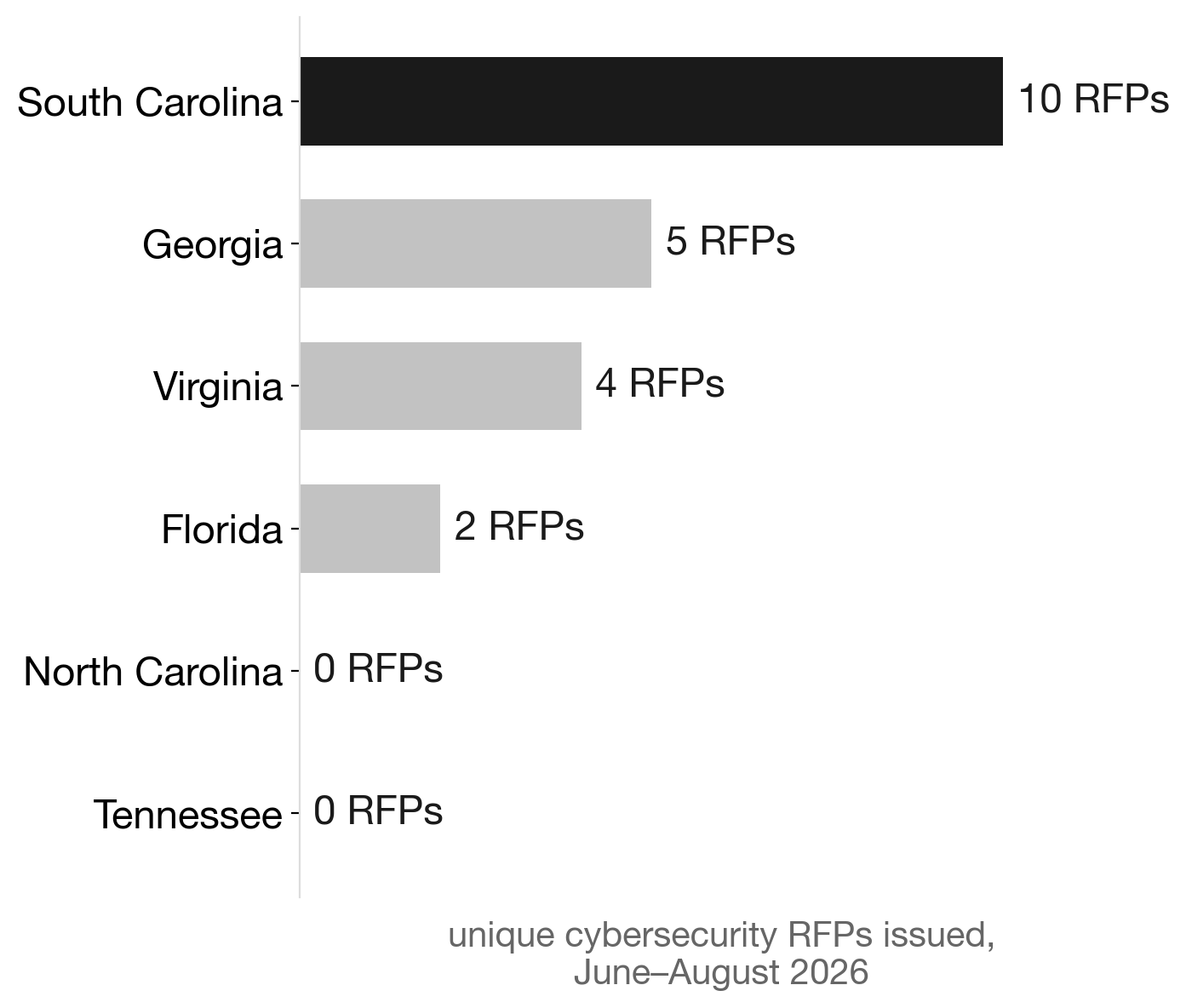
The regional comparison makes South Carolina's summer unusual. Neighboring states posted far less activity in the same window: Georgia logged five cybersecurity RFPs, Virginia four, Florida two, and both North Carolina and Tennessee recorded none. Raw volume alone does not measure procurement quality, but the gap signals that South Carolina's centralized grant pipeline, funneled entirely through SLED, compressed what might have been a gradual spend-out into a single season.
The Municipal Association of South Carolina's longstanding cybersecurity partnership with managed IT provider VC3 gives smaller jurisdictions a pre-vetted vendor pathway, which helps explain how a county the size of Jasper can move from zero formal cyber contract to a full MSSP solicitation without building procurement expertise from scratch. That infrastructure matters because the state's exposure is not limited to county payroll databases. The Port of Charleston is among the fastest-growing container ports on the East Coast, and Joint Base Charleston and Shaw Air Force Base give South Carolina a defense footprint that makes supply-chain and operational technology security a live concern, not a hypothetical one.
Clemson University's $12.5 million Regional Tech Hub grant from the Commerce Department, awarded in November 2024 with cybersecurity components, is adding institutional capacity at the research end of the same pipeline. Greenville Tech's campus and Clemson's hub are not competing projects; they sit at different points on the workforce-to-research spectrum that any state needs to sustain a durable cyber posture.
What changes for someone working inside a South Carolina county or municipal agency is straightforward: the contracts being awarded this summer will determine who monitors their networks for the next three years, which hardware gets ripped out to satisfy the state security act, and whether their jurisdiction has the documentation to apply in the next SLCGP cycle. The next signal to watch is whether SLED's FY2025 SLCGP sub-grant window, which has not yet been announced, compresses the lag. If awards move faster and localities have already done the planning work required for FY2024 contracts, the next procurement wave could arrive in months rather than years.