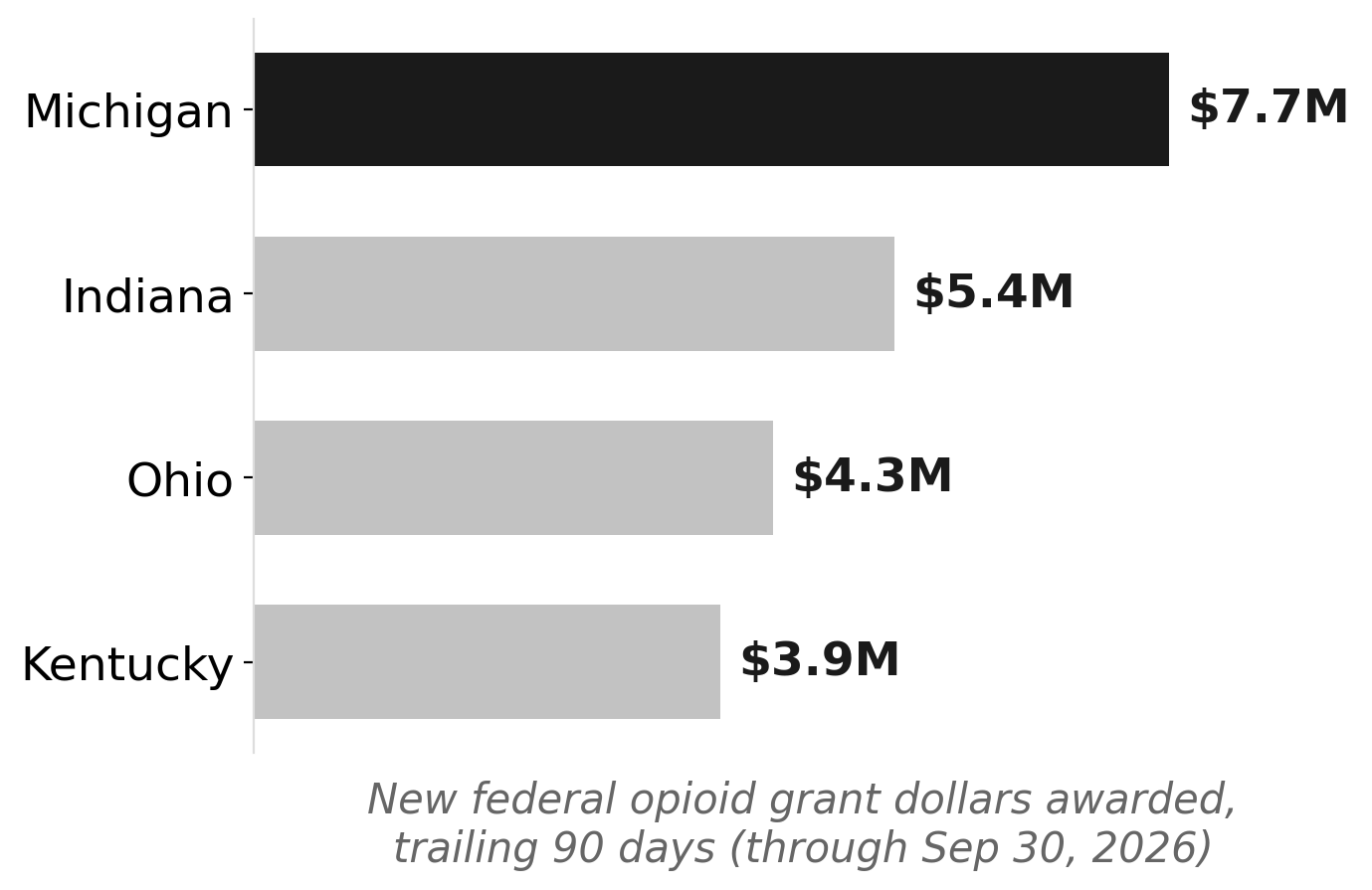
Michigan pulled in $7.67 million in new federal opioid grants over the last 90 days, a 370% jump above the $1.63 million the state received in the same window a year ago. The surge covers 13 separate awards, every one of them carrying a September 30, 2026 start date. That uniform date is the key to understanding what happened: this is not a policy breakthrough but a SAMHSA fiscal year-end cohort, the annual wave of discretionary dollars the agency releases in the final weeks of the federal fiscal year under its Projects of Regional and National Significance program (CSAT-PRNS, Assistance Listing 93.243). What makes Michigan's version of this story unusual is the geography.
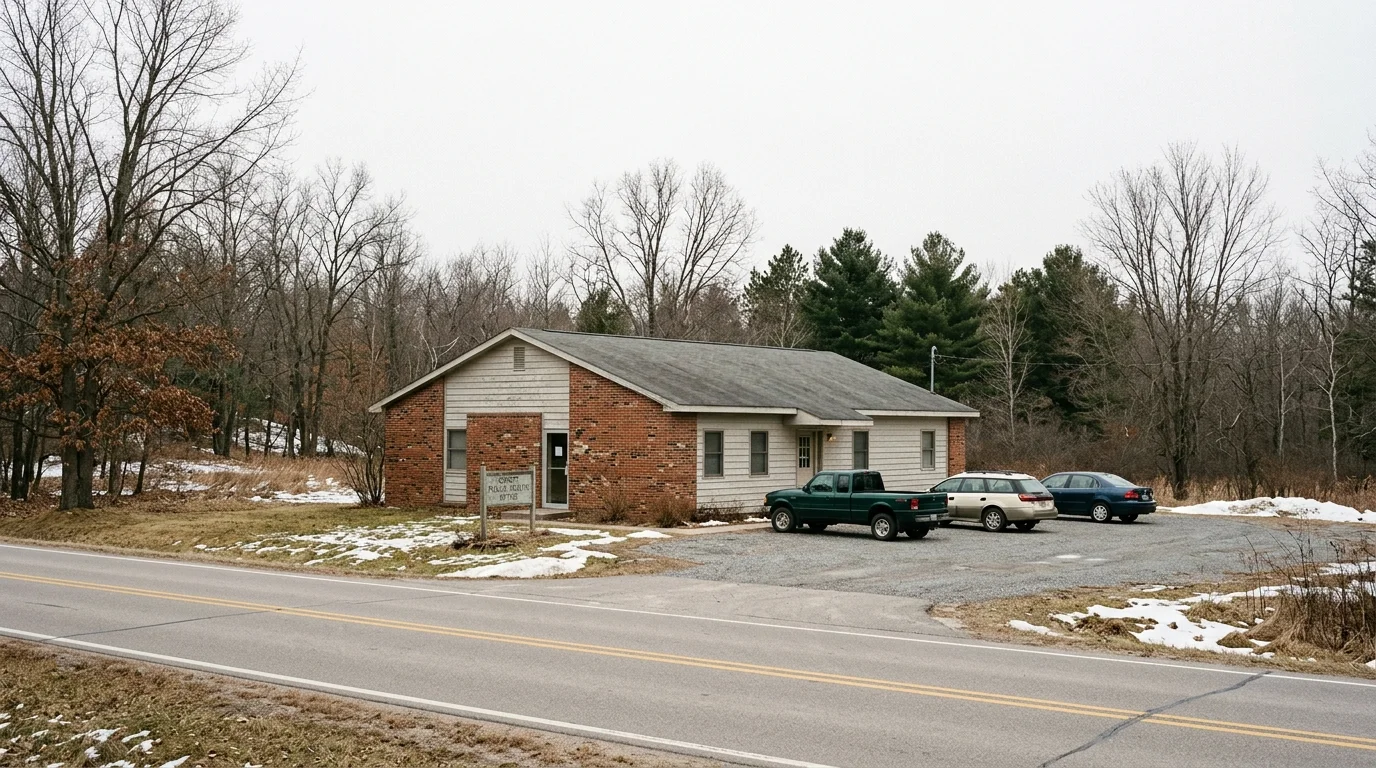
The largest single award, $3 million to the City of Detroit Health Department running through 2030, is the kind of grant a city health department with a full grants team can usually capture. The surprises are the awards at the other end of the population scale: Frederic Township and Cherry Grove Township, both in rural Wexford County, each received $300,000 PRNS grants in the same cohort. Kent County secured two CSAT-PRNS awards totaling $1.15 million; Ottawa County received $400,000. The simultaneous reach from Detroit to small northern Michigan townships suggests Michigan's Department of Health and Human Services has been coaching sub-state applicants to compete directly for discretionary federal dollars, rather than routing everything through Lansing.
According to MDHHS budget materials presented to the Michigan House in April 2025, Michigan has accumulated one of the most layered opioid funding architectures in the country. That structure matters here. MDHHS holds a separate $74.2 million SAMHSA State Opioid Response grant running through September 2027, which flows through 10 regional Prepaid Inpatient Health Plans covering all 83 Michigan counties. That SOR grant is the existing backbone, not the new money. The $7.67 million in PRNS awards is a parallel, decentralized stream: competitive dollars won directly by local governments and county agencies, not sub-granted through the state. These are distinct mechanisms doing distinct things, and collapsing them would misread why rural Wexford County is at the table at all.
Source: NationGraph.
A third stream runs separately from both federal programs. Michigan's FY2026 state budget appropriated $131.75 million from the Michigan Opioid Healing and Recovery Fund, drawn from the state's share of the national opioid manufacturer and distributor settlements. Settlement spending details published by the state show that fund is projected to deliver nearly $1.8 billion to Michigan governments by 2040 and is governed by the Opioid Advisory Commission under a separate executive order. That money is litigation settlement funds, not federal grants, and the Legislature appropriates it independently.
Taken together, Michigan's projected spending across all three sources runs to roughly $350 million on substance use disorder services in FY2027, according to a June 2026 Michigan House Fiscal Agency hearing. That scale gives Michigan a distribution backbone few peer states can match, and the new PRNS numbers bear that out: Michigan ranked first among eight Midwest and Appalachian comparison states in new opioid federal grants over the past 90 days, ahead of Indiana ($5.37 million), Ohio ($4.35 million), and Kentucky ($3.91 million).
The Opioid Advisory Commission's 2026 Annual Report offers a useful counterweight to the grant figures. Provisional overdose death data show Michigan declining faster than national averages, a real benchmark. But the same report warns that substance use disorder remains undertreated and that Michiganders still encounter fragmented systems that limit access to evidence-based care. Grants landing in Frederic Township are one signal; whether a township of a few hundred residents can staff and sustain a program past the grant period is a different question the awards themselves don't answer.
The practical signal for Michigan residents is that the coverage map is widening. For years, rural opioid programs have competed at a structural disadvantage: smaller applicants with thinner administrative capacity, competing against urban health departments with full grants offices. The Wexford County awards suggest that disadvantage is not insurmountable, at least in a September SAMHSA cycle. MDHHS Director Elizabeth Hertel has described the SOR program specifically as addressing the multi-generational impact of the epidemic and racial disparities, a framing that points toward continued geographic and demographic targeting in future cycles.
The next signal to watch is whether the FY2027 SAMHSA PRNS competition, which will open in early 2027, sees Michigan's rural applicant pool grow again. If Kent, Ottawa, and Wexford County programs can demonstrate performance data under the new awards, the case for a second round gets measurably stronger.