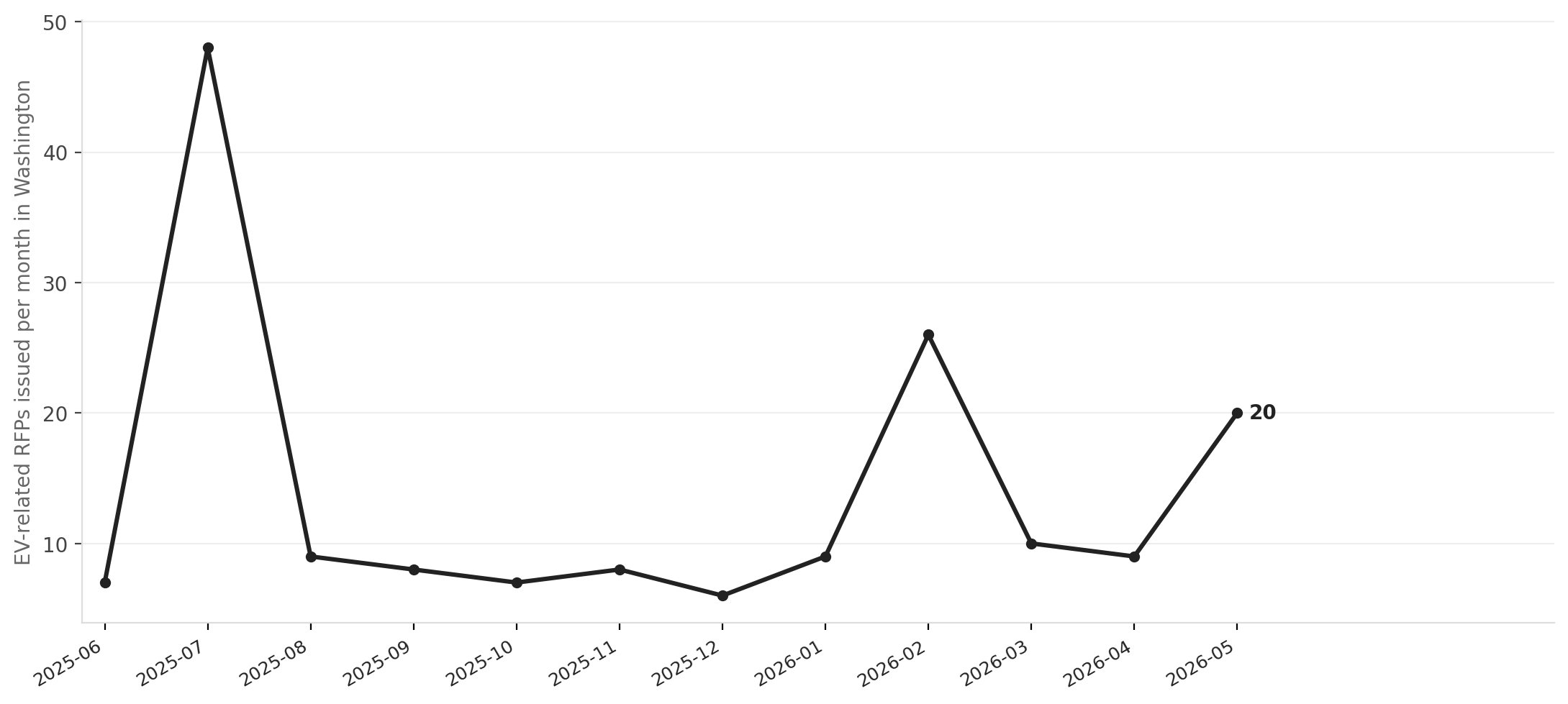
Washington state has issued 20 electric vehicle-related RFPs in the past 30 days, against a 12-month monthly average of about 8.5, a 135% surge that traces directly to two events that landed within days of each other in late January 2026.
On January 26, a federal judge in the Western District of Washington ruled in Washington v. U.S. Department of Transportation that the Trump administration's February 2025 freeze of NEVI formula funds was unlawful, restoring state access to more than $15 million already obligated to WSDOT. Three days later, WSDOT announced $12.16 million in Round 1 NEVI awards for 14 charging stations along I-90, US 97, US 195, and US 395, with contracts going to Electric Era, Energy Northwest, EV Gateway, EVgo, and Tesla. Simultaneously, Washington's Advanced Clean Cars II ZEV mandate, requiring that 35% of new vehicle sales be electric or plug-in hybrid starting with model year 2026, came into legal effect, pressing public fleets to accelerate purchases to demonstrate compliance.
The result is a procurement pipeline that is now moving from planning to contracts at a pace that stands out even on the West Coast. Washington's 20 RFPs over the past 30 days trails only California (45) and is roughly 10 times Oregon's 2, a ratio that significantly exceeds Washington's population advantage over its neighbor.
Source: NationGraph.
The current wave is the third in a recognizable sequence. A burst of 48 RFPs in July 2025 followed a preliminary court injunction that temporarily stayed the NEVI freeze; 26 more arrived in February 2026 in the immediate wake of the permanent ruling. Each spike has been tied to a discrete legal or regulatory trigger, and each subsequent wave has shifted closer to actual contracting. The July 2025 activity was heavily weighted toward planning documents and program resubmissions. The current May-June 2026 wave shows agencies writing checks.
The RFPs divide into two distinct tracks. One covers fleet vehicle replacement: the City of Cheney is procuring electric SUVs, pickups, and utility terrain vehicles; Washington Department of Fish and Wildlife is soliciting fleet fuel card services that cover EV charging. The other covers charging infrastructure: the University of Washington is bidding out fleet charging stations, the Port of Ridgefield is specifying EV parking equipment, the City of Issaquah is adding park charging, and the Taholah tribal building is installing its first EV charger. Both tracks are moving at the same time because both mandates are now simultaneously in force.
A third compliance pressure reinforces the infrastructure track specifically. Washington Senate Bill 5528, passed in 2025, requires that all public-works EV charger installations use EVITP-certified electricians, effective January 1, 2026. Agencies that waited on certified-vendor pipelines are now under deadline to lock in qualified contractors, adding a separate procurement rationale on top of the NEVI awards.
The scale of what's still unspent makes clear this isn't a one-month story. Washington's active federal EV grant portfolio totals $129.7 million obligated across 15 active grants; only $2.8 million has been outlayed. That gap between committed and disbursed dollars means procurement activity has significant runway. As analysts tracking the NEVI program nationally have noted, the Washington ruling was one of the first final judgments against the freeze, and it established the legal footing other states are now using to press their own access claims.
The compliance gap on the ZEV mandate adds pressure that won't ease quickly. Washington's actual EV sales rate sits at roughly 21-22% against the 35% model-year-2026 requirement, a shortfall that applies to public fleet purchases as directly as to private dealers. Agencies that need to show progress toward the mandate by end of model year have a hard procurement deadline, not a soft planning horizon.
The one risk that could interrupt the pace is a pending federal appropriations measure that would redirect $879 million in NEVI funds into other Federal Highway Administration programs. If that transfer clears Congress, the formula funds Washington fought to unlock could be substantially reduced for future rounds, compressing the window for the remaining $127 million in active grants to flow through to contracts.
For residents, the near-term signal is visible infrastructure: 14 new charging stations along the state's major eastern corridors, plus a wave of municipal and institutional installations that will begin appearing in parks, ports, and university parking lots over the next 12 to 18 months. The next indicator to watch is how many of the current 20 RFPs close to contracts before the federal appropriations deadline, and whether a fourth procurement wave follows.