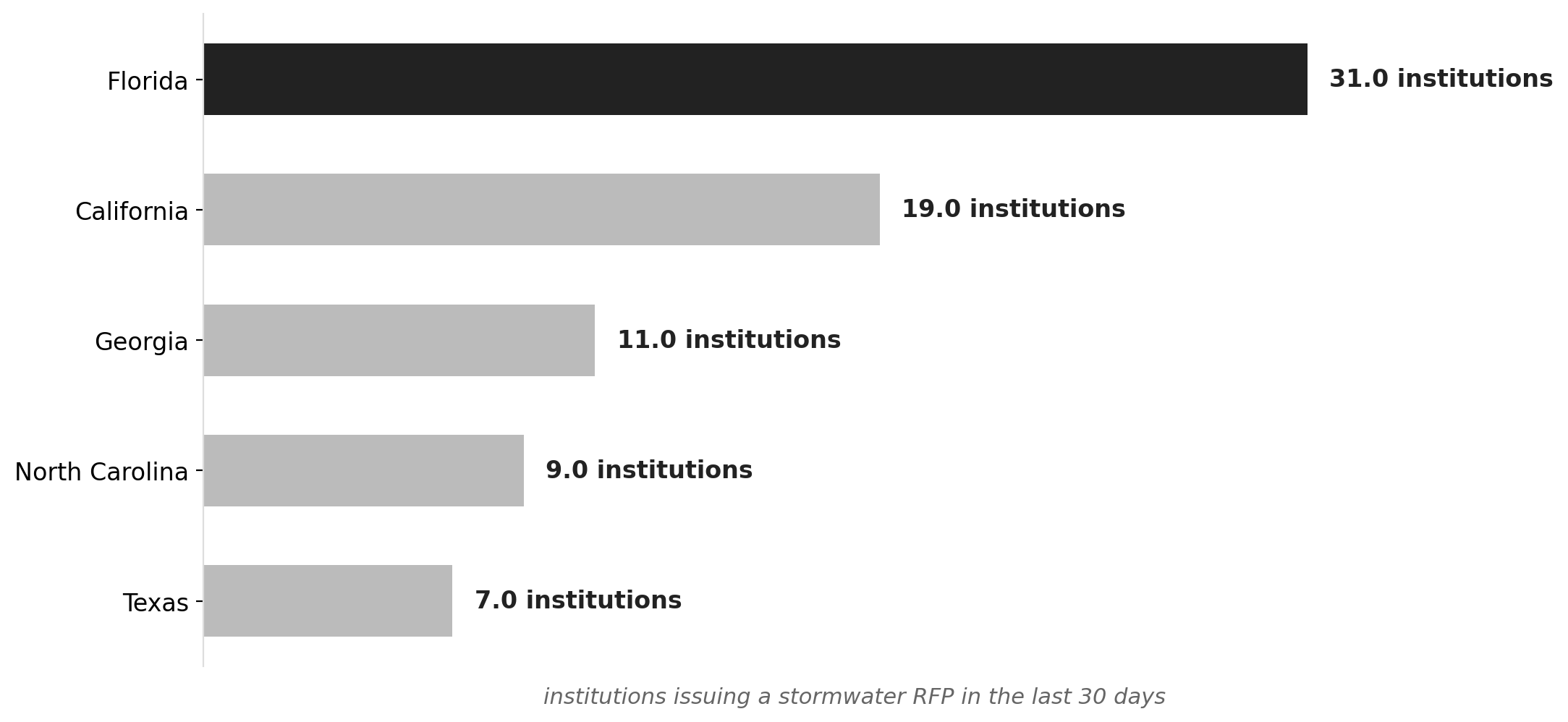
Thirty-one Florida governments that had not issued a single stormwater management solicitation in more than a year all went to market within the same 30-day window, not because of a routine budget cycle, and not because the rain suddenly got worse, but because the federal checkbook finally opened.
The number is striking in isolation. It is more striking in context: in any comparable prior window, the count was effectively zero. Florida's June 2026 total of 31 first-time-in-over-a-year stormwater RFP issuers is 63 percent higher than California's 19 and more than four times Texas's 7, states with comparable storm histories and comparable infrastructure obligations. This is not a seasonal blip and it is not a national pattern. It is a Florida-specific procurement shock.
The force behind it is HUD's phased release of Community Development Block Grant Disaster Recovery funds tied to Hurricanes Helene and Milton, which struck in September and October 2024. Those storms, arriving weeks apart, overwhelmed drainage systems across multiple regions simultaneously and created a repair backlog that localities knew existed but could not fund. Administrative clearance at HUD took months. Now the money is moving.
Source: NationGraph.
Hillsborough County's $709 million CDBG-DR award, one of the largest single disaster recovery allocations in Florida history, explicitly names stormwater channels, culverts, and pump stations as primary uses, with design phases beginning as early as summer 2026. Manatee County received $252.7 million after the same storm sequence. Both counties appear in the cohort of 31. Governor DeSantis layered additional capital on top through two tranches of the state's CDBG-DR Infrastructure Repair Program: $311 million to 37 communities and a follow-on $167.5 million to 34 rural communities, with multiple awards specifically designated for stormwater channel widening, drainage pipe installation, and culvert replacement. Those grants became actionable in late 2025 through early 2026, compressing what would normally be a staggered multi-year procurement cycle into a single crowded window.
The geographic spread of the 31 confirms this is not concentrated in one hard-hit region. Miami-Dade institutions account for three of the RFPs, Escambia and Pensacola for two, Orange County and Orlando for two. Hillsborough, Lee, Manatee, and Flagler each contribute one anchor institution, with 19 additional counties filling out the rest. Pensacola and Escambia lead in total solicitation volume within the cohort, with 14 individual RFPs between them, a figure that reflects both the severity of Helene's impacts on the Panhandle and the scale of drainage rehabilitation those communities have queued up.
There is also a compliance dimension that accelerates the timeline. Florida DEP's NPDES MS4 stormwater permitting program requires all regulated municipalities to implement Stormwater Management Programs meeting Maximum Extent Practicable standards. A municipality sitting on newly available disaster recovery capital and a degraded drainage system is not just facing an infrastructure problem, it is facing a legal obligation. The combination of available funding and permit compliance pressure shortens the window in which a jurisdiction can reasonably delay procurement.
The $188 million in already-obligated federal stormwater grants from EPA, DOT, and Gulf Coast Restoration Council programs forms the baseline on which CDBG-DR dollars are now being layered. Florida's stormwater RFP volume had already reached an elevated plateau, 67 institutions issued solicitations in May 2026, a monthly peak, but the current 30-day wave represents a second pulse, pulling in institutions that had sat out even that earlier surge.
For residents in the affected counties, the practical meaning is straightforward: drainage projects that stalled for lack of funding are now moving to the design and engineering phase. That does not mean construction is imminent. Procurement of engineering and planning services typically precedes physical work by 12 to 18 months, and a number of these RFPs are for master planning and feasibility studies. Pasco County's Infrastructure Mitigation Program, for example, lists a summer 2026 estimated launch for procurement, the planning work, not the shovels.
The open question for the rest of the year is capacity. Thirty-one jurisdictions entering the stormwater engineering market in a single month, against a backdrop of already-elevated national procurement activity, will test the availability of qualified contractors and consultants across the state. Florida's flat topography and shallow water tables give it less margin for error than most states, drainage systems here fail under conditions that would be manageable elsewhere. The 2026 Atlantic hurricane season began June 1. The procurement paperwork is just now going out.