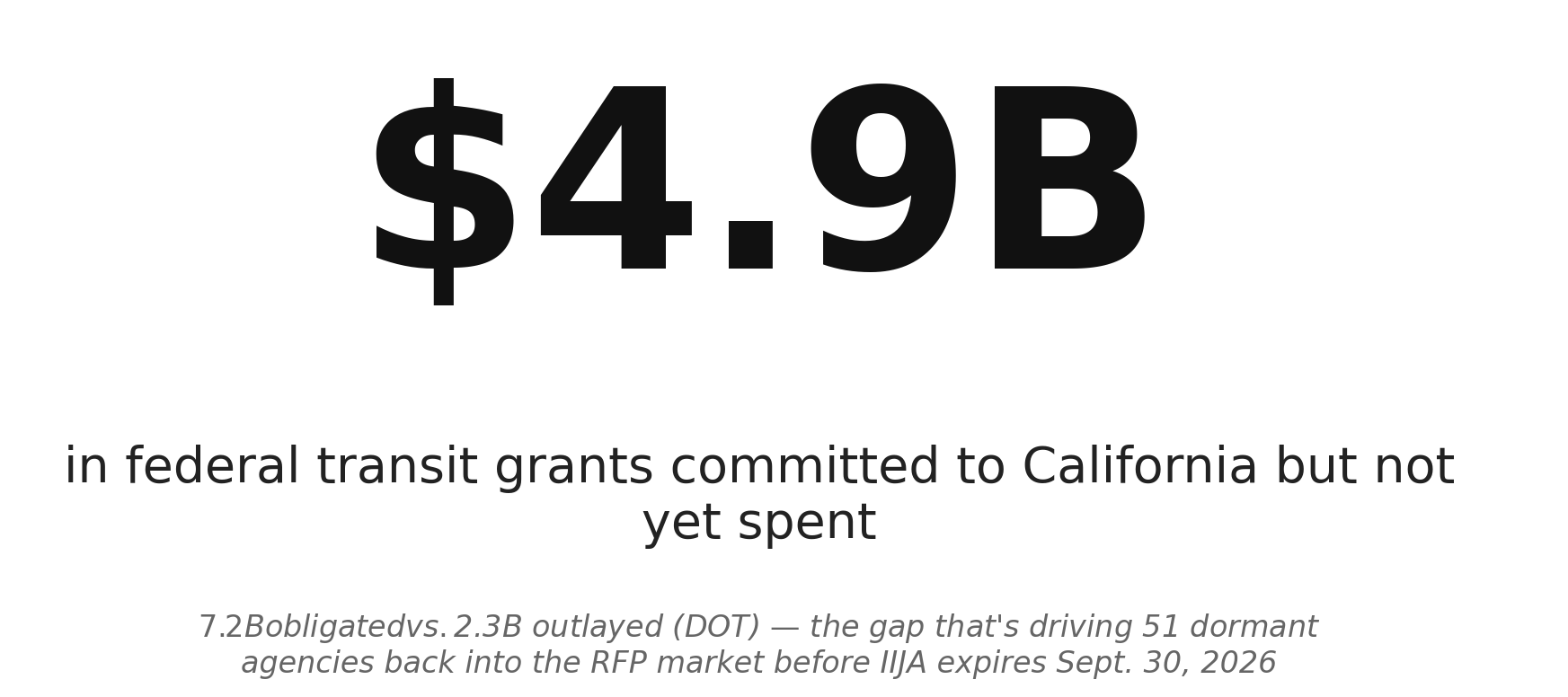
Fifty-one California public agencies that had gone silent on transit procurement for more than twelve months all issued new RFPs within the same thirty-day window, a near-complete reactivation of dormant buyers that points to a hard deadline none of them can ignore. The IIJA's surface transportation authorizations expire September 30, 2026, and California is sitting on $7.2 billion in federally obligated transit dollars with only $2.3 billion actually outlayed. The money is committed, but it still needs projects to absorb it.
The urgency is not abstract. The FTA's FY2026 full-year funding tables, posted March 31, 2026, locked in $14.6 billion in formula grants nationally, the final year of IIJA-era levels. Without reauthorization, transit formula funding reverts to a pre-IIJA baseline roughly $28 billion per year lower. President Trump's FY2027 budget has proposed zeroing out IIJA's competitive programs entirely, a move that would represent a roughly 26 percent cut against FY2026 levels. For agencies that have been slow-walking their procurement, the window to obligate under current rules is measured in weeks, not months.
A second deadline landed almost simultaneously. The DOJ's ADA Title II rule required public entities serving populations of 50,000 or more to complete web and physical accessibility compliance plans by April 24, 2026. Agencies that missed it now face civil penalties up to $75,000 for a first violation and the threat of losing federal funding altogether. That exposure explains one of the three distinct clusters visible in the new RFPs: cities including Galt, La Quinta, Visalia, Salinas, Dixon, and Temecula all issued ADA Self-Evaluation and Transition Plan solicitations within the same stretch, agencies trying to document compliance after the clock already ran out.
Source: NationGraph.
The other two clusters follow the IIJA spending logic more directly. A set of service contracts, local fixed-route, dial-a-ride, and on-demand transit operations in cities like Monterey Park and Torrance, reflects agencies finally standing up service they had funding commitments for but no vendor contracts to execute against. The largest and most capital-intensive cluster covers planning and infrastructure work: Santa Clara VTA's Palo Alto Mobility Hub, El Monte's Transit Route Analysis, a transit station generator in Tracy, and Marin County's Sir Francis Drake Corridor Plan all represent agencies turning grant allocations into actual procurement documents before the authorization runs out.
Los Angeles County dominates the surge, with ten institutions issuing twenty-eight RFPs in the period. Ventura, Riverside, Sacramento, and San Bernardino counties round out the active geography. That distribution matters: these are not California's mega-agencies, which have been absorbing capital since 2021. LA Metro alone holds $4.9 billion in active federal transit grants; Santa Clara VTA holds $1.7 billion; San Francisco holds $798 million. Those institutions have procurement infrastructure built for exactly this environment. The fifty-one agencies now flooding back into the market are mostly smaller cities and special districts that sat out the IIJA boom and are now compressing years of inactivity into a single sprint.
State government has amplified the signal. On February 9, 2026, Caltrans created a new Deputy Director for Transit and Rail Programs and issued its first holistic Director's Policy on Transit, a structural reorganization that smaller municipalities have read as Sacramento's endorsement of moving fast. On March 25, 2026, Governor Newsom and the California Transportation Commission allocated nearly $900 million in blended IIJA and SB 1 funds to modernize mass transit statewide, a pump-priming move that gave agencies cover to accelerate their own spending plans.
The pace is already running ahead of last year. California transit agencies obligated $3.29 billion across 854 grants in the last twelve months, up from $3.03 billion across 738 grants in the prior period. The new RFP surge suggests that acceleration is about to steepen, driven not by agencies with mature capital programs but by the long tail of smaller municipalities now entering the market for the first time under IIJA rules.
For Californians who live outside the major metro corridors, the practical effect is a wave of service and infrastructure improvements that either arrive in the next eighteen months or may not arrive at all at current funding levels. Whether cities can move from RFP to awarded contract to obligated grant before September 30 depends on procurement speed that many of these agencies have not demonstrated before.
The next signal to watch is how many of these RFPs actually close. An RFP issued in June that doesn't yield a contract until November lands outside the window. Congress is weighing a surface transportation reauthorization that could extend current funding structures, but no bill has passed committee. For now, California's quietest transit buyers have all shown up at the same door at the same time, and the door has a closing date.