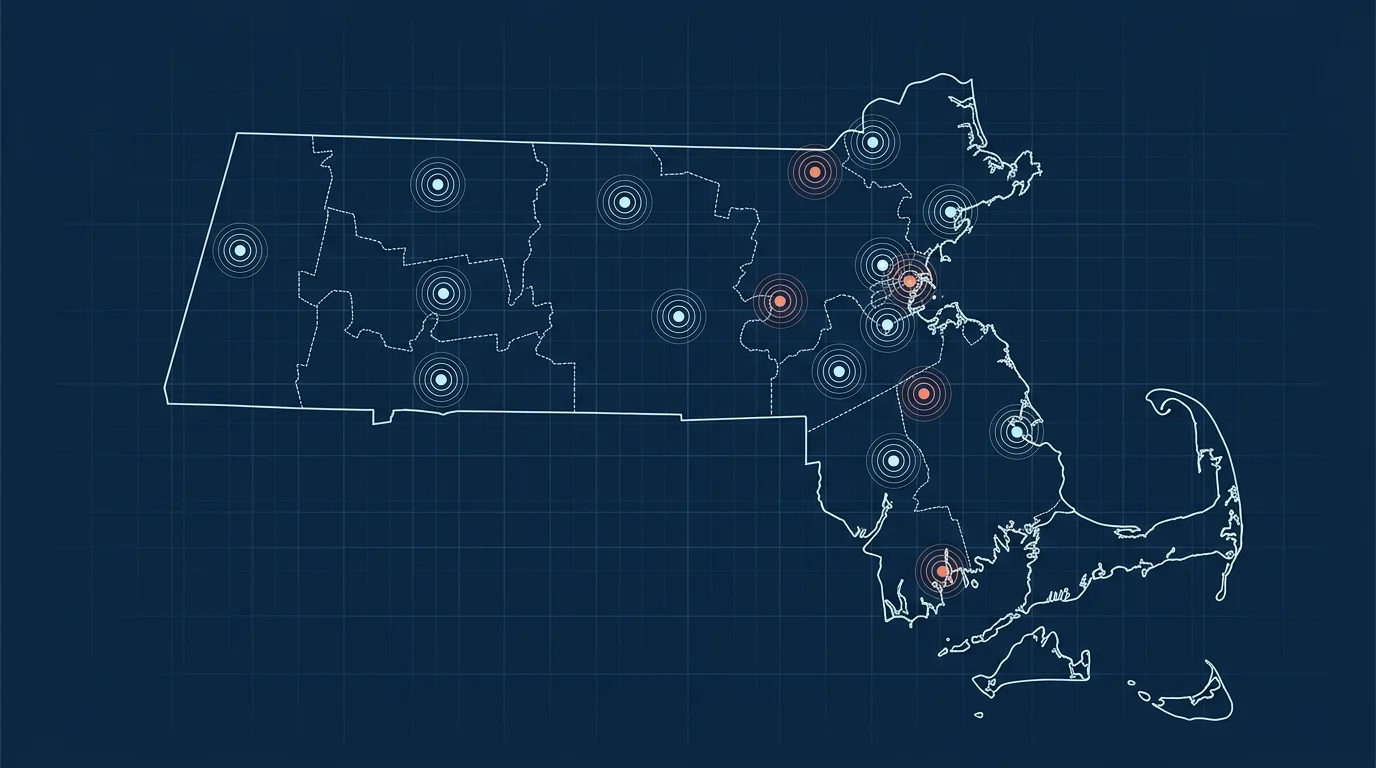
Thirty-one Massachusetts municipalities and housing agencies issued their first housing RFP in more than a year during a single 30-day window in late May and June 2026, a burst of procurement activity that spans 14 counties and touches nearly every category of housing production, from zoning rewrites to elderly congregate facilities to coastal land acquisition.
The number is striking not because any single RFP is unusually large, but because of the simultaneity. Institutions from Holyoke to Chatham, from Melrose to Amherst, all arriving at the procurement desk in the same month is not a coincidence. It is the visible exhaust of two years of compounding policy mandates finally converting into actual contracts.
Three forces converged to produce this moment. Governor Maura Healey signed the Affordable Homes Act on August 6, 2024, authorizing $5.16 billion in housing capital, including $2 billion for public housing rehabilitation and $800 million for the Affordable Housing Trust Fund. The law's ADU-by-right provisions took effect February 2, 2025, immediately placing a zoning-update compliance burden on every municipality in the state. Separately, the MBTA Communities Act's December 31, 2025 deadline arrived and passed, with 12 holdout towns beginning to lose state grant eligibility in early 2026. And EOHLC's new Seasonal Communities grant program, finalized in late 2025 under the Affordable Homes Act's coastal provisions, opened fresh funding tools specifically for Cape Cod and Martha's Vineyard towns. Each mandate created its own procurement pressure; landing at roughly the same time, they created a wave.
Source: NationGraph.
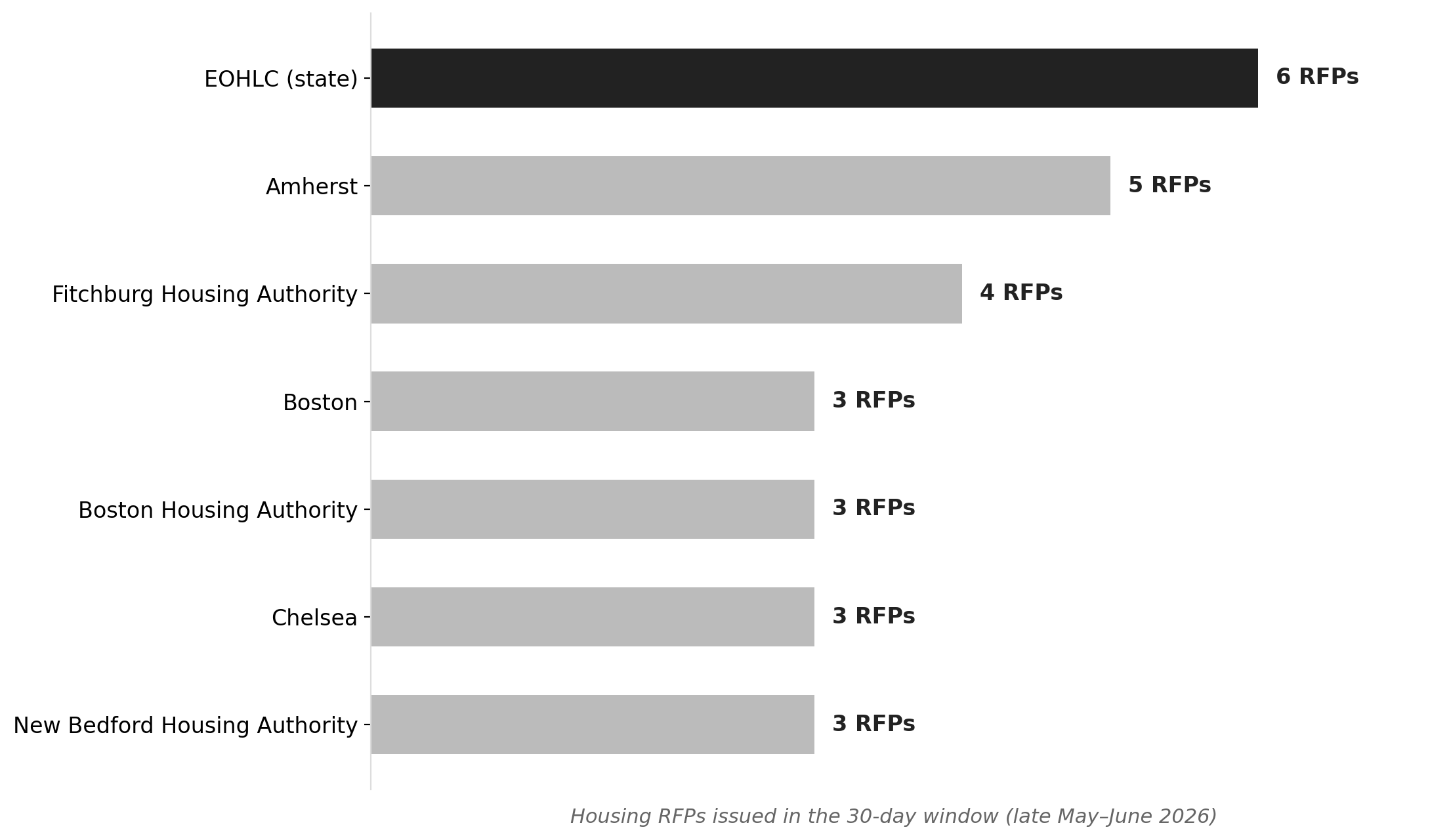
EOHLC leads the cohort with six RFPs of its own, including a FY27 Continuum of Care Notice of Funding Availability and a developer solicitation for the Housing Help Hub's Salesforce platform. The agency is not just distributing capital, it is building the administrative infrastructure to manage what one year of implementation has already produced: nearly 100,000 new housing units under development statewide as of August 2025.
Amherst follows with five RFPs, concentrated on supportive housing developer solicitations and a market needs study, the kind of planning groundwork that typically precedes a construction pipeline. Fitchburg Housing Authority issued four, including community center and facility upgrades that reflect the $2 billion rehabilitation authorization now flowing into aging public housing stock.
The geographic spread tells the policy story as clearly as the volume. The MBTA Communities Act pressure shows up in the inner-ring and commuter-belt suburbs: Melrose is soliciting for a zoning ordinance rewrite, Acton for affordable housing land disposition. Both are covered communities with new multi-family zoning obligations. Tewksbury Housing Authority, whose town is among the 12 that missed the compliance deadline and began losing funding this year, issued a Congregate housing RFP in the same window, an institution moving forward on production even as its municipality remains in a funding loss standoff with the state.
The coastal cluster is a distinct story. Chatham, Yarmouth, and West Tisbury all issued housing RFPs in this cohort, each tied to EOHLC's FY27 Seasonal Communities grant program. These are towns where year-round workforce housing has been structurally constrained by seasonal land economics for decades; the new grant tools represent the first dedicated state capital targeting that dynamic. Chatham's RFP involves property acquisition for attainable housing, a direct use of the new program's land-banking flexibility.
For residents and developers, the practical implication is a procurement market that has re-opened across the state essentially at once. Housing authorities that had not gone to market in over a year are now soliciting for elderly and congregate developments. Cities that had been waiting on capital certainty are now moving on land disposition. The RFP wave is the leading indicator of a construction pipeline that, if procurement moves on normal timelines, would begin producing units in 2027 and 2028.
The next signal to watch is conversion: how many of these 31 RFPs result in awarded contracts within 90 days, and whether the institutions that issued them have the administrative capacity to close deals at the pace the capital stack now demands. EOHLC's own Salesforce developer solicitation suggests the agency is aware of that bottleneck and is already trying to fix it. The holdout towns under MBTA Communities Act enforcement face a harder calculus, procurement activity at the housing authority level does not resolve a municipality's zoning compliance status, and the AG's office retains authority to bring enforcement suits against the 12 non-compliant communities. Whether those towns move from RFPs to rezoning before the next round of grant cycles closes is the open question that will determine whether this wave produces durable supply or a one-month spike in paperwork.