Federal stormwater grants flowing to Texas have surged to $8.43 million in the last 90 days, nearly ten times the $848,000 awarded in the same window a year ago. That jump is striking on its own. What it signals is larger: Texas is now sitting on more federal flood dollars than at any point in its history, and a convergence of three hard deadlines in the next 18 months means that if construction doesn't accelerate sharply, billions of those dollars could be clawed back before a single new detention basin opens.
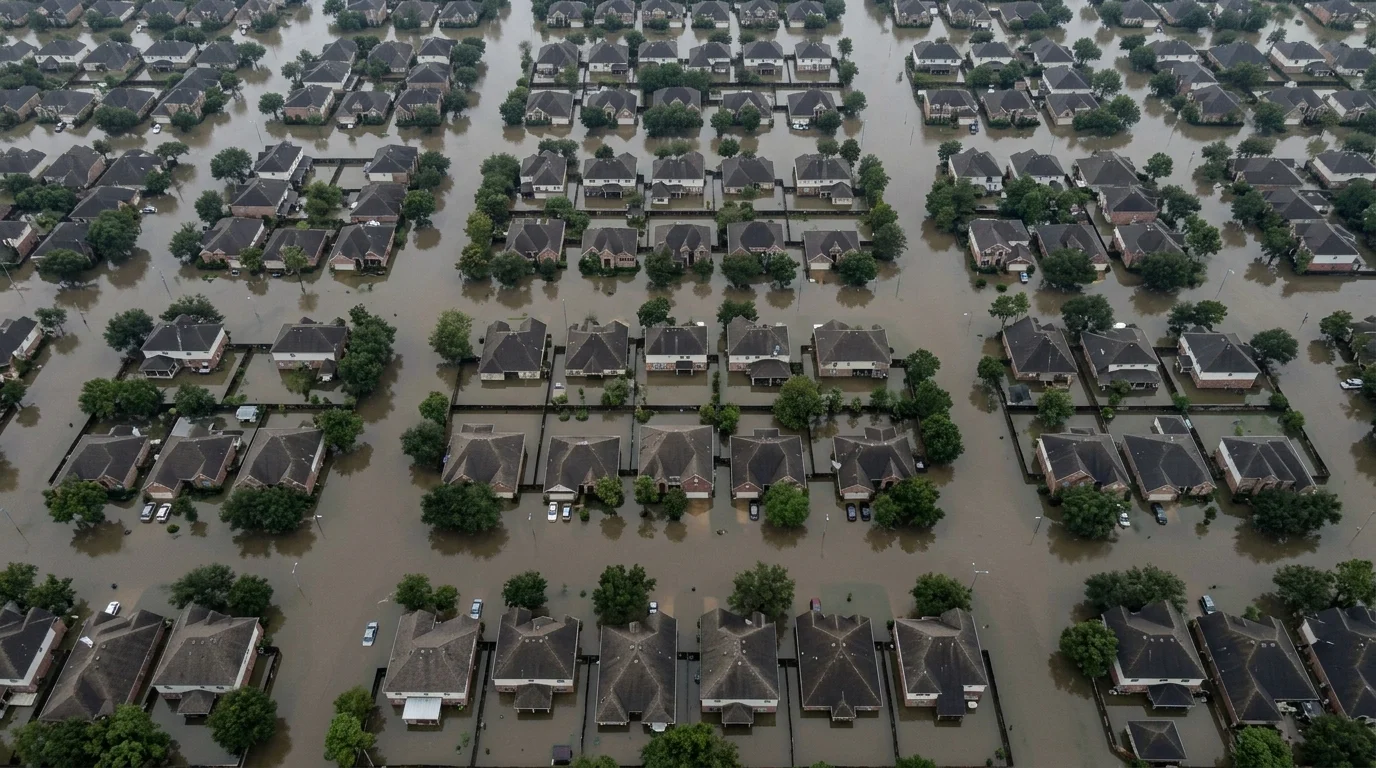
The 90-day figure is only the visible edge of the surge. In Q3 2025, Texas stormwater grants totaled $24.5 million across nine awards; Q4 2025 added another $19.9 million. That run rate is roughly five times the 2022-2024 quarterly average. The two grants driving the most recent window are a $7.47 million DOT Federal Transit Formula award to the Near Northwest Management District (a Harris County flood-management entity, started May 13, 2026) and a $959,000 EPA Congressionally Mandated Projects grant to Harris County Flood Control (started April 6, 2026). Harris County is the undeniable epicenter: a county of 2,500 miles of waterways, the nation's fourth-largest city, and the address of Hurricane Harvey's $125 billion in 2017 damage.
Three clocks are now running simultaneously, and all three expire before the end of FY2027.
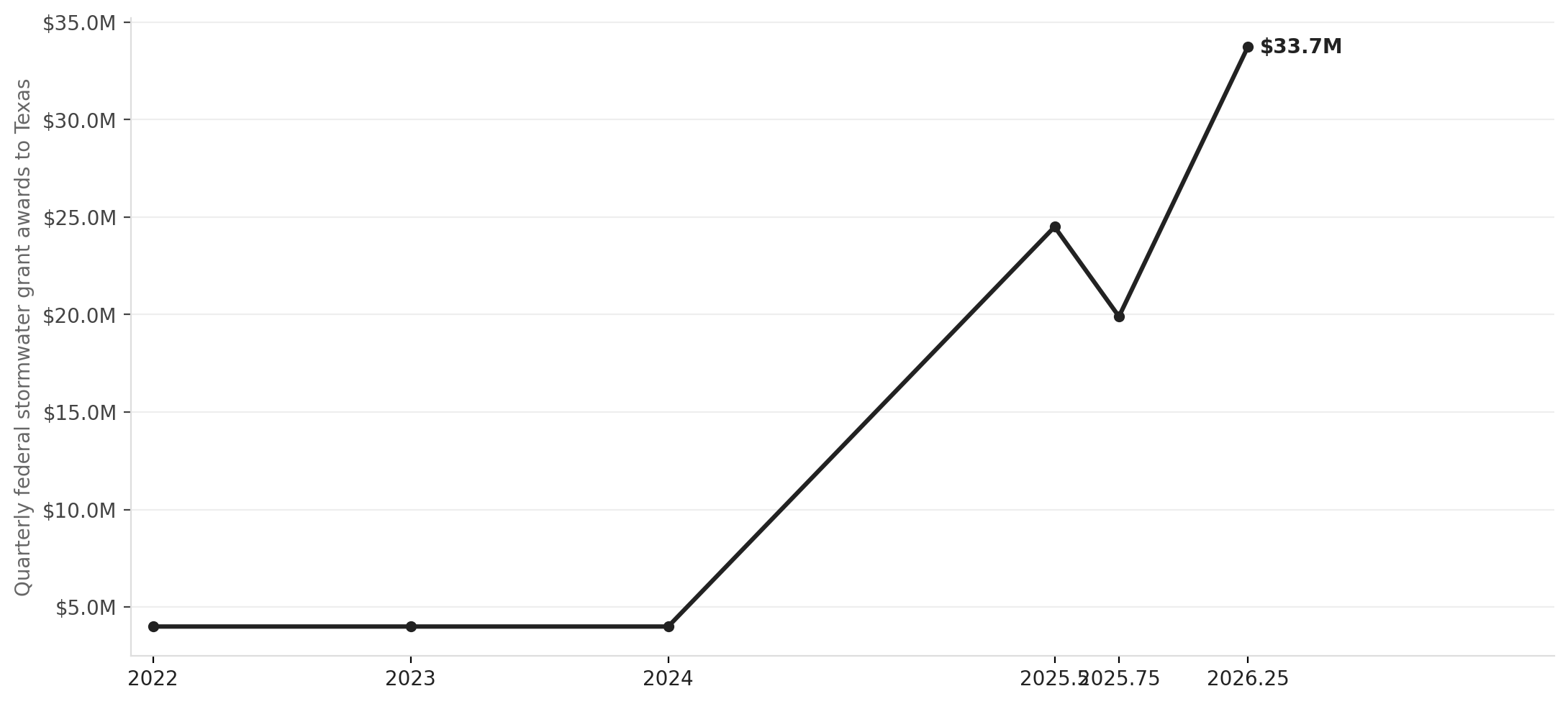
Source: NationGraph.
The first is federal. The Infrastructure Investment and Jobs Act added $11.7 billion to the Clean Water State Revolving Fund over FY2022-2026, roughly tripling annual capitalization. That authorization expires September 30, 2026, creating a hard deadline for states to obligate remaining funds or lose them. The Texas Water Development Board's CWSRF had at least $460 million available in SFY2024 alone, and the pipeline has been filling faster than local governments have been drawing it down.
The second clock is post-Harvey. The Texas General Land Office has set a February 2027 deadline for Harris County to spend $245.8 million in federal disaster recovery grants tied to six major stormwater detention basin projects. A May 2026 report found Harris County had spent just 0.36% of the $75 million allocated to the largest at-risk project, the Greens Bayou basin. Harvey-era federal dollars routed through the GLO rather than directly through HUD introduced years of delay before the money began moving; now those same dollars are arriving nearly a decade after the storm, colliding with the IIJA expiry in the same fiscal year.
The third clock is legal. In April 2025, after the Texas Supreme Court declined to hear its appeal, Houston finalized a court settlement over its drainage funding obligations, requiring the city to escalate Dedicated Drainage and Street Renewal Fund contributions from 57% to 67% of the voter-approved 11.8-cent property tax allotment in FY2026, and to 77% in FY2027. That settlement didn't just resolve a lawsuit; it legally committed Houston to spending more on drainage at the precise moment federal money is also demanding to be spent.
The political pressure around Harris County Flood Control has been building in parallel. Texas HB 2068, introduced in the 89th Legislature, would have placed the district under state governance; the bill was left pending in committee in April 2025, but the scrutiny it generated over the district's spending pace hasn't dissipated. Harris County's $2.5 billion voter-approved flood bond from 2018 is only now converting into construction bids, many of which were scheduled for Q1 and Q2 2026. The bond was sold to voters as a post-Harvey reckoning; the projects it funds are now racing the same federal deadlines the bond was meant to complement.
For residents of Harris County and the Houston metro, the practical question is whether a decade's worth of deferred flood infrastructure can be compressed into 18 months of construction. The engineering and permitting pipelines are moving: Cypress Creek stormwater detention basins are in the design process, and Harris County Flood Control has active EPA awards running through 2027. But the Greens Bayou spending figure, 0.36% of allocated funds with nine months left on the clock, is the number that most directly tests whether the acceleration is real.
The next signal to watch is the Texas GLO's quarterly spending reviews for Harris County, which will show by late summer 2026 whether the construction pace has closed the gap or whether the county will need to negotiate another deadline extension. The IIJA authorization cliff on September 30 is fixed and non-negotiable. After that date, whatever Clean Water SRF funds remain unobligated go back.