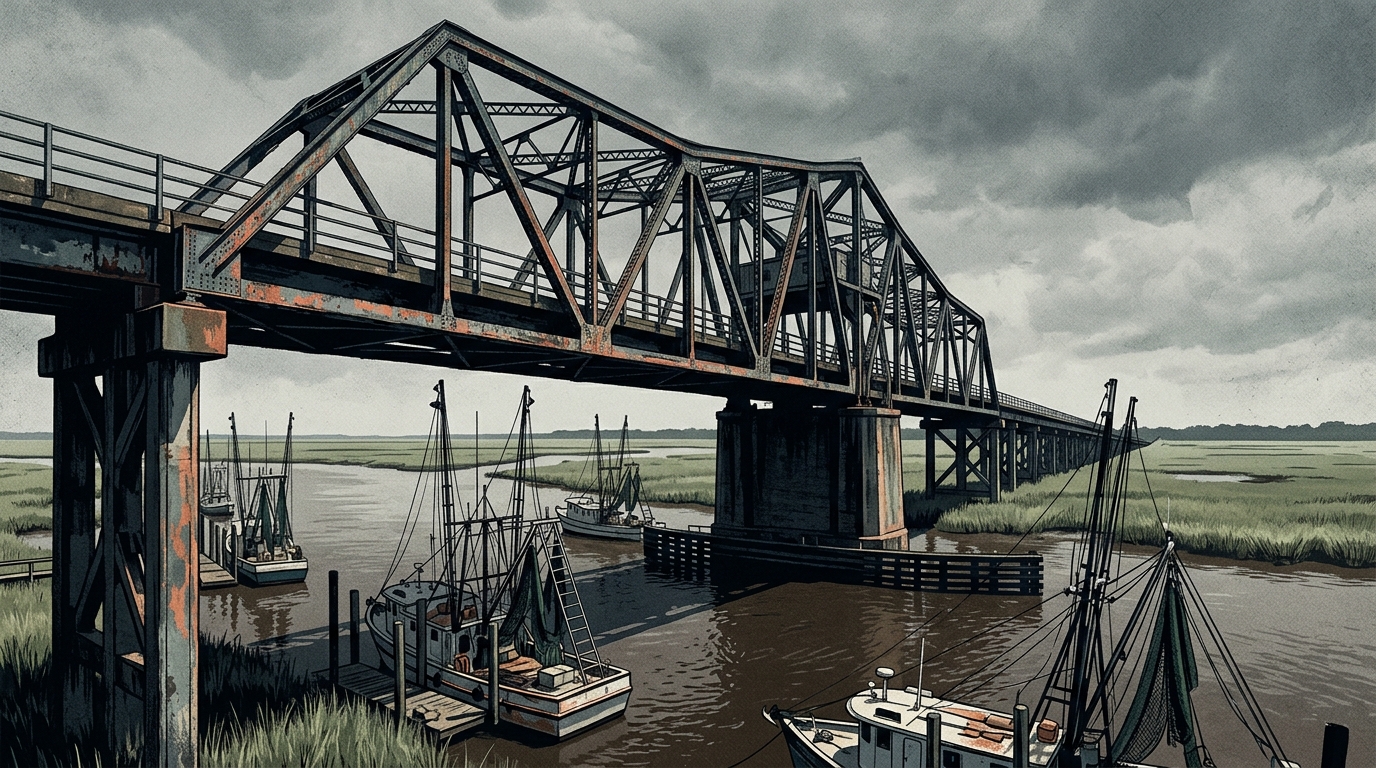
The bridge carrying State Route 25 over the Darien River in McIntosh County, Georgia is getting replaced, a move that residents of one of the state's most vulnerable coastal communities have long needed.
Georgia DOT is seeking qualified contractors for the project, which affects a crossing that serves as far more than a convenience for the roughly 14,000 residents of McIntosh County. SR 25 is the county's main north-south connector, linking the historic city of Darien to US 17 and I-95 and serving as a designated hurricane evacuation route. When a storm threatens Georgia's coast, this bridge is how people get out.
Darien, founded in 1736 and one of Georgia's oldest settlements, sits in the heart of the Altamaha River delta system, a low-lying stretch of coastline that has taken direct hits from Hurricanes Matthew and Irma in recent years. The local economy runs on commercial shrimping, fishing, and eco-tourism tied to the Altamaha, which is the largest undammed river system on the East Coast. Fishing boats and supply trucks move over this bridge daily. A prolonged closure or failure would ripple through an already fragile local economy in a county where per-capita income ranks among the lowest in the state.
Coastal bridges like this one face a punishing combination of engineering challenges: saltwater corrosion eats at structural steel, hurricane-force wind loads stress the deck, and federal navigable waterway rules require enough clearance for boat traffic below. Increasingly, state and federal engineers are also building in climate resilience standards to account for sea level rise and intensifying storm surge.
The project is part of Georgia DOT's broader push to address hundreds of bridges across the state rated in poor condition. Federal funding from the 2021 Bipartisan Infrastructure Law has helped accelerate that work, directing roughly $225 million to Georgia specifically for bridge repair and replacement over five years through the Bridge Formula Program.
Contractor selection is underway now. Once a firm is chosen, engineering and construction timelines will become clearer, though projects of this complexity in navigable coastal waterways typically take several years from design through completion.